
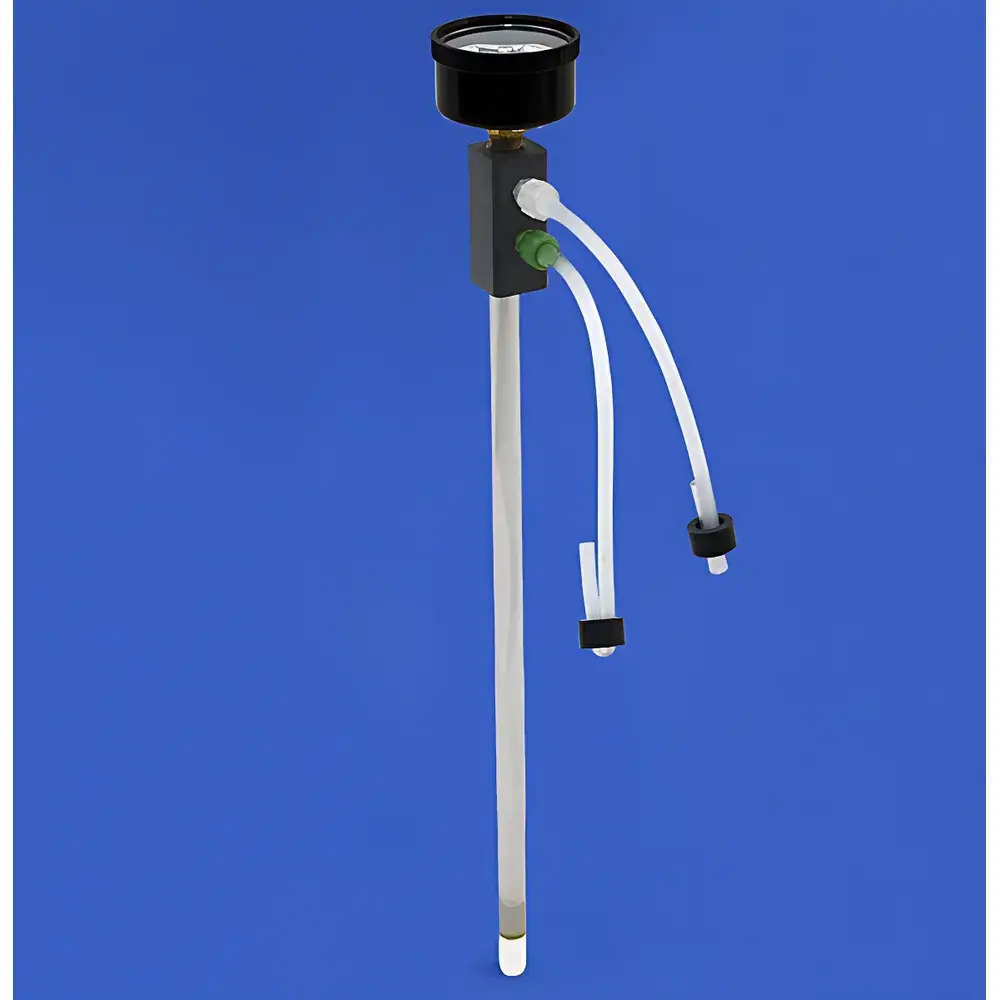
SEC 2705 Ultra-Slim Soil Tensiometer
| Brand | SEC (USA) |
|---|---|
| Origin | USA |
| Model | 2705 |
| Diameter | 9.52 mm |
| Available Lengths | 15 cm, 30 cm, 45 cm, 60 cm, 90 cm |
| Application | In-situ soil water potential measurement and soil solution extraction |
| Mounting Orientation | Vertical or horizontal installation |
| Import Status | Imported instrument |
Overview
The SEC 2705 Ultra-Slim Soil Tensiometer is a precision-engineered ceramic-based tensiometric sensor designed for continuous, real-time monitoring of soil matric potential (ψm) in saturated to unsaturated soil conditions. Operating on the fundamental principle of hydrostatic equilibrium between pore water pressure and a sealed, water-filled measurement chamber, the device transduces changes in soil water tension into quantifiable hydraulic head readings—typically expressed in centibars (cbar) or kilopascals (kPa). Its ultra-slim 9.52 mm outer diameter enables minimally invasive insertion into intact soil columns, rhizoboxes, and small-container systems—including standard laboratory pots—without significant soil disturbance or structural compromise. Unlike conventional tensiometers with larger ceramic cups or rigid casings, the SEC 2705 maintains high mechanical stability and long-term calibration integrity under repeated wet-dry cycles, making it suitable for controlled-environment studies requiring spatially resolved, depth-specific water potential profiling.
Key Features
- Ultra-compact profile: 9.52 mm outer diameter ensures minimal soil disruption during installation and compatibility with narrow-diameter soil columns (e.g., 2.5–5 cm ID PVC or acrylic tubes).
- Multi-length configuration: Five standardized lengths (15 cm, 30 cm, 45 cm, 60 cm, and 90 cm) support flexible deployment across shallow-rooted crops, deep-profile lysimeters, and layered soil horizon experiments.
- Bidirectional mounting capability: Engineered for both vertical and horizontal orientation—enabling use in horizontal flow cells, saturated zone monitoring, and benchtop soil column rigs.
- Ceramic cup specification: High-porosity, low-air-entry-pressure (≈85 kPa) sintered ceramic tip ensures rapid equilibration (<30 min in moist soils) and reliable response down to –80 kPa under field-relevant conditions.
- Integrated solution extraction port: A dedicated luer-lock fitting at the proximal end allows vacuum-assisted collection of soil solution for subsequent ion chromatography, nutrient analysis, or isotopic tracing—without requiring separate sampling probes.
- Material construction: Chemically inert stainless steel body and FDA-compliant silicone tubing interface ensure compatibility with acidic, saline, or organic-rich soil matrices over extended deployment periods.
Sample Compatibility & Compliance
The SEC 2705 is validated for use in mineral soils (sand to clay loam), peat-based substrates, and engineered growth media (e.g., perlite-vermiculite mixes). It is not recommended for highly gravelly, coarse-textured soils (>20% particles >2 mm) where ceramic tip contact may be inconsistent. The device complies with ASTM D4318 (Standard Test Methods for Liquid Limit, Plastic Limit, and Plasticity Index of Soils) for matric potential correlation protocols and supports GLP-aligned data acquisition when paired with certified pressure transducers and logging systems. All wetted components meet USP Class VI biocompatibility requirements, facilitating use in phytotoxicity or root exudate studies under regulated research environments.
Software & Data Management
While the SEC 2705 operates as an analog hydraulic sensor, it is fully compatible with industry-standard data loggers (e.g., Campbell Scientific CR1000X, Decagon EM50G, Onset HOBO U30) equipped with ±50 mV or 0–2.5 V differential pressure inputs. When integrated into networked environmental monitoring platforms, it supports time-stamped, audit-trail-enabled data streams compliant with FDA 21 CFR Part 11 requirements—provided the host system implements electronic signature controls, user access tiers, and immutable storage. Raw tension values are convertible to volumetric water content via established pedotransfer functions (e.g., van Genuchten model) using open-source tools such as ROSETTA or Hydrus-1D.
Applications
- Controlled-environment plant physiology: Quantifying root-zone water stress gradients in pot-based drought-response assays.
- Soil physics research: Validating numerical models of unsaturated flow (e.g., HYDRUS-2D/3D) through high-resolution vertical potential profiles.
- Green infrastructure monitoring: Measuring matric potential dynamics in bioswales, green roof substrates, and permeable pavement base layers.
- Nutrient leaching studies: Co-locating with solution extractors to correlate water potential thresholds with nitrate or phosphate mobility.
- Calibration reference: Serving as a primary standard for validating capacitance-, neutron probe-, or GPR-based soil moisture sensors in calibration laboratories.
FAQ
What is the maximum negative water potential measurable with the SEC 2705?
The practical lower limit is approximately –80 kPa under standard laboratory conditions; beyond this point, air entry into the ceramic matrix may cause hysteresis or drift. For drier conditions, thermocouple psychrometers or dew point hygrometers are recommended.
Can the SEC 2705 be used in saline soils?
Yes—the stainless steel housing and ceramic tip resist chloride-induced corrosion; however, osmotic effects must be accounted for when interpreting total soil water potential (ψ = ψm + ψs).
Is sterilization possible before reuse?
Autoclaving is not advised due to thermal expansion mismatch; instead, surface decontamination with 70% ethanol followed by 30-min UV-C exposure is validated for pathogen control without compromising ceramic porosity.
How often does the device require recalibration?
Under stable temperature and installation conditions, annual verification against a mercury manometer or certified pressure standard is sufficient; more frequent checks are recommended after mechanical shock or prolonged desiccation.
Does the SEC 2705 require periodic refilling?
Yes—initial saturation and periodic maintenance refilling (every 3–6 months depending on evaporation rate and ambient humidity) are required to maintain hydraulic continuity within the water-filled column.







