
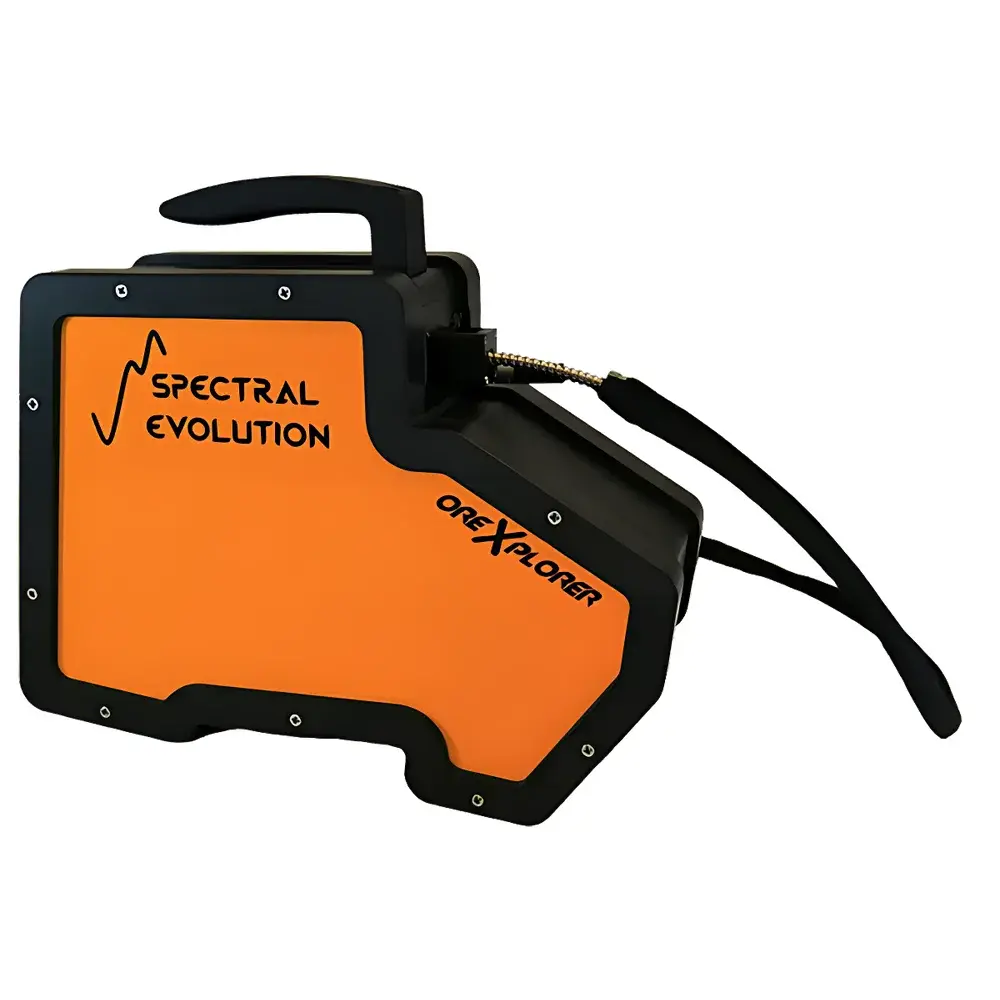
SEI OreX Series Mineral Analysis Fiber Optic Spectrometer
| Brand | SEI |
|---|---|
| Origin | USA |
| Distributor Type | Authorized Distributor |
| Import Status | Imported |
| Model | OreX |
| Price Range | USD 85,000 – 170,000 |
| Spectral Range | 350–2500 nm |
Overview
The SEI OreX Series Mineral Analysis Fiber Optic Spectrometer is a field-deployable, high-fidelity near-ultraviolet to short-wave infrared (NUV-SWIR) spectrometer engineered for quantitative and qualitative mineral identification in geological exploration, mine site characterization, and resource evaluation. Based on calibrated reflectance spectroscopy—leveraging diffuse reflectance principles across 350–2500 nm—the system captures diagnostic absorption features associated with electronic transitions (e.g., Fe²⁺/Fe³⁺, Cr³⁺), vibrational overtones (e.g., OH⁻, CO₃²⁻, Al–OH, Mg–OH), and lattice harmonics in silicates, oxides, carbonates, sulfates, and rare-earth-bearing phases. Unlike lab-based XRF or XRD, the OreX enables rapid, non-destructive, in-situ spectral acquisition under ambient lighting or integrated illumination, supporting real-time decision-making during trenching, core logging, outcrop mapping, and drill-core scanning.
Key Features
- Triple-detector architecture: Back-thinned Si CCD (350–1000 nm), TE-cooled InGaAs linear arrays (1000–1630 nm and 1630–2500 nm), enabling seamless full-range spectral coverage with optimized signal-to-noise ratio across all bands.
- No moving parts in optical path: Monolithic fore-optics and fixed grating design ensure mechanical stability during transport and operation in rugged terrain, minimizing calibration drift and maintenance requirements.
- Automated acquisition sequence: Integrated motorized shutter, auto-exposure control, and dark-current correction executed prior to each scan—eliminating manual intervention and ensuring measurement consistency across operators and environmental conditions.
- Low-noise performance: Typical NER values of ≤0.8 × 10⁻⁹ W/cm²/nm/sr @ 400 nm and ≤0.3 × 10⁻⁹ W/cm²/nm/sr @ 1500 nm (OreXpert configuration) support high-fidelity detection of weak absorption features in low-reflectance minerals such as clays and weathered ores.
- Ruggedized field housing: IP65-rated enclosure with thermal management for operation between −10 °C and +50 °C; compatible with standard geophysical survey mounts, handheld grips, and drone-integrated payloads.
Sample Compatibility & Compliance
The OreX spectrometer accommodates solid, powdered, and consolidated samples—including drill cores, rock chips, soil horizons, and mine tailings—without sample preparation beyond surface cleaning. It complies with ASTM E131 (Standard Terminology Relating to Molecular Spectroscopy) and supports traceable calibration via NIST-traceable ceramic standards (e.g., Spectralon®). Data acquisition workflows align with GLP and GMP documentation practices: metadata (GPS coordinates, timestamp, integration time, lamp status, detector temperature) are embedded in every spectrum header. While not FDA-certified as a medical device, its data structure and audit trail capabilities meet foundational requirements for ISO/IEC 17025-accredited laboratories performing geological assay support.
Software & Data Management
The bundled EZ-ID mineral identification software provides automated spectral matching against curated reference libraries—including the USGS Digital Spectral Library (Version 7) and SpecMIN—containing >3,800 validated mineral spectra. Matching algorithms apply continuum-removed correlation, spectral angle mapper (SAM), and derivative-based feature weighting to reduce false positives from grain-size effects or surface moisture. All acquired spectra are saved in ASCII format (.txt) with tab-delimited columns (wavelength, reflectance, uncertainty), ensuring native compatibility with ENVI, The Spectral Geologist (TSG), Python (NumPy/SciPy), MATLAB, and R-based spectral processing pipelines. Software logs include full acquisition history, instrument state parameters, and user-defined annotations—all exportable for LIMS integration or regulatory reporting.
Applications
- Porphyry copper system delineation via hydrothermal alteration mapping (e.g., kaolinite–sericite–chlorite–epidote zonation).
- Kimberlite indicator mineral (KIM) screening using Cr-pyrope garnet and ilmenite spectral signatures.
- Silicate mineral discrimination in shear-hosted gold systems (e.g., albite vs. oligoclase, actinolite vs. tremolite).
- REE-bearing phase detection (e.g., monazite, xenotime, bastnäsite) through characteristic Ce³⁺ and Nd³⁺ absorption bands near 440 nm and 790–820 nm.
- Uranium mineral identification (e.g., coffinite, uraninite) via U⁴⁺/U⁶⁺ electronic transitions in the visible–NIR range.
- Lateritic bauxite profiling through goethite/hematite ratio estimation and gibbsite crystallinity assessment.
FAQ
What spectral resolution options are available across the OreX model variants?
The OreXpress offers 2.8 nm (350–1000 nm), 8 nm @ 1500 nm, and 6 nm @ 2100 nm; the OreXplorer achieves 2.7 nm (350–1000 nm), 5.5 nm @ 1500 nm, and 5.8 nm @ 2100 nm; the OreXpert delivers 1.5 nm (350–1000 nm), 3 nm @ 1500 nm, and 3.8 nm @ 2100 nm.
Is the system compatible with third-party spectral libraries beyond USGS and SpecMIN?
Yes—EZ-ID supports user-imported ASCII-formatted spectral libraries with wavelength–reflectance pairs, provided they conform to the same sampling interval and calibration conventions.
Can the OreX be operated without a laptop in the field?
No standalone tablet or onboard display is included; operation requires connection to a Windows laptop or ruggedized tablet running the EZ-ID application and drivers.
Does the system require annual recalibration?
Factory calibration is stable for ≥12 months under normal use; users are advised to verify performance quarterly using supplied NIST-traceable reflectance standards.
Is spectral data export compliant with 21 CFR Part 11 requirements?
While EZ-ID does not provide electronic signature or audit trail modules required for full Part 11 compliance, raw ASCII output and acquisition logs may be incorporated into validated LIMS or ELN platforms that implement those controls.





