
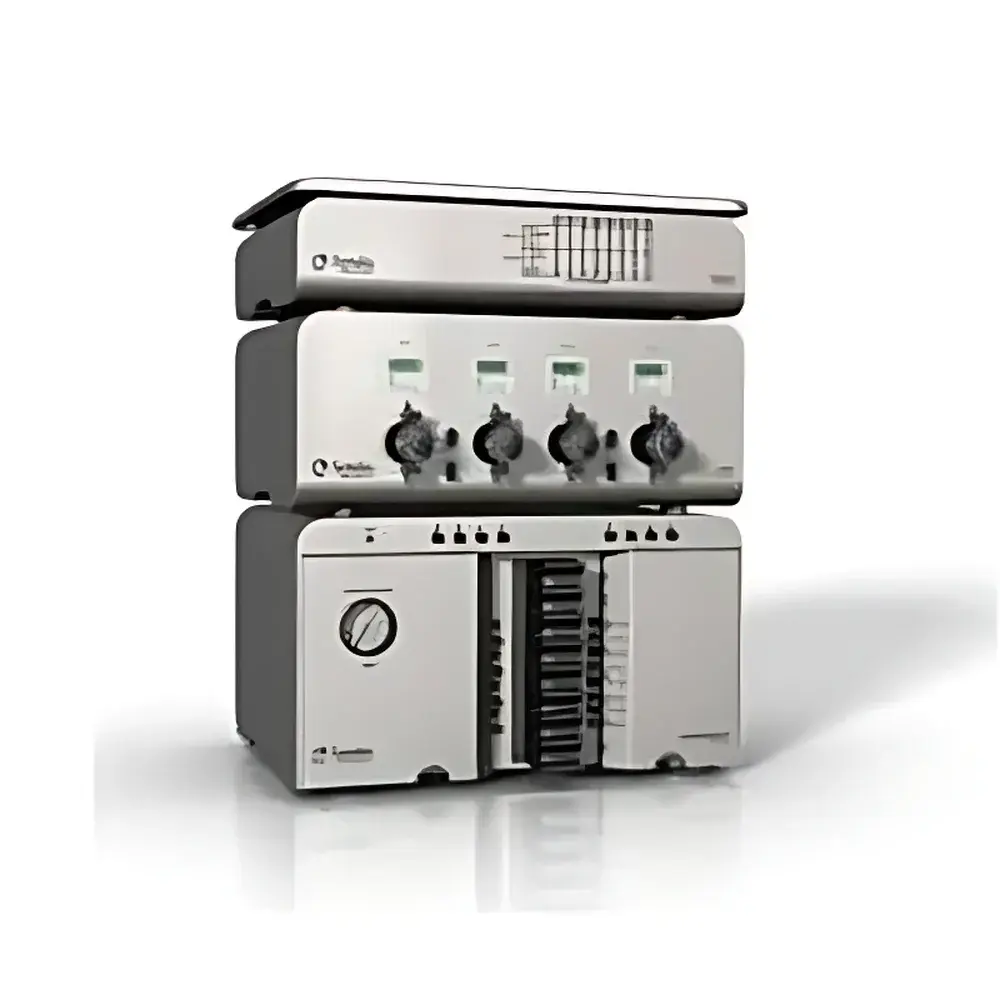
Semba Biosciences SMB-8 Desktop Simulated Moving Bed Chromatography System
| Origin | USA |
|---|---|
| Manufacturer Type | Distributor |
| Origin Category | Imported |
| Model | SMB-8 |
| Pricing | Available Upon Request |
Overview
The Semba Biosciences SMB-8 Desktop Simulated Moving Bed (SMB) Chromatography System is an engineered continuous separation platform designed for high-efficiency purification of biologics and chiral molecules. Unlike conventional batch chromatography—where separation occurs in discrete loading, washing, elution, and regeneration steps—the SMB operates on the principle of counter-current solid–liquid mass transfer by dynamically switching flow paths among eight interconnected chromatographic columns. This simulates the physical movement of the stationary phase while maintaining a fixed hardware configuration, enabling steady-state operation with minimized solvent consumption, reduced resin usage, and enhanced productivity. The SMB-8 is specifically configured for laboratory-scale development and pilot-scale process optimization, supporting seamless method translation from analytical HPLC or preparative protein chromatography workflows into continuous mode. Its compact benchtop footprint and integrated fluidic architecture make it suitable for integration into GMP-aligned process development labs and academic bioprocessing facilities.
Key Features
- First commercially available desktop SMB system featuring eight synchronized, independently controlled chromatographic columns
- Full fluidic path constructed from bio-inert materials (e.g., PEEK, stainless steel 316L, and fluoropolymer seals) to ensure compatibility with sensitive biomolecules including monoclonal antibodies (mAbs), recombinant proteins, and glycoproteins
- Modular column manifold design allowing rapid reconfiguration for diverse stationary phases (e.g., chiral selectors, Protein A, ion-exchange, and size-exclusion media)
- Integrated precision pumping system with dual-solvent capability and real-time flow rate control (0.1–10 mL/min per channel, ±0.5% accuracy)
- Onboard pressure monitoring across all column zones (0–20 bar range) with automatic fault detection and safety interlock protocols
- Pre-validated application method packages—including column sets, optimized mobile phase compositions, and stepwise SMB cycle parameter templates—for chiral resolution, mAb polishing, and therapeutic protein capture
Sample Compatibility & Compliance
The SMB-8 supports purification of thermolabile and aggregation-prone biomolecules without compromising structural integrity. It accommodates sample loads ranging from milligram to gram scale under fully controllable residence time and gradient conditions. All wetted components comply with USP Class VI biocompatibility standards. The system architecture aligns with current Good Manufacturing Practice (cGMP) expectations for early-phase process development, supporting audit-ready electronic records when operated with compliant software configurations. While not certified as a GMP production system, its design facilitates traceability, calibration documentation, and adherence to ICH Q5A/Q5B quality guidelines for biopharmaceutical intermediates. Method transfer validation studies conducted per ASTM E2500-13 and ISO 17025 principles are supported through built-in data logging and export functionality.
Software & Data Management
The SMB-8 is operated via Semba’s proprietary ChromaControl™ software suite, which provides intuitive graphical interface for cycle timing definition, zone flow assignment, and real-time chromatogram overlay. All operational parameters—including valve sequencing logic, pump profiles, UV/RI signal acquisition, and pressure traces—are timestamped and stored in .csv and .xml formats. The software includes configurable user roles, electronic signature support, and optional 21 CFR Part 11 compliance modules (audit trail, change control, and data integrity safeguards). Raw sensor data and processed fraction collection logs can be exported directly to LIMS or ELN platforms. Batch reports generated include critical quality attributes (CQAs) such as recovery yield, purity (by UV peak area %), and solvent consumption per gram of purified product—enabling direct comparison against traditional batch chromatography benchmarks.
Applications
The SMB-8 serves as a scalable tool for continuous downstream processing in biopharmaceutical R&D and fine chemical synthesis. Key use cases include: continuous chiral resolution of enantiomeric drug candidates (e.g., NSAIDs, β-blockers); polishing of monoclonal antibodies post-Protein A capture; isolation of specific glycoforms from heterogeneous IgG pools; purification of His-tagged recombinant enzymes; and separation of structurally similar oligosaccharides or nucleotide analogs. Its ability to operate at elevated linear velocities without breakthrough enables higher throughput than equivalent single-column systems—demonstrated experimentally to deliver 5–10× greater productivity (g purified product/hour/mL resin) under comparable resolution constraints. The platform is also employed in academic studies on SMB modeling, residence time distribution analysis, and dynamic binding capacity estimation under non-equilibrium conditions.
FAQ
What types of stationary phases are compatible with the SMB-8?
The system accepts standard 10 × 250 mm or 10 × 100 mm preparative columns packed with silica-based, polymer-based, or agarose-based media—including chiral CSPs (e.g., amylose tris(3,5-dimethylphenylcarbamate)), Protein A resins, cation/anion exchangers, and hydrophobic interaction matrices.
Can existing HPLC methods be directly transferred to SMB operation?
Yes—Semba provides method translation services and pre-configured templates that convert isocratic or gradient elution conditions from analytical or semi-preparative HPLC into SMB zone-specific flow rates and switching times using equilibrium-dispersive model approximations.
Is the SMB-8 suitable for GMP manufacturing environments?
It is intended for process development, tech transfer, and clinical material supply—not commercial-scale manufacturing. However, its design basis and documentation package support regulatory filing submissions for continuous processing strategies outlined in FDA Guidance for Industry (2022) on Continuous Manufacturing of Drug Substances.
What maintenance is required for long-term reliability?
Routine maintenance includes quarterly calibration of flow sensors and pressure transducers, biannual replacement of column switching valves’ sealing elements, and annual verification of UV detector linearity per USP . No consumables beyond standard chromatographic columns and solvents are required.





