
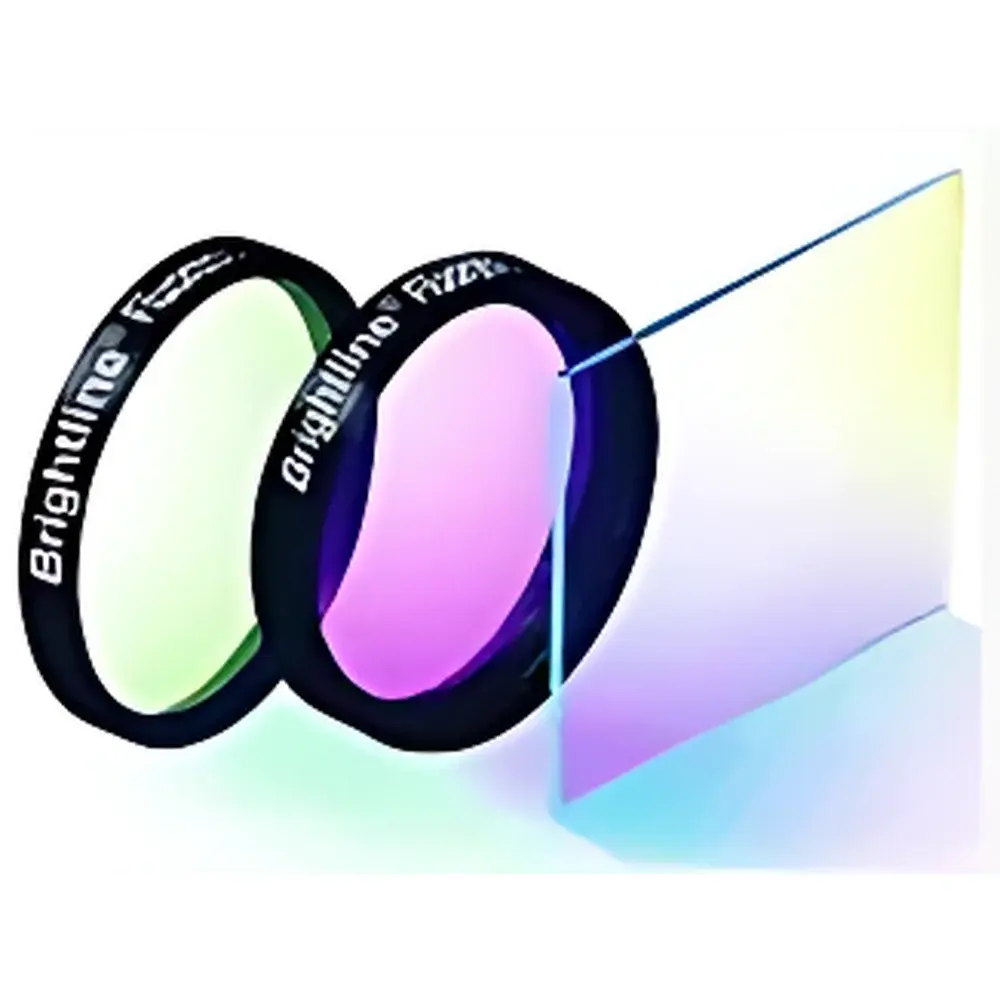
Semrock BrightLine® Long-Pass and Short-Pass Single-Edge Optical Filters
| Brand | Semrock |
|---|---|
| Origin | USA |
| Model | FF01-XXX/LP-25 & FF01-XXX/SP-25 Series |
| Mounting | 25 mm Ø Aluminum Ring (Clear Aperture ≥ 21 mm) |
| Coating Type | Hard-Dielectric, Thermally Stable |
| Warranty | 5 Years |
| Lead Time for Custom Orders | 7 Business Days |
Overview
Semrock BrightLine® long-pass (LP) and short-pass (SP) single-edge optical filters are high-performance interference filters engineered for precision spectral separation in fluorescence microscopy, Raman spectroscopy, laser-based instrumentation, and optical sensing systems. These filters operate on the principle of multilayer dielectric thin-film interference, where precisely controlled layer thicknesses and refractive index contrasts enable sharp cut-on or cut-off transitions with minimal ripple in the passband and deep blocking in the rejection band. Designed for demanding laboratory and industrial applications, each filter features a robust hard-coated architecture that resists thermal drift, humidity-induced degradation, and mechanical abrasion—ensuring long-term spectral stability under repeated thermal cycling and continuous illumination.
Key Features
- Ultra-steep edge transition: Typical transition widths (10%–90% transmission) < 1.5% of the edge wavelength, enabling precise channel isolation in multi-color fluorescence imaging.
- High transmission (>90%) across the designated passband, with average transmission >85% over broadband LP or SP regions.
- Deep out-of-band blocking: OD6 (10⁻⁶ transmission) or better from UV to NIR (200–1200 nm), including laser-line blocking for common excitation sources (e.g., 405 nm, 488 nm, 561 nm, 640 nm).
- Hard-dielectric coating deposited via ion-beam sputtering (IBS), providing exceptional environmental durability, low scatter (<0.1%), and resistance to power densities exceeding 5 W/cm² CW at 532 nm.
- Standard 25 mm diameter with precision-machined anodized aluminum ring mount; clear aperture ≥21 mm ensures compatibility with standard lens tubes, filter cubes, and OEM optical benches.
- Angle-of-incidence (AOI) optimized for 0° ± 2°; performance specifications validated per ISO 9022-3 and MIL-C-48497A test protocols.
Sample Compatibility & Compliance
BrightLine® LP/SP filters are compatible with all standard optical mounting hardware and integrate seamlessly into commercial microscope filter sets (e.g., Nikon Eclipse, Zeiss Axio, Leica DMi8), spectroscopic beam paths, and custom optomechanical assemblies. Each filter is supplied with full spectral characterization data (T(λ) curves, AOI sensitivity plots, and polarization-dependent loss profiles) traceable to NIST-calibrated spectrophotometers. The product line complies with ISO 10110-7 (optical component surface quality), ISO 9211-4 (interference filters — environmental durability), and meets RoHS 3 and REACH regulatory requirements. For regulated environments, documentation supports GLP/GMP audit readiness—including lot-specific test reports, coating process logs, and material declarations.
Software & Data Management
While inherently passive optical components, BrightLine® filters are fully supported within industry-standard optical design and simulation platforms including Zemax OpticStudio, CODE V, and FRED. Spectral transmission data files (.txt, .csv, .spectrum) are provided for each filter lot and are compatible with MATLAB, Python (via NumPy/SciPy), and LabVIEW for automated system calibration and spectral modeling. For OEM integration, Semrock offers a comprehensive API-accessible spectral database and custom spectral matching tools—enabling rapid selection of complementary LP/SP pairs for dichroic beam splitting or multi-channel detection schemes. All delivered data packages include timestamps, operator IDs, instrument serial numbers, and uncertainty estimates per GUM (Guide to the Expression of Uncertainty in Measurement).
Applications
- Fluorescence lifetime imaging (FLIM) and spectral unmixing workflows requiring minimal crosstalk between emission channels.
- Laser clean-up and pump rejection in confocal, STED, and light-sheet microscopy systems.
- Raman spectroscopy pre-filtering to suppress Rayleigh scatter while preserving Stokes/anti-Stokes signals.
- UV-VIS-NIR photometric calibration standards and radiometric reference setups.
- OEM integration into portable biosensors, environmental monitoring instruments, and industrial machine vision systems operating under variable ambient conditions.
- Multi-spectral imaging in astronomy instrumentation, where thermal stability and long-term repeatability are critical for extended exposure sequences.
FAQ
What is the typical damage threshold for these filters under CW laser illumination?
For 532 nm CW operation at normal incidence, the specified maximum power density is 5 W/cm²; for pulsed lasers (e.g., 10 ns, 10 Hz), the fluence limit is 0.5 J/cm². Exact values depend on wavelength, pulse duration, and beam profile—consult the certified test report for your specific lot number.
Can I use these filters at non-zero angles of incidence?
Yes, but spectral edges will shift toward shorter wavelengths as AOI increases. A 5° tilt induces ~1–2 nm blue-shift for LP filters near 500 nm. Angular tuning curves are provided in the spectral data package.
Do you offer custom edge wavelengths or bandwidths?
Yes—custom designs are available with lead time of 7 business days. Minimum order quantity is one unit; tolerances on edge position are ±0.5 nm (3σ) with full metrology validation.
Are mounting options other than 25 mm aluminum rings available?
Standard alternatives include unmounted substrates (1.0 mm or 2.0 mm fused silica), SM1-threaded mounts (1.035″-40), and OEM-compatible flange designs with kinematic alignment features.
How does the 5-year warranty apply to OEM integrators?
The warranty covers material and workmanship defects under normal use conditions. For volume OEM contracts, extended support agreements—including accelerated replacement, lot traceability, and dedicated QA liaison—are available upon request.






