
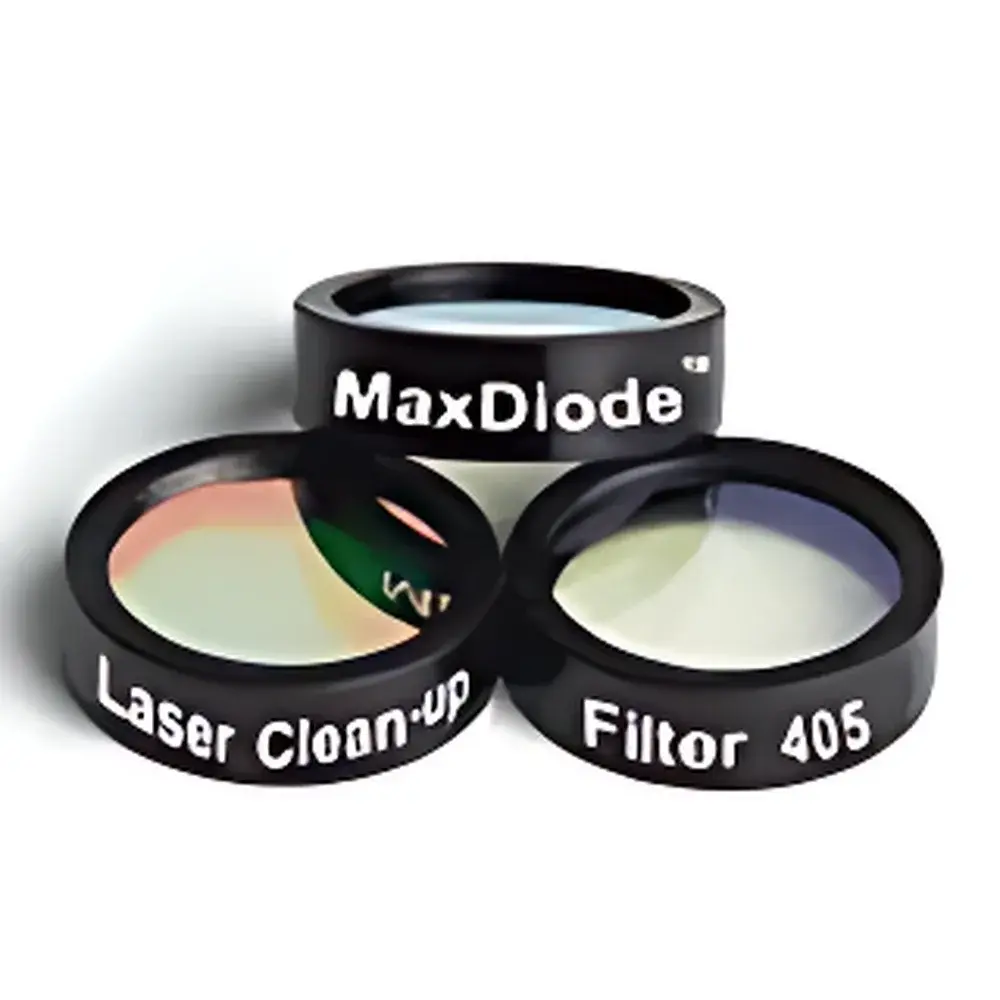
Semrock MaxLine® Laser-Line Filter Series
| Brand | Semrock |
|---|---|
| Origin | USA |
| Model | LL01-532-25 |
| Filter Type | Hard-Coated Laser-Line Bandpass |
| Center Wavelength | 532 nm |
| Bandwidth (FWHM) | 25 nm |
| Substrate | Fused Silica |
| Surface Quality | 20–10 Scratch-Dig |
| Parallelism | <3 arcsec |
| Damage Threshold | >5 J/cm² @ 10 ns, 20 Hz, 532 nm |
Overview
Semrock MaxLine® Laser-Line Filters are high-performance, hard-coated interference filters engineered for precision spectral control in demanding laser-based optical systems. Based on advanced thin-film deposition technology and proprietary ion-assisted coating processes, these filters deliver exceptional transmission (>95% peak), deep out-of-band blocking (OD6+), and minimal wavefront distortion—critical for applications requiring high signal-to-noise ratio and beam integrity. Unlike soft-coated or epoxy-bonded alternatives, MaxLine® filters utilize monolithic, plasma-enhanced dielectric coatings directly deposited onto high-homogeneity fused silica substrates, eliminating thermal delamination risks and ensuring long-term stability under continuous laser irradiation. They operate on the principle of constructive and destructive interference within multilayer quarter-wave stacks, enabling narrowband selection with steep spectral edges and excellent angular insensitivity (<±2° for specified performance). These filters are routinely deployed in confocal microscopy, Raman spectroscopy, flow cytometry, laser-induced fluorescence (LIF), and OEM laser instrumentation where spectral purity and repeatability are non-negotiable.
Key Features
- Hard-Coated Architecture: Ion-beam sputtered (IBS) or advanced plasma-assisted reactive sputtering (PARS) coatings ensure mechanical durability, thermal stability up to 150 °C, and resistance to humidity and cleaning solvents.
- High Laser Damage Threshold: Certified to >5 J/cm² (10 ns pulse, 20 Hz, 532 nm), making them suitable for Q-switched and CW solid-state lasers including Nd:YAG, DPSS, and frequency-doubled sources.
- Precision Spectral Performance: Tight center wavelength tolerance (±0.5 nm standard), narrow FWHM control (±1.5 nm), and edge steepness (5%–90% transition <1.5 nm) enable reliable separation of excitation and emission bands.
- Low Autofluorescence & Scatter: Fused silica substrate with super-polished surfaces (RMS roughness <0.3 nm) minimizes stray light and background noise in low-light detection systems.
- Customization Ready: Standard catalog includes over 70 center wavelengths from 248 nm to 1064 nm, with options for custom CWL, bandwidth, substrate thickness (12.5 mm or 25 mm), and mounting configurations (unmounted, kinematic mounts, or housed assemblies).
Sample Compatibility & Compliance
MaxLine® filters are compatible with standard optical breadboards, cage systems (e.g., Thorlabs 30 mm and 60 mm), and microscope filter cubes (e.g., Olympus U-MWIG, Nikon C-HGFI). All filters comply with ISO 10110-7 surface quality specifications (20–10 scratch-dig), RoHS Directive 2011/65/EU, and REACH Regulation (EC) No. 1907/2006. For regulated environments—including clinical diagnostics, pharmaceutical QC labs, and GLP-compliant research—the filters support full traceability via lot-specific test reports (including spectral scans, transmission maps, and damage threshold verification). While not inherently FDA-cleared devices, they are widely integrated into Class I and Class II laser systems conforming to IEC 60825-1:2014 and ANSI Z136.1–2022 safety standards.
Software & Data Management
Semrock provides downloadable spectral data files (CSV and SDF formats) for all standard models via its online Filter Finder tool, enabling direct import into optical design software such as Zemax OpticStudio, CODE V, and FRED. Each filter is supplied with a unique serial number linked to its factory-measured transmission curve, angle-tuned performance map, and environmental stress validation report. For integration into automated workflows, spectral metadata conforms to the Photonics Metadata Standard (PMS-1.0), supporting interoperability with LabVIEW, MATLAB, and Python-based instrument control frameworks (e.g., PyVISA, InstrumentKit). Audit trails for calibration and usage history can be maintained in compliance with FDA 21 CFR Part 11 when deployed within validated LIMS or ELN platforms.
Applications
- Excitation/emission isolation in multi-laser fluorescence microscopes (e.g., spinning disk, TIRF, light-sheet)
- Spectral cleanup in pump-probe and time-resolved spectroscopy setups
- Background suppression in hyperspectral imaging and laser-induced breakdown spectroscopy (LIBS)
- Line selection and harmonic rejection in ultrafast amplifier chains (e.g., Ti:sapphire, Yb:fiber)
- OEM integration into portable Raman analyzers, medical endomicroscopy systems, and industrial laser processing heads
FAQ
What is the difference between MaxLine® and MaxDiode™ filters?
MaxLine® filters are optimized for single-frequency, narrow-linewidth lasers (e.g., DPSS, HeNe), while MaxDiode™ filters target broader-linewidth laser diodes (e.g., 3–10 nm FWHM), featuring tailored edge roll-off and enhanced out-of-band blocking for diode-specific noise profiles.
Can these filters be used at non-normal incidence?
Yes—but angular tuning shifts the center wavelength toward shorter wavelengths (~0.25 nm/degree for 532 nm filters). Performance specifications are guaranteed only at 0° ±2°; custom designs with angled mounting or wedge substrates are available upon request.
Do you offer mounting solutions or filter wheels?
Semrock does not manufacture mechanical mounts, but all 25 mm filters meet ANSI ITI B4.1-2018 dimensional tolerances for seamless integration into third-party filter wheels (e.g., Sutter Lambda 10-B, Thorlabs FW102C) and motorized sliders.
Is there documentation for regulatory submissions?
Certificates of Conformance, material declarations, and spectral validation reports are provided with every shipment. Full ISO 17025-accredited test data (including environmental cycling and lifetime testing) is available under NDA for regulated product development.




