
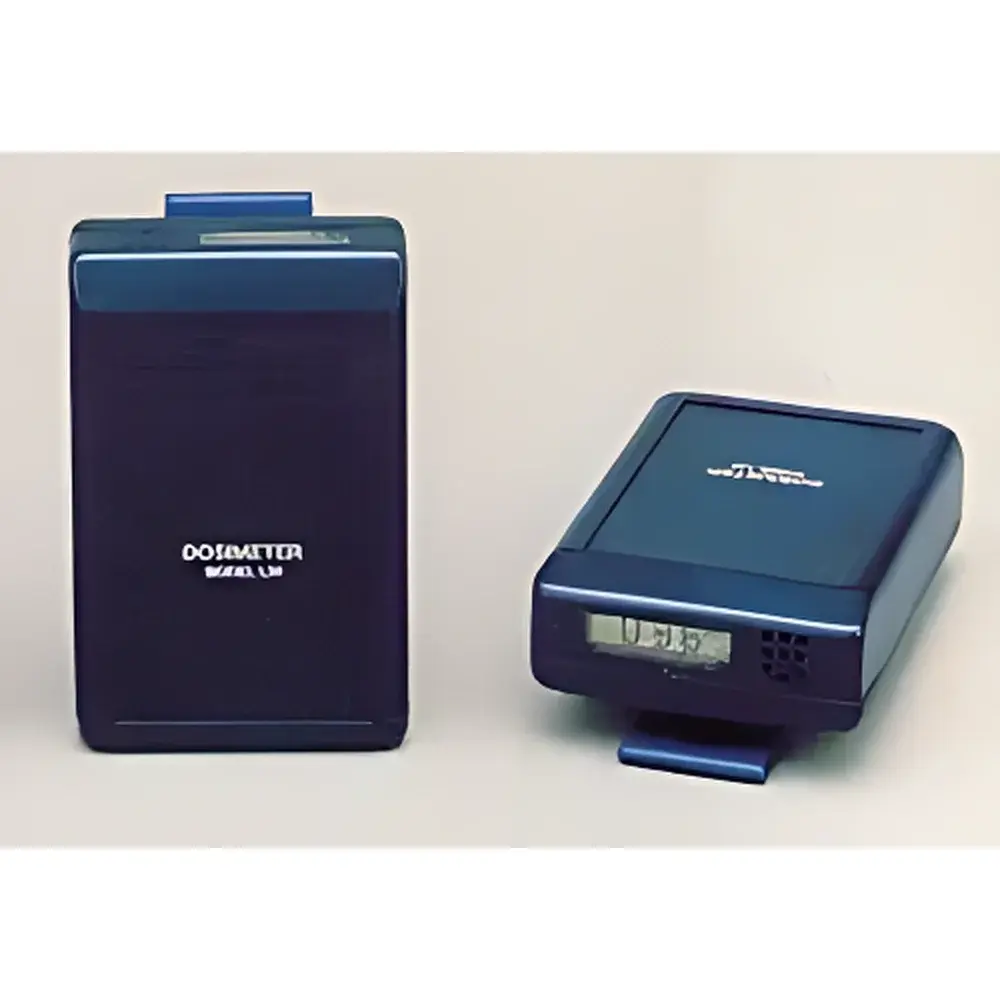
SEN-L36 Personal Radiation Dosimeter & Alarm Monitor
| Origin | France |
|---|---|
| Manufacturer Type | Authorized Distributor |
| Origin Category | Imported |
| Model | SEN-L36 |
| Price | €500 |
| Detector Type | Energy-Compensated Solid-State Silicon Semiconductor |
| Measured Radiation | X-rays and Gamma Rays |
| Energy Response Range | ±25% (60 keV – 6.2 MeV) |
| Dose Range | 0–999 mSv (1 µSv resolution) |
| Dose Rate Range | 0–250 mSv/h (1 µSv/h resolution) |
| Accuracy | ±10% (1 µSv/h – 1 Sv/h) |
| Response Time | <5 s (to 90% of final value) |
| Neutron Sensitivity | <1% relative to ¹³⁷Cs |
| Display | 3-digit LCD showing µSv, mSv, µSv/h, mSv/h, BAT/LOW, dose/dose rate alarm thresholds |
| Power Supply | Single 3.6 V AA-size lithium-ion battery (9-month service life at 40 h/week usage) |
| Operating Environment | −20 °C to +52 °C, 0–99% RH |
| Drop Test Compliance | ANSI N13.27–1981 |
| Housing Material | High-impact thermoplastic polymer |
| Dimensions & Weight | 48 × 70 × 17 mm / 77 g (including battery) |
| Dose Alarm Threshold | 65,000 µSv |
| Dose Rate Alarm Threshold | 65,000 µSv/h |
| Alert Duration | 1900 min |
| Calibration Interval | 6–36 months (field-adjustable per regulatory guidance) |
Overview
The SEN-L36 Personal Radiation Dosimeter & Alarm Monitor is a compact, CE-marked radiation safety instrument engineered for real-time monitoring of personal absorbed dose and dose rate from ionizing X-ray and gamma radiation fields. Based on energy-compensated solid-state silicon semiconductor detection technology, the device operates on the principle of charge carrier generation within the detector diode under photon irradiation—converted to measurable current and processed via embedded microcontroller firmware calibrated to ICRU reference spectra. Its design adheres to fundamental dosimetric principles defined in IEC 61526 and ISO 4037-3 for passive and active personal dosimeters, enabling traceable measurements suitable for occupational exposure assessment in regulated environments. The SEN-L36 is not intended for neutron or beta particle dosimetry; its low neutron cross-section (<1% relative to ¹³⁷Cs) ensures minimal interference in mixed-field scenarios typical of nuclear medicine, radiopharmacy, and industrial radiography settings.
Key Features
- Energy-compensated silicon diode detector with flat response across 60 keV–6.2 MeV—optimized for clinical and industrial photon spectra including ⁹⁹ᵐTc, ¹³¹I, ¹⁸F, and ⁶⁰Co.
- Dual-mode digital display (LCD) simultaneously indicating accumulated dose (µSv/mSv) and ambient dose equivalent rate (µSv/h/mSv/h), with dedicated indicators for battery status (BAT/LOW) and active alarm state.
- Configurable audible alarm (85 dB @ 30 cm) and dual-color red LED flash synchronized to dose or dose rate threshold exceedance—user-selectable thresholds up to 65,000 µSv and 65,000 µSv/h respectively.
- Ruggedized housing certified to ANSI N13.27–1981 drop-test standard (1 m onto concrete), rated IP54 for dust and splash resistance.
- Low-power architecture supporting continuous operation for ≥9 months on a single 3.6 V AA lithium-ion cell (tested at 40 h/week duty cycle); battery replacement requires no recalibration.
- Real-time response time <5 seconds to 90% of final reading—meeting IEC 62387-1 requirements for alarm-type operational dosimeters.
Sample Compatibility & Compliance
The SEN-L36 is designed exclusively for measurement of Hp(10) — personal dose equivalent at 10 mm depth — in photon fields. It does not provide direct Hp(0.07) or Hp(3) evaluation and is unsuitable for extremity or eye lens dosimetry. Device performance complies with the functional requirements of IEC 61526 Ed. 3.0 (2017) for electronic personal dosimeters, including linearity, angular dependence (<±20% up to ±60°), and temperature/humidity stability (±5% variation over −20 °C to +52 °C, 0–99% RH). While not individually type-approved under EU Directive 2013/59/Euratom, the unit meets essential safety and metrological criteria for use as a supplementary or task-specific dosimeter in facilities operating under national radiation protection ordinances aligned with IAEA Safety Standards Series No. GSR Part 3.
Software & Data Management
The SEN-L36 operates as a standalone, non-networked instrument with no onboard data logging or USB/Bluetooth interface. All configuration—including dose/dose rate alarm thresholds, alert duration (1900 min max), and display mode cycling—is performed via tactile button sequence per the manufacturer’s calibration protocol. No software driver or proprietary application is required. For regulatory recordkeeping, users must manually transcribe readings or integrate the device into facility-wide dosimetry programs using compatible badge readers or centralized reporting platforms compliant with ISO/IEC 17025 and FDA 21 CFR Part 11 (where electronic records are maintained). Calibration certificates issued by accredited laboratories (e.g., COFRAC, UKAS) include uncertainty budgets traceable to national standards (LNE-LNHB, PTB).
Applications
- Nuclear medicine departments: Monitoring technologist exposure during radiopharmaceutical preparation, PET/CT injection, and waste handling.
- Radiation oncology clinics: Real-time verification of shielding integrity near linear accelerator bunkers and brachytherapy suites.
- Research laboratories: Personnel dosimetry for gamma irradiators (e.g., ⁶⁰Co sources), X-ray diffraction systems, and radioisotope synthesis hot cells.
- Industrial NDT teams: Field verification of scatter dose rates during pipeline or weld inspection using Ir-192 or Se-75 sources.
- Educational institutions: Demonstrating ALARA principles, inverse-square law, and shielding effectiveness in health physics laboratories.
FAQ
Is the SEN-L36 suitable for neutron radiation monitoring?
No. The detector exhibits negligible sensitivity to fast and thermal neutrons (<1% relative response to ¹³⁷Cs), and the device lacks moderation or conversion layer required for neutron dosimetry.
Does the instrument require annual factory recalibration?
Calibration interval is user-determined based on usage intensity and local regulatory requirements—typically 6 to 36 months. Accredited third-party labs may perform on-site or benchtop calibration using traceable ¹³⁷Cs and ⁶⁰Co reference sources.
Can the alarm thresholds be modified in the field?
Yes. Thresholds for accumulated dose and dose rate alarms are fully programmable via the front-panel interface without special tools or software.
What is the recommended method for verifying ongoing accuracy between calibrations?
Users should perform daily or pre-shift check using a long-lived sealed check source (e.g., ¹³⁷Cs disk) and compare reading against baseline response recorded at time of last calibration.
Is the device compatible with international radiation protection recordkeeping systems?
As a readout-only instrument, it does not generate electronic audit trails. Integration into LIMS or dosimetry management software requires manual entry or optical character recognition of displayed values—consistent with GLP/GMP documentation practices for secondary monitoring devices.







