
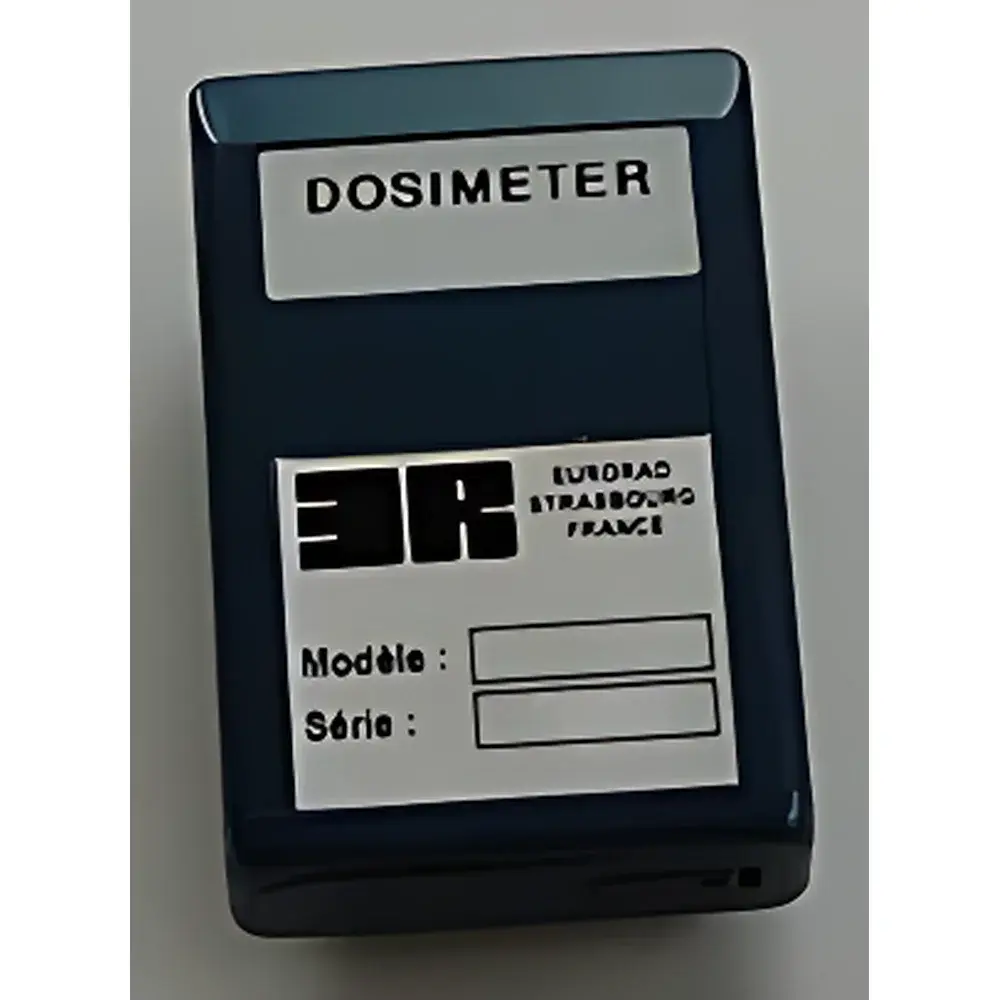
SEN-L36 Portable Energy-Compensated Radiation Dose Rate and Accumulated Dose Alarm Monitor
| Origin | France |
|---|---|
| Manufacturer Type | Authorized Distributor |
| Origin Category | Imported |
| Model | SEN-L36 |
| Price | €500 |
| Detector Type | Energy-Compensated Silicon Solid-State Detector |
| Radiation Types Detected | X-rays and Gamma Rays |
| Energy Response Range | ±25% (60 keV – 6.2 MeV) |
| Dose Range | 0–999 mSv (1 µSv increment) |
| Dose Rate Range | 0–250 mSv/h (1 µSv/h increment) |
| Accuracy | ±10% (1 µSv/h – 1 Sv/h) |
| Response Time | <5 s (to 90% of final reading) |
| Neutron Sensitivity | <1% relative to ¹³⁷Cs |
| Display | 3-digit LCD showing µSv, mSv, µSv/h, mSv/h, BAT/LOW, dose/dose rate alarm thresholds |
| Power Supply | Single 3.6 V AA-size lithium-ion battery (9-month service life at 40 h/week usage) |
| Operating Environment | −20 °C to +52 °C, 0–99% RH |
| Drop Test Compliance | ANSI N13.27–1981 |
| Housing Material | High-impact thermoplastic polymer |
| Dimensions & Weight | 48 × 70 × 17 mm / 77 g (including battery) |
| Dose Alarm Threshold | 65,000 µSv |
| Dose Rate Alarm Threshold | 65,000 µSv/h |
| Alert Duration | 1900 min |
| Calibration Interval | 6–36 months (field-adjustable per regulatory guidance) |
Overview
The SEN-L36 is a compact, CE-marked, energy-compensated radiation monitor engineered for real-time detection and alarm notification of ionizing photon radiation—specifically X-rays and gamma rays—in occupational and educational environments. Based on solid-state silicon semiconductor detection technology, the instrument employs passive energy compensation to maintain flat spectral response across a broad energy range (60 keV to 6.2 MeV), minimizing under- or over-response to low- and high-energy photons—a critical requirement for accurate personal dosimetry in mixed-field scenarios. Unlike Geiger-Müller tubes, which exhibit pronounced energy dependence and saturation at high dose rates, the SEN-L36’s compensated diode architecture delivers stable, linear output with ±10% accuracy from 1 µSv/h up to 1 Sv/h. Its microprocessor-controlled measurement engine continuously evaluates both accumulated dose (0–999 mSv) and instantaneous dose rate (0–250 mSv/h), updating readings every 2 seconds and triggering dual-mode alerts—audible beeping and red LED flashing—when user-defined thresholds are exceeded. Designed for continuous wear, it meets ANSI N13.27–1981 drop-test specifications and operates reliably under demanding field conditions: −20 °C to +52 °C and up to 99% relative humidity.
Key Features
- Energy-compensated silicon PIN diode detector with certified flat response (±25% from 60 keV to 6.2 MeV)
- Dual-parameter real-time monitoring: accumulated dose (µSv/mSv) and dose rate (µSv/h/mSv/h)
- User-configurable alarm thresholds for dose (up to 65,000 µSv) and dose rate (up to 65,000 µSv/h)
- Three-digit LCD with auto-ranging units, battery status (BAT/LOW), and alternating display of dose/dose rate/alarm state
- Low-power design powered by a single 3.6 V AA lithium-ion cell (typical 9-month service life at 40 h/week usage)
- Robust housing: high-impact thermoplastic casing (77 g total mass), integrated clip for belt or lab coat attachment
- Fast response: <5 seconds to 90% of final reading; no warm-up time required
- Negligible neutron sensitivity (<1% relative to ¹³⁷Cs), ensuring specificity for photon fields
Sample Compatibility & Compliance
The SEN-L36 is intended for direct measurement of ambient photon radiation fields encountered during routine operations in nuclear medicine departments, radiopharmacy labs, industrial radiography facilities, research reactor support areas, and university teaching laboratories. It does not require sample preparation or shielding configuration—measurements are performed in situ via isotropic angular response. The device complies with ANSI N13.27–1981 mechanical durability requirements and conforms to IEC 60846-1:2014 for portable photon dose rate meters. While not a primary standard dosimeter, its performance characteristics align with secondary calibration traceability to national metrology institutes (e.g., LNE-LNHB, PTB). It supports GLP-aligned documentation through manual log entry of alarm events and calibration dates; however, it does not include electronic audit trail or 21 CFR Part 11-compliant data storage.
Software & Data Management
The SEN-L36 operates as a standalone, firmware-driven instrument without onboard memory or wired/wireless connectivity. All operational parameters—including alarm thresholds, display mode, and alert duration (1900 min)—are configured via tactile button interface. No proprietary software, drivers, or cloud platform integration is provided. Users are responsible for maintaining calibration records, alarm logs, and battery replacement schedules in accordance with internal QA procedures or local radiation protection ordinances (e.g., EURATOM Directive 2013/59, UK IR(ME)R 2017). Optional third-party USB adapters may enable basic serial logging, but such configurations fall outside factory validation scope and are not supported under warranty.
Applications
- Personal dosimetry for radiographers, nuclear medicine technologists, and radiotherapy physicists during fluoroscopy, PET/CT, or brachytherapy procedures
- Area monitoring near gamma irradiators, X-ray diffractometers, or sealed source storage cabinets
- Field verification of shielding integrity prior to occupancy of controlled radiation zones
- Training aid in academic physics and health physics curricula for demonstrating dose accumulation dynamics
- Emergency response pre-screening for first responders entering potentially contaminated zones (as supplementary tool, not primary survey meter)
- Long-term exposure tracking for maintenance personnel working intermittently in radiologically monitored areas
FAQ
Is the SEN-L36 suitable for neutron radiation monitoring?
No. The detector exhibits <1% relative response to thermal and fast neutrons compared to ¹³⁷Cs gamma rays; it is optimized exclusively for X- and gamma-ray photons.
What is the recommended calibration interval?
Calibration should be performed every 6–36 months depending on usage frequency, regulatory jurisdiction, and quality management system requirements. Annual calibration is typical for clinical or industrial QA programs.
Can the alarm thresholds be modified in the field?
Yes. Both accumulated dose and dose rate alarm limits are fully programmable via the front-panel interface without special tools or software.
Does the device meet IEC 61526 or ISO 4037 standards?
It complies with IEC 60846-1:2014 for portable dose rate meters. It is not certified to IEC 61526 (for contamination monitors) or ISO 4037 (reference radiation fields), as those apply to laboratory reference systems.
How is battery replacement performed?
The rear battery compartment is accessed using a standard Phillips #0 screwdriver; replacement requires a commercially available 3.6 V AA lithium-ion cell (e.g., Saft LS14250 or equivalent).
Related Products







