
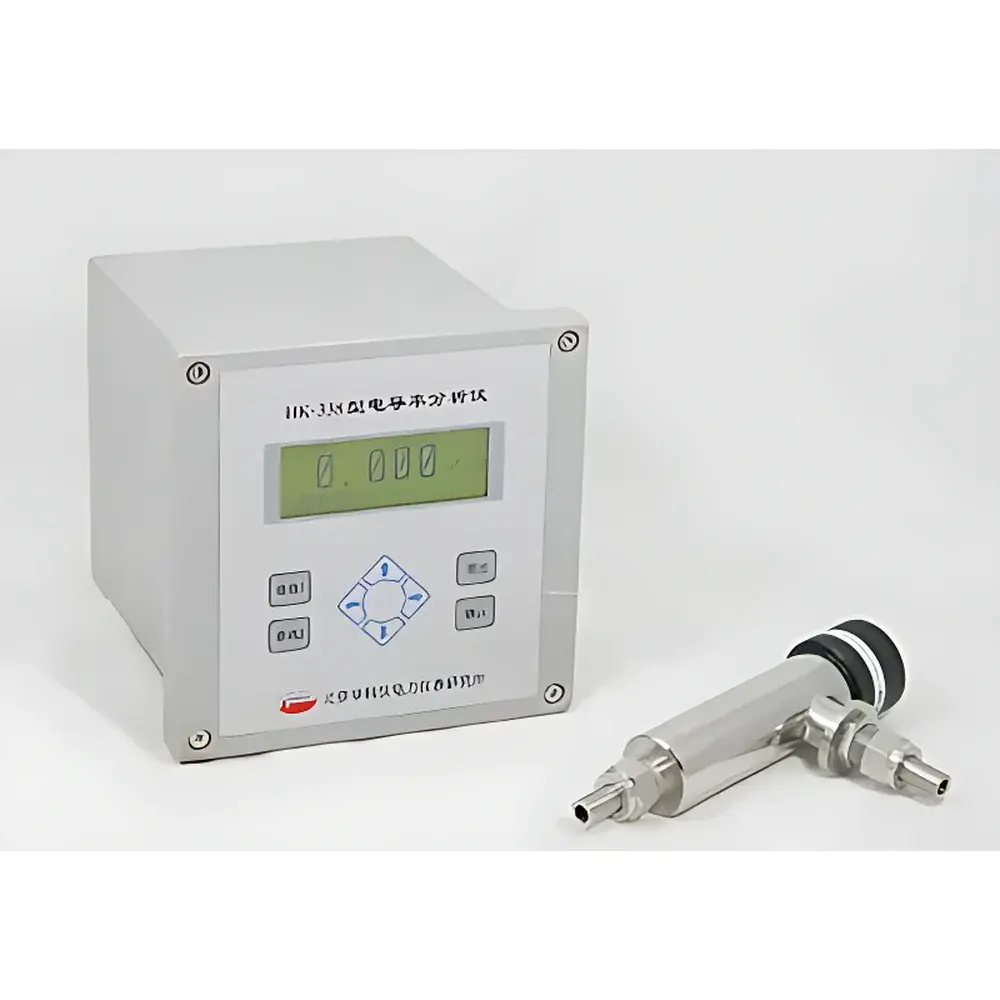
SENHK-338 Conductivity Meter
| Origin | Beijing, China |
|---|---|
| Manufacturer Type | Authorized Distributor |
| Origin Category | Domestic (PRC) |
| Model | SENHK-338 |
| Price | Upon Request |
| Conductivity Range (Auto-ranging via electrode) | 0.000–2.000 µS/cm, 0.00–20.00 µS/cm, 0–2000 µS/cm, 0.000–10.00 mS/cm, 0.000–20.00 mS/cm, 0.00–100.00 mS/cm |
| Temperature Measurement Range | 0.0–99.9 °C |
| ATC Compensation Range | 0.1–60.0 °C |
| Resolution | Conductivity: 0.001 µS/cm (lowest range), 0.01 µS/cm, 1 µS/cm, 0.001 mS/cm, 0.01 mS/cm |
| Temperature | 0.1 °C |
| Accuracy | Conductivity: ±1% of Full Scale, Temperature: ±0.5 °C |
| Response Time | ≤30 s to 90% of final value at 25 °C |
| Current Output Options | 0–10 mA, 0–20 mA, or 4–20 mA (isolated) |
| Max Load Resistance | 800 Ω (at 20 mA) |
| Output Accuracy | ±0.1 mA |
| Alarm Outputs | 2 programmable relay outputs (SPST, 250 VAC/3 A) |
| Communication Interface | Optional CAN bus (ISO 11898-compliant) |
| Sample Temp. Range | 5–50 °C |
| Sample Flow Rate | ≤6 L/h |
| Max Suspended Solids | ≤5 µm (no colloids, no oil/grease) |
| Ambient Operating Temp. | 5–45 °C |
| Ambient Humidity | ≤90% RH (non-condensing) |
| Storage/Transport Temp. | −25 to +55 °C |
| Dimensions (W×H×D) | 158 × 158 × 170 mm |
| Panel Cutout | 140 × 140 mm |
| Power Supply | 198–242 VAC, 50 Hz ±1 Hz |
| Power Consumption | ≤8 VA |
| Electrical Insulation | 1500 VAC/1 min (power-to-chassis) |
| Weight | 2.0 kg |
Overview
The SENHK-338 Conductivity Meter is a precision industrial-grade electrochemical analyzer engineered for continuous, stable measurement of aqueous solution conductivity in process control and laboratory monitoring applications. It operates on the principle of two-electrode or four-electrode AC conductometric measurement—applying a low-frequency alternating current across an electrode cell and measuring the resulting voltage drop to calculate conductance, corrected for cell geometry via user-configurable cell constant (K = 0.01–10 cm⁻¹). The instrument features automatic range switching based on real-time conductivity magnitude, eliminating manual range selection errors and enabling seamless transition across six decades—from ultra-pure water (sub-µS/cm) to high-salinity brines (up to 100 mS/cm). Integrated Automatic Temperature Compensation (ATC) uses a Pt1000 RTD sensor with linearization per DIN EN 60751, applying either fixed β-coefficient or customizable polynomial correction to normalize readings to 25 °C—critical for compliance with ASTM D1125, ISO 7888, and USP . Its robust design meets IP65 front-panel ingress protection when mounted in standard 140 mm square cutouts, supporting wall, pipe, or panel installation in water treatment plants, pharmaceutical utilities, boiler feedwater systems, and chemical dosing loops.
Key Features
- Four-wire conductivity measurement architecture—eliminates lead resistance effects, ensuring accuracy independent of cable length (up to 100 m with shielded twisted pair)
- 192 × 64 dot-matrix LCD with dual-language (English/Chinese) interface and simultaneous display of conductivity, temperature, ATC status, and alarm states
- Embedded microcontroller platform with flash-based firmware, supporting field-upgradable calibration coefficients and configuration profiles
- Two isolated 4–20 mA analog outputs (user assignable to conductivity, temperature, or % saturation), each with configurable damping and zero/span calibration
- Two programmable SPST relay outputs (250 VAC/3 A), configurable as high/low limit alarms, maintenance alerts, or system interlock triggers
- Secure parameter programming protected by 4-digit access code—prevents unauthorized configuration changes in regulated environments
- Optional CAN 2.0B interface (ISO 11898-2) for integration into distributed automation networks (e.g., PLC-based SCADA systems)
- Non-volatile memory stores >10,000 timestamped data points (conductivity + temp), accessible via serial port for audit trail generation
Sample Compatibility & Compliance
The SENHK-338 is validated for use with clean, low-turbidity aqueous streams meeting specified physical constraints: sample temperature 5–50 °C, flow rate ≤6 L/h (for inline sensor variants), and suspended solids ≤5 µm—with strict exclusion of colloidal silica, emulsified oils, or biofilm-forming organics that may coat electrodes and induce drift. It complies with electromagnetic compatibility standards IEC 61326-1 (industrial environment) and safety requirements per IEC 61010-1. For GxP-regulated operations, the device supports ALCOA+ data integrity principles: all configuration changes, calibration events, and alarm activations are logged with timestamps and operator IDs (when integrated with external authentication systems). While not FDA 21 CFR Part 11–certified out-of-the-box, its audit trail functionality—combined with controlled user access and electronic signature readiness—enables qualification under GLP and GMP frameworks when deployed with validated software infrastructure.
Software & Data Management
Data acquisition and configuration are managed via RS-232 serial interface (standard) or optional CAN bus, supporting Modbus RTU or proprietary ASCII command protocol. PC-based configuration utility (Windows-compatible) enables full setup—including cell constant entry, temperature compensation curve selection, alarm thresholds, output scaling, and data logging interval (1 s to 24 h). All operational parameters are stored in EEPROM with battery-backed RAM retention. Raw conductivity and temperature values are timestamped at acquisition and can be exported in CSV format for trend analysis in Excel or LIMS platforms. The built-in event log records up to 500 entries—including power cycles, calibration initiations, range switches, and relay state transitions—serving as a primary source for root-cause analysis during deviation investigations.
Applications
- Pharmaceutical purified water (PW) and water-for-injection (WFI) systems per USP and EU Annex 1 requirements
- Power plant demineralized water monitoring in condensate polishing and feedwater circuits
- Food & beverage CIP rinse water verification and conductivity-based concentration control
- Environmental wastewater effluent compliance reporting (e.g., EPA Method 120.1)
- Chemical manufacturing batch reactor endpoint detection and dilution control
- Academic and QC lab benchtop verification of standard KCl solutions (e.g., 0.01 mol/L, 0.1 mol/L)
FAQ
What electrode types are compatible with the SENHK-338?
The meter supports industry-standard two-electrode and four-electrode conductivity cells with BNC or DIN connectors and cell constants from 0.01 to 10 cm⁻¹. Recommended OEM probes include SENHK’s own stainless steel or graphite-bodied sensors with integrated Pt1000 temperature elements.
Does the instrument support calibration traceability to NIST standards?
Yes—calibration is performed using certified KCl reference standards (e.g., 1413 µS/cm at 25 °C, NIST SRM 3199). Calibration certificates documenting as-found/as-left values, uncertainty budgets, and technician accreditation can be issued upon request.
Can the 4–20 mA outputs be assigned to different parameters simultaneously?
No—each output channel is independently configurable, but only one parameter (conductivity, temperature, or % of full scale) may be assigned per channel. Dual-parameter transmission requires external signal multiplexing or CAN bus integration.
Is firmware update capability available in the field?
Yes—firmware upgrades are delivered as signed binary files and installed via serial connection using the official configuration tool. Version history and checksum validation ensure integrity and rollback safety.
How is temperature compensation applied when measuring non-aqueous solutions?
The SENHK-338 is validated exclusively for aqueous electrolyte solutions. Use with organic solvents or mixed-phase systems is not supported and may result in erroneous compensation due to divergent thermal conductivity and ion mobility behavior.
Related Products




