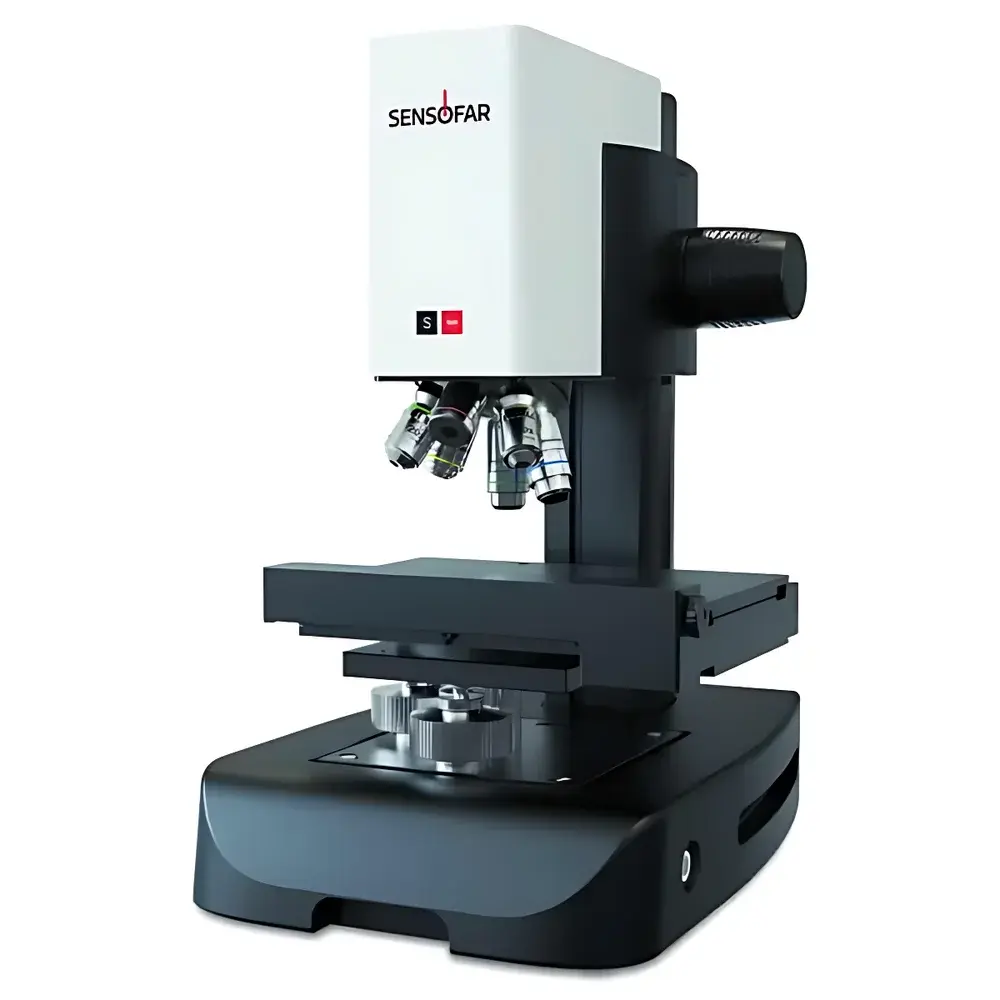
Sensofar S lynx 2 Confocal White-Light Interferometric Profilometer
| Brand | Sensofar |
|---|---|
| Origin | Spain |
| Model | S lynx 2 |
| Product Type | Non-contact 3D Optical Profilometer / Surface Roughness Analyzer |
| Operating Principle | White-light Interferometry & Confocal Microscopy |
| Measurement Technologies | Vertical Scanning Interferometry (VSI), Confocal Chromatic Profilometry (CCP), AI-powered Multi-Focal Plane Stacking |
| Motorized Stage Coverage | 125 × 75 mm |
| Footprint | Compact Benchtop Design |
Overview
The Sensofar S lynx 2 is a high-performance, benchtop 3D optical profilometer engineered for precision surface topography characterization across research laboratories, quality control environments, and production-integrated metrology workflows. It integrates three complementary non-contact optical measurement principles—vertical scanning interferometry (VSI), confocal chromatic profilometry (CCP), and AI-optimized multi-focal plane stacking—within a single compact sensor head. This tri-modal architecture enables robust adaptation to diverse surface types: from highly reflective or transparent substrates (e.g., silicon wafers, optical lenses) to low-reflectivity, rough, or structured surfaces (e.g., machined metals, textured polymers, MEMS devices). Unlike conventional single-technology profilometers, the S lynx 2 dynamically selects the optimal acquisition method based on real-time surface feedback, ensuring maximum lateral resolution, vertical repeatability, and measurement fidelity without manual intervention.
Key Features
- Tri-Modal Optical Engine: Combines VSI for sub-nanometer vertical resolution on smooth surfaces, CCP for high lateral resolution on steep slopes and discontinuous topographies, and AI-driven focal stack fusion for extended depth-of-field on complex, multi-height features.
- On-Sensor Real-Time Processing: All raw interferometric and confocal data acquisition, fringe analysis, and z-height reconstruction are executed within the sensor head’s embedded FPGA and GPU-accelerated processing unit—offloading computational demand from the host PC and enabling faster cycle times and deterministic latency.
- Full-Range Motorized Stage Integration: A high-precision 125 × 75 mm XY motorized stage supports automated stitching of up to thousands of individual fields-of-view with sub-pixel registration accuracy. Proprietary stitching algorithms maintain nanoscale height continuity across stitched boundaries, validated per ISO 25178-6 and ISO 25178-7.
- Benchtop Form Factor: Designed for flexibility in space-constrained environments—including cleanroom-compatible lab benches, QC inspection booths, and near-line production cells—the system requires no vibration isolation table and operates under standard ambient laboratory conditions (20–25°C, <50% RH).
- Modular Illumination & Objective Support: Compatible with a range of long-working-distance objectives (5× to 100×), LED white-light sources, and optional polarized or structured illumination modules for enhanced contrast on challenging surfaces.
Sample Compatibility & Compliance
The S lynx 2 accommodates samples ranging from bare silicon and sapphire wafers to coated medical implants, additive-manufactured metal parts, and microfluidic PDMS devices. Its non-contact operation eliminates mechanical loading or surface damage risks, making it suitable for soft polymers, thin films (<10 nm), and delicate nanostructured surfaces. The system complies with ISO 25178 series standards for areal surface texture parameters (Sa, Sq, Sz, Sdr, etc.) and supports traceable calibration via NIST-traceable step-height artifacts. For regulated industries, software configurations can be aligned with FDA 21 CFR Part 11 requirements—including electronic signatures, audit trails, and user-access controls—when deployed in GLP/GMP-compliant environments.
Software & Data Management
Sensofar’s proprietary MountainsMap® SP software provides full control over acquisition, analysis, reporting, and data export. It includes pre-validated analysis templates compliant with ISO 25178, ISO 4287, and ASTM E2903-20. Batch processing, scripting (via Python API), and integration with MES/SPC platforms (e.g., Siemens Opcenter, Rockwell FactoryTalk) are supported. Raw interferograms and confocal intensity stacks are stored in open HDF5 format, ensuring long-term archival integrity and third-party tool interoperability. All processing steps—including filtering, leveling, segmentation, and parameter calculation—are fully documented in an immutable audit trail.
Applications
- Wafer-level metrology for semiconductor process development (CMP uniformity, etch depth, lithographic resist profiles)
- Surface finish verification of orthopedic implants and dental prostheses per ISO 14644 and ISO 13322-2
- Characterization of laser-textured functional surfaces (hydrophobicity, friction reduction, cell adhesion)
- 3D dimensional inspection of micro-molded plastic components and injection-molded optics
- Failure analysis of delamination, coating thickness variation, and thermal fatigue cracks in power electronics packaging
FAQ
What surface materials can the S lynx 2 measure without contact?
It measures metallic, ceramic, polymeric, glass, and composite surfaces—including transparent, semi-transparent, and highly reflective substrates—without requiring conductive coatings or vacuum environments.
Does the system support automated pass/fail inspection against GD&T tolerances?
Yes—through MountainsMap® SP’s custom report builder and tolerance-based deviation mapping, users can define geometric specifications (e.g., flatness, curvature, step height) and generate automated compliance reports with color-coded deviation maps.
How is measurement traceability ensured?
Traceability is maintained via factory calibration using certified step-height standards (NIST-traceable), documented in the system’s calibration certificate. Optional annual recalibration services include uncertainty budgeting per ISO/IEC 17025.
Can the S lynx 2 be integrated into a production line?
Yes—its compact footprint, Ethernet/IP communication interface, and support for PLC-triggered acquisition enable seamless integration into automated inspection stations and Industry 4.0 architectures.