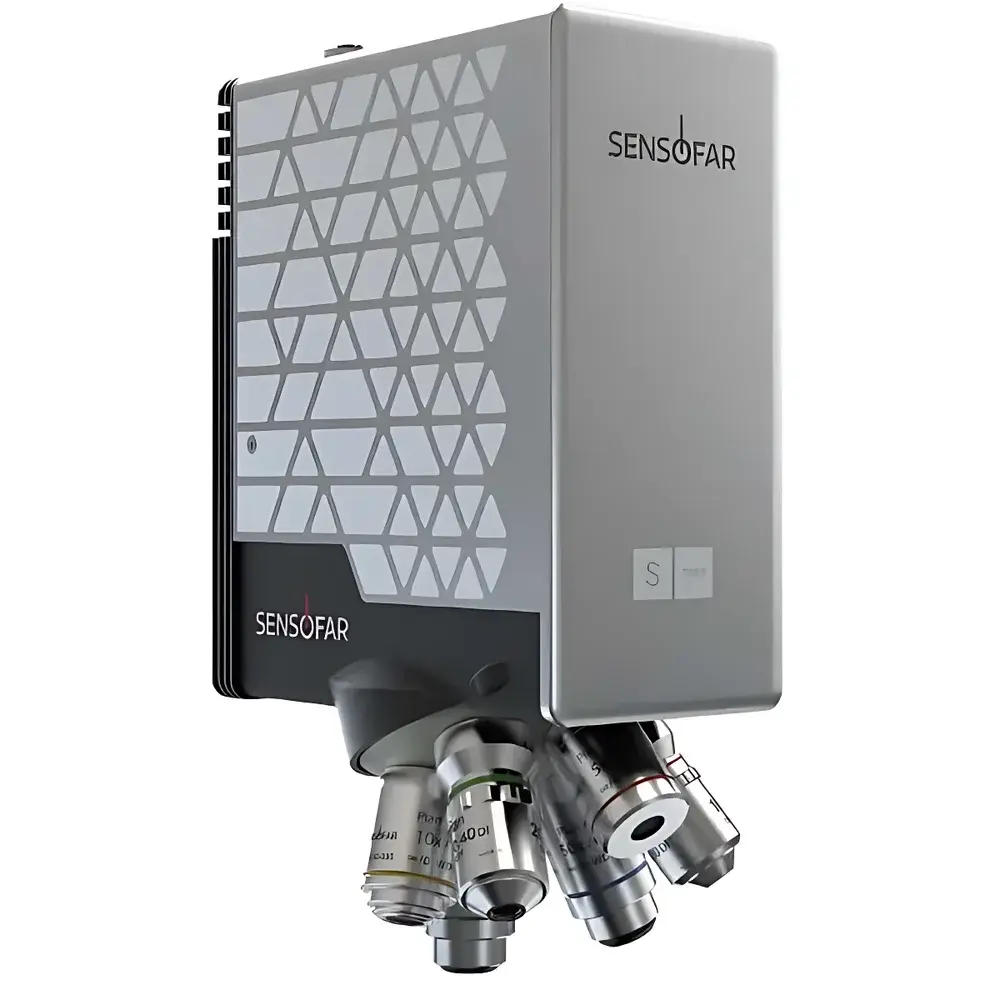
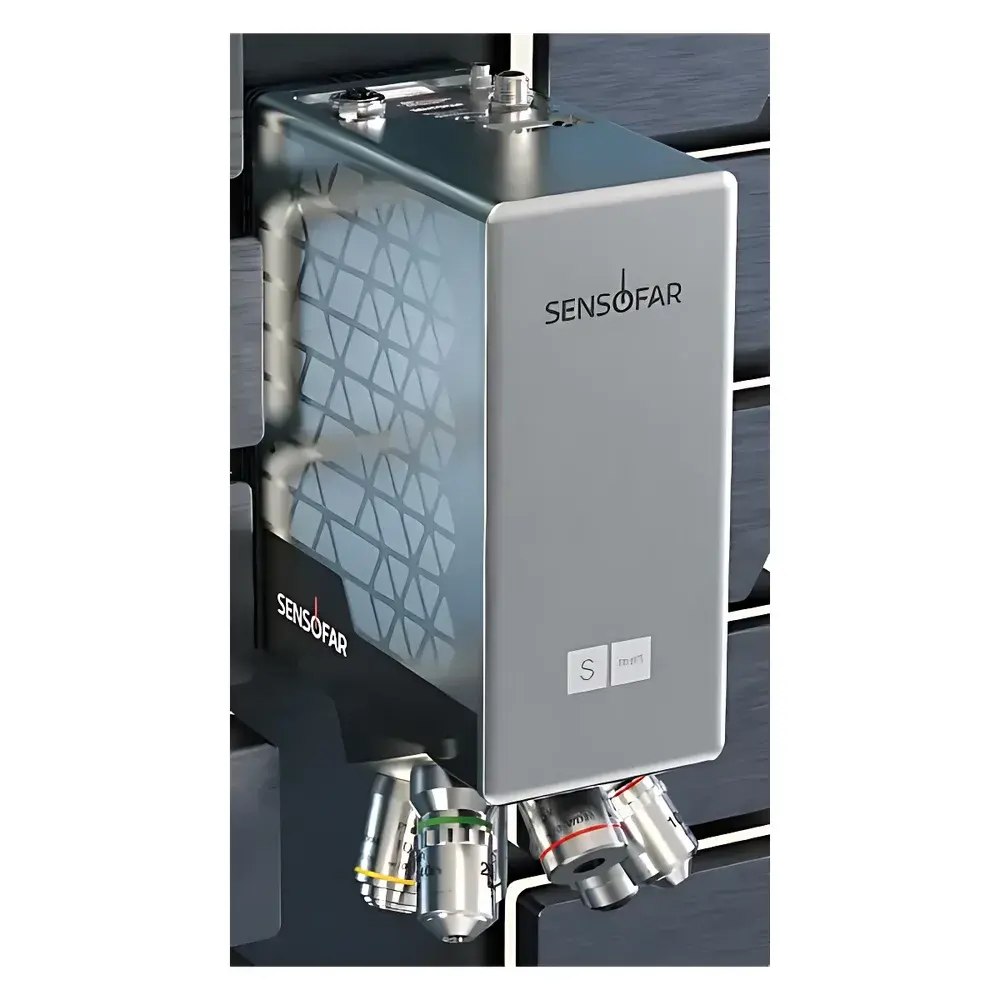
Sensofar S mart2 Integrated Interferometric + Confocal Measurement Head
| Brand | Sensofar |
|---|---|
| Origin | Spain |
| Model | Sensofar S mart2 |
| Product Type | Non-contact Profilometer / Surface Roughness Analyzer |
| Operating Principle | White-light Interferometry |
| Measurement Modalities | Coherence Scanning Interferometry (CSI), Extended Phase-Shifting Interferometry (ePSI), Confocal Microscopy, AI-powered Multi-Focal Stack Imaging |
| Integration Interface | Gigabit Ethernet + DC Power |
| Onboard Processing | Embedded computing core with real-time image acquisition and reconstruction engine |
| Calibration Traceability | NIST/NPL/PTB-traceable reference standards |
| Compliance | Designed for integration into automated manufacturing and QC environments compliant with ISO 16610, ISO 25178, and ASTM E2949 |
Overview
The Sensofar S mart2 is an integrated, compact optical measurement head engineered for high-precision, non-contact 3D surface topography analysis in industrial metrology and R&D environments. It combines three complementary optical modalities—Coherence Scanning Interferometry (CSI), extended Phase-Shifting Interferometry (ePSI), and Confocal Microscopy—within a single, self-contained housing. Unlike point-scanning or line-profilometry systems, the S mart2 performs true area-based (areal) measurements: it captures full-field height data across the entire field of view simultaneously, ensuring uniform lateral resolution (X–Y) independent of scanning speed or direction. Its white-light interferometric architecture delivers sub-nanometer vertical resolution and nanometer-level repeatability under controlled environmental conditions. The system is fundamentally designed for seamless integration into automated production lines, inline inspection stations, and modular metrology platforms—eliminating external controllers, frame grabbers, or external PCs by embedding the full acquisition, processing, and control electronics directly within the sensor head.
Key Features
- Triple-modal optical architecture: Simultaneous support for CSI, ePSI, and confocal imaging—enabling optimal technique selection per sample morphology, reflectivity, slope, and step height.
- Fully embedded computing core: Real-time image capture, fringe analysis, height map reconstruction, and surface parameter calculation performed onboard—no external PC required for basic operation.
- Minimal integration footprint: Slim mechanical profile (reduced width vs. prior generations) facilitates installation in space-constrained tooling, robotic cells, or multi-sensor gantries without mechanical interference.
- Plug-and-play connectivity: Only two physical interfaces—Gigabit Ethernet (for command/control/data streaming) and regulated DC power—simplify cabling, reduce EMI susceptibility, and accelerate system commissioning.
- Autofocus & adaptive illumination: Proprietary AI-assisted multi-focal stack analysis enables automatic focus search, optimal illumination intensity adjustment, and dynamic scan range selection based on surface geometry.
- Traceable metrology: All calibration routines and height scale verification are traceable to national metrology institutes (NIST, NPL, PTB) via certified step-height and roughness reference standards.
Sample Compatibility & Compliance
The S mart2 accommodates diverse sample types—including polished metals, silicon wafers, MEMS devices, medical implants, coated optics, and textured polymers—without contact-induced deformation or thermal loading. Its non-destructive, dry measurement process complies with ISO 25178-601 (areal surface texture parameters), ISO 16610 (filtration and assessment of surface texture), and ASTM E2949 (standard guide for optical 3D surface topography measurement). For regulated industries (e.g., semiconductor fabrication, orthopedic device manufacturing), the system supports audit-ready operation when deployed with Sensofar’s Metrology Suite software configured for 21 CFR Part 11-compliant user access control, electronic signatures, and immutable audit trails.
Software & Data Management
The S mart2 operates natively with Sensofar’s Metrology Suite—a modular, Windows-based application supporting automated script execution (via Python API), batch processing, statistical process control (SPC) charting, GD&T evaluation (per ASME Y14.5), and export to industry-standard formats (STL, CSV, X3P, ISO 25178-71 XML). Raw interferograms and confocal stacks are stored in lossless HDF5 containers with embedded metadata (timestamp, lens ID, calibration ID, operator tag). Data integrity is preserved through checksum validation and optional encrypted storage. The embedded firmware supports remote firmware updates and diagnostic telemetry via HTTP/HTTPS RESTful endpoints—enabling predictive maintenance and centralized fleet monitoring.
Applications
- Wafer-level metrology: Step height, film thickness (transparent layers), CMP uniformity, and defect characterization in semiconductor front-end and back-end processes.
- Precision machining QA: Areal roughness (Sa, Sq), peak density (Spd), functional parameters (Sk, Spk, Svk), and form deviation on turned, milled, or EDM-finished components.
- Optical component verification: Surface flatness, scratch/dig assessment, coating uniformity, and micro-lens array profiling.
- Biomedical device inspection: Surface texture of dental implants, stent struts, and surgical instruments—critical for osseointegration and biocompatibility validation.
- Micro-opto-electro-mechanical systems (MOEMS): 3D morphology of actuators, mirrors, and grating structures with sub-100 nm vertical fidelity.
FAQ
Does the S mart2 require an external computer for operation?
No—the measurement head contains a fully integrated industrial-grade computing module. Basic acquisition, reconstruction, and reporting can be executed autonomously; a host PC is only required for advanced analysis, report customization, or networked fleet management.
Can the S mart2 measure highly reflective or transparent surfaces?
Yes. The dual-mode interferometric engine (CSI + ePSI) dynamically selects optimal phase analysis algorithms based on surface coherence properties. Transparent thin films are analyzed using spectral-domain phase retrieval, while highly reflective surfaces benefit from ePSI’s enhanced noise suppression.
Is calibration documentation provided with the system?
Each unit ships with a factory calibration certificate referencing NIST-traceable step-height and roughness standards. Optional on-site recalibration services include uncertainty budgets per ISO/IEC 17025 requirements.
How is software licensing managed for automated production environments?
Metrology Suite supports concurrent node-locked or floating licenses. For inline deployment, runtime licenses enable unattended operation without GUI interaction—ideal for PLC-triggered measurements in Industry 4.0 architectures.
What environmental conditions affect measurement stability?
Vertical resolution and repeatability are optimized at 20 ± 1 °C with <50% RH and vibration isolation (Class M1 per ISO 22476-1). Optional active temperature stabilization and air-bearing vibration damping kits are available for metrology-grade installations.