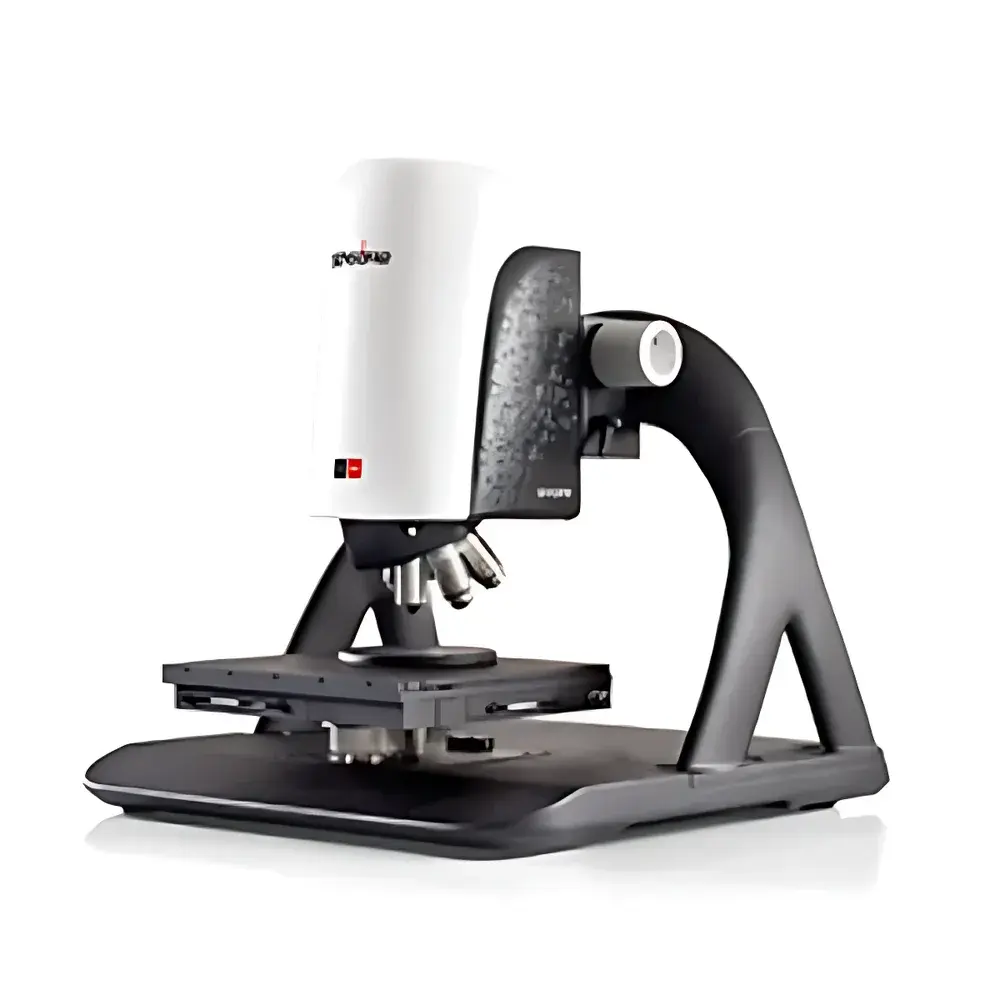
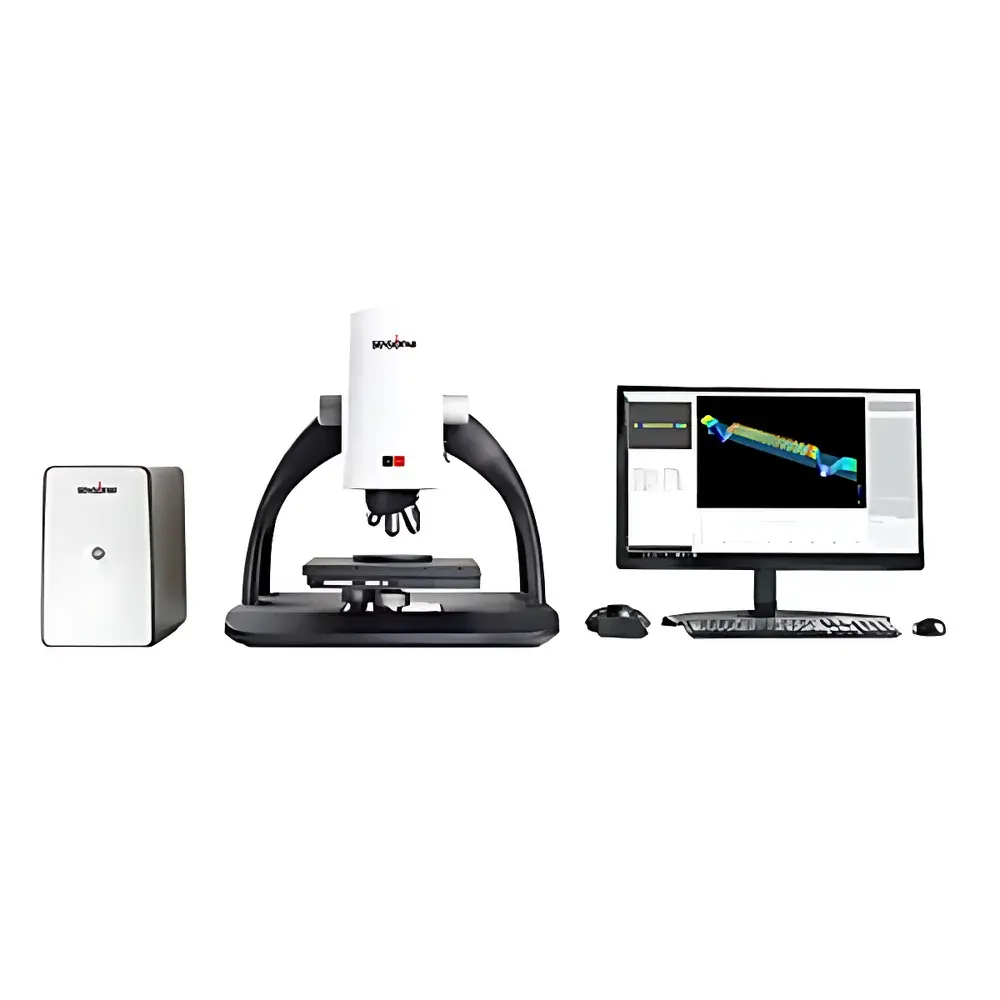
Sensofar S neox 3D Optical Profilometer
| Brand | Sensofar |
|---|---|
| Origin | Spain |
| Model | S neox |
| Product Type | Non-contact Optical Profilometer / Surface Roughness Analyzer |
| Measurement Principle | White-light Interferometry & Confocal Microscopy & AI-powered Multi-Focal Stacking |
| Data Acquisition Speed | Up to 180 fps |
| Lateral Resolution | Down to 0.14 µm |
| Vertical Repeatability | Sub-nanometer |
| Maximum Surface Slope | Up to 86° |
| Vertical Measurement Range | Up to several millimeters (depending on objective and mode) |
| LED Illumination | Multi-wavelength, Long-life (>50,000 h), Speckle-free |
Overview
The Sensofar S neox 3D Optical Profilometer is a high-precision, multi-technique surface metrology platform engineered for nanoscale topography characterization across diverse industrial and research environments. It integrates three complementary optical measurement modalities—confocal microscopy, white-light interferometry (WLI), and AI-enhanced multi-focal stacking—within a single sensor head, enabling seamless adaptation to surfaces ranging from ultra-smooth optics (<0.1 nm Ra) to highly textured, steep-slope engineering components (up to 86°). Unlike conventional profilometers limited to a single principle, the S neox leverages physics-based signal acquisition combined with real-time algorithmic optimization to deliver traceable, repeatable 3D surface data under ISO 25178 and ISO 4287 compliance frameworks. Its core architecture supports both R&D-grade metrological rigor and production-floor robustness, making it suitable for applications demanding GLP-aligned documentation, automated pass/fail decisioning, and long-term stability in 24/7 QC workflows.
Key Features
- Triple-sensor-head architecture: Simultaneous hardware integration of confocal, white-light interferometric, and AI-driven multi-focal stacking optics—enabling automatic mode selection based on surface topology and roughness parameters.
- Sub-100 nm vertical repeatability: Achieved through thermally stabilized optical path design, precision piezo scanning stages, and proprietary noise-suppression algorithms validated per ISO 25178-601.
- High-speed acquisition: Up to 180 frames per second (fps) data capture enabled by next-generation CMOS sensors and parallelized image processing pipelines—reducing typical scan times by 5× versus prior-generation systems.
- Multi-wavelength LED illumination: Four independently controllable LED channels (450–660 nm) eliminate laser speckle artifacts, extend source lifetime beyond 50,000 hours, and optimize contrast for transparent films, reflective metals, or low-contrast polymers.
- Modular software architecture: SensoPRO v6.x supports role-based user access control, SOP-driven measurement sequencing, barcode/QR-triggered batch execution, and customizable report generation compliant with FDA 21 CFR Part 11 audit-trail requirements.
- Extended slope capability: Confocal mode supports lateral resolution down to 0.14 µm and surface inclinations up to 86°; WLI mode maintains coherence over vertical ranges exceeding several millimeters at low magnifications.
Sample Compatibility & Compliance
The S neox accommodates a broad spectrum of sample types without contact-induced deformation or preparation artifacts: polished silicon wafers, machined turbine blades, biomedical implants, MEMS devices, coated optical lenses, heritage artifacts, and additive-manufactured metal parts. Its non-destructive methodology meets ASTM E2923 (Standard Guide for Measuring Surface Topography), ISO 25178 series (Geometrical Product Specifications – Surface Texture), and USP (Optical Microscopy for Pharmaceutical Applications). For regulated environments—including medical device manufacturing and aerospace component inspection—the system supports full electronic records, operator authentication logs, calibration traceability to NIST standards, and configurable electronic signatures aligned with GMP/GLP practices.
Software & Data Management
SensoPRO software provides an integrated environment for acquisition, analysis, reporting, and data governance. Built on a modular plugin framework, it allows users to embed custom Python or MATLAB scripts for advanced feature extraction (e.g., grain boundary detection, defect classification, or thin-film stack modeling). All measurement sessions include timestamped metadata, instrument configuration snapshots, environmental condition logging (temperature/humidity), and full raw-data retention. Export options include ISO-standardized .sdf files, industry-compatible .stl/.obj meshes, CSV/XLSX quantitative summaries, and PDF reports with embedded uncertainty budgets. Data integrity is ensured via SHA-256 hashing, version-controlled project archives, and optional integration with enterprise LIMS or MES platforms via RESTful API.
Applications
- Aerospace & Automotive: Quantitative assessment of thermal barrier coatings, combustion chamber roughness, gear tooth flank deviation, and surface integrity after EDM or laser shock peening.
- Medical Devices: Verification of micro-textured orthopedic implant surfaces, stent strut geometry, and hydrophilic coating uniformity per ISO 10993-18.
- Optics & Photonics: Characterization of aspheric lens form error, diffractive optical element (DOE) step height, and anti-reflective coating thickness via spectral reflectometry.
- Microelectronics & Semiconductors: Critical dimension (CD) metrology of etched trenches, wafer-level packaging bump height, and MEMS mirror flatness.
- Cultural Heritage & Archaeology: Non-invasive 3D documentation of engraved inscriptions, corrosion patterns on ancient metals, and stratigraphic layer profiling in fragile organic substrates.
- Advanced Manufacturing: In-process validation of binder jetting surface fidelity, laser powder bed fusion melt pool morphology, and ultrasonic welding interface quality.
FAQ
What measurement principles does the S neox support?
The S neox combines confocal microscopy, white-light interferometry, and AI-optimized multi-focal stacking—all accessible within one sensor head and controlled via unified software logic.
Can the system measure transparent thin films?
Yes. Integrated spectral reflectometry enables non-contact thickness measurement of single- or multi-layer dielectric films (50 nm–1.5 µm) using visible-range LED illumination and physics-based fitting algorithms.
Is the system compliant with FDA 21 CFR Part 11?
SensoPRO supports electronic signatures, audit trails, user access tiers, and data immutability features required for regulated pharmaceutical and medical device QA/QC environments.
What is the maximum measurable surface slope?
Up to 86° in confocal mode; slope tolerance varies with objective NA and magnification but remains significantly higher than conventional interferometers.
Does the system require vibration isolation?
While not mandatory for all configurations, operation at sub-nanometer vertical resolution is recommended on passive or active optical tables—particularly when using high-NA objectives or long integration times.
How is calibration traceability maintained?
Calibration is performed using NIST-traceable step-height standards and sphere-plane reference artifacts; full calibration history, uncertainty budgets, and certificate linkage are embedded in every measurement dataset.