Sentec SA180 Series AC LVDT Linear Position Sensor
| Origin | Guangdong, China |
|---|---|
| Manufacturer Type | Authorized Distributor |
| Origin Classification | Domestic (China) |
| Model | SA180 |
| Unit Price | USD 35 (FOB Guangdong) |
| Outer Diameter | 18 mm |
| Housing Material | Stainless Steel (AISI 304) |
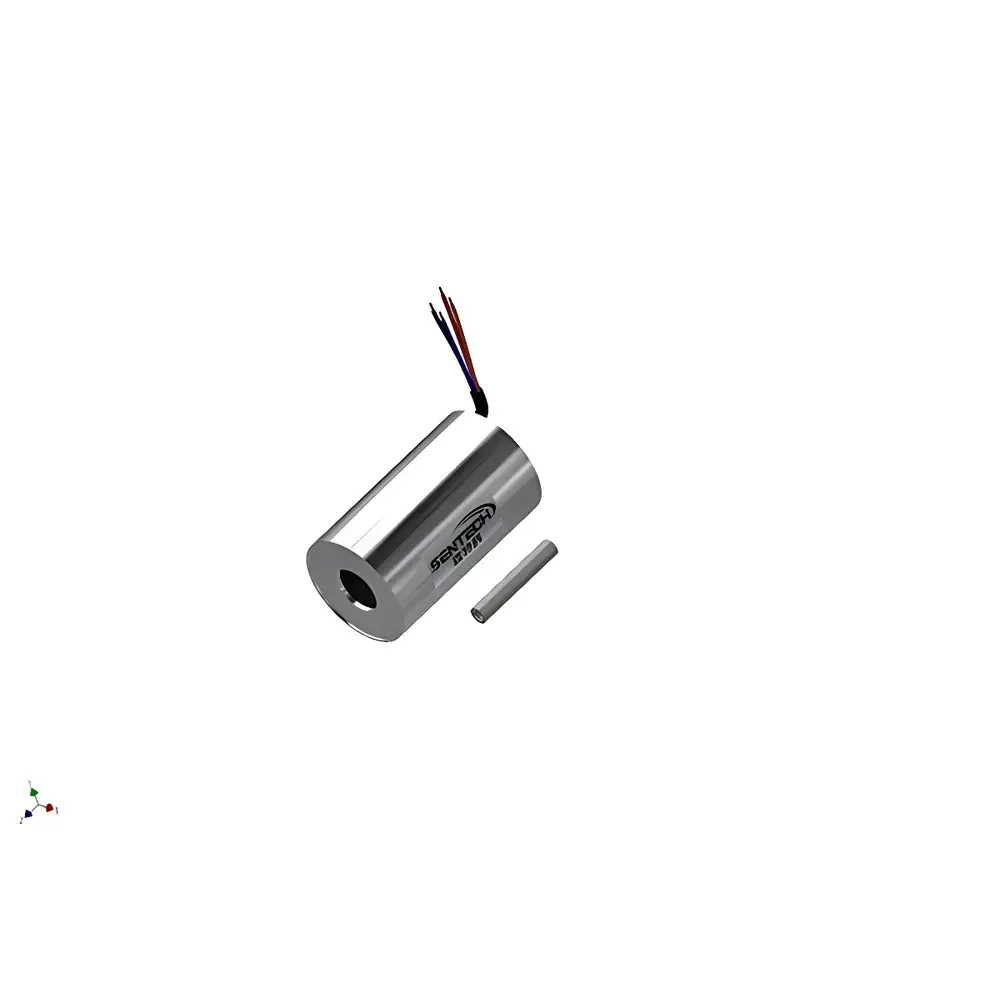
| Core Configuration | Separable Ferromagnetic Core |
| Electrical Interface | Lead Wires (Standard 3-wire configuration) |
| Ingress Protection | IEC IP61 |
| Operating Temperature Range | −55 °C to +155 °C |
| Stroke Range | 0–600 mm (Customizable) |
| Excitation Voltage | 3.0 V<sub>rms</sub> (Nominal) |
| Excitation Frequency | 2.5–5.5 kHz |
| Linearity Error | < ±0.25 % of Full-Scale Output (FSO) |
| Repeatability Error | < 0.01 % FSO |
| Hysteresis Error | < 0.01 % FSO |
| Temperature Coefficient of Zero & Sensitivity | −0.02 %/°C (Nominal) |
Overview
The Sentec SA180 Series AC LVDT (Linear Variable Differential Transformer) is a precision contact-type displacement transducer engineered for high-stability analog position measurement in demanding industrial and laboratory environments. Based on the well-established electromagnetic principle of mutual inductance variation, the SA180 operates by detecting the axial displacement of a ferromagnetic core relative to a set of three coaxial, wound transformer stages — one primary and two secondary windings. As the core moves along the sensor’s bore, the differential voltage output between the secondaries changes linearly with position, enabling robust, drift-free analog signal generation without physical contact or wear. Designed with a separable core architecture, the SA180 decouples mechanical mounting constraints from sensing performance — allowing independent alignment of the core rod and stator body to minimize side-load-induced errors and extend service life. Its stainless steel (AISI 304) housing and IP61-rated sealing ensure resistance to dust ingress and mechanical handling in factory-floor conditions, while its extended thermal operating range (−55 °C to +155 °C) supports deployment in aerospace actuators, high-temperature hydraulic systems, and automotive test rigs.
Key Features
- Separable ferromagnetic core design enables flexible mechanical integration and eliminates binding under misalignment or thermal expansion mismatch
- Stainless steel (AISI 304) hermetically sealed housing ensures long-term corrosion resistance and mechanical durability in harsh environments
- High intrinsic linearity (< ±0.25 % FSO) and exceptional repeatability (< 0.01 % FSO) validated per ISO 17025-accredited calibration procedures
- Low temperature coefficient (−0.02 %/°C nominal) minimizes zero and sensitivity drift across wide ambient fluctuations
- Optimized excitation at 3.0 Vrms, 2.5–5.5 kHz enables stable operation with standard LVDT signal conditioners (e.g., DC2000, SCM5B series)
- Stroke lengths configurable from 1 mm to 600 mm; custom stroke, cable length, termination (e.g., MIL-DTL-5015 connectors), and shielding options available upon request
Sample Compatibility & Compliance
The SA180 is compatible with all standard AC-operated LVDT signal conditioning electronics that support 3-wire differential outputs and 2.5–5.5 kHz carrier frequencies. It requires no internal electronics or DC power — making it intrinsically safe for use in explosive atmospheres when paired with appropriately rated barrier modules (per ATEX/IECEx Zone 2 guidelines). The sensor conforms to IEC 60529 (IP61), meets RoHS 2011/65/EU requirements, and is manufactured under ISO 9001:2015 quality management systems. While not certified to SIL or ASME BPE standards, its metrological stability and traceable calibration data support qualification under GMP/GLP-controlled processes where position verification is critical — such as servo-valve characterization per ISO 10770-1 or hydraulic actuator validation per SAE J1210.
Software & Data Management
As a passive analog transducer, the SA180 does not incorporate onboard firmware or digital interfaces. Its output is a low-impedance, ratiometric AC voltage signal requiring external demodulation. Integration into automated test systems is achieved via industry-standard signal conditioners (e.g., Dataforth SCM5B34, Phoenix Contact MINI MCR-2-U-I) that provide carrier generation, phase-sensitive demodulation, filtering, and scaling to 0–10 VDC or 4–20 mA. Conditioner outputs are compatible with SCADA platforms (Ignition, Siemens WinCC), DAQ hardware (NI cDAQ, Keysight 34972A), and PLC analog input modules (Rockwell 1769-IF4, Siemens SM 331). All calibration certificates include NIST-traceable data and uncertainty budgets compliant with ISO/IEC 17025:2017 Annex A.5, supporting audit readiness for FDA 21 CFR Part 11 environments when paired with electronic record systems featuring audit trail and electronic signature capabilities.
Applications
- Precision feedback in electro-hydraulic servo valves and proportional control systems (ISO 10770-1 compliant testing)
- Real-time stroke monitoring in CNC machine tool axis dampers and brake actuators
- Material elongation measurement in universal tensile testers (ASTM E8/E21)
- Position verification in robotic end-effectors and pick-and-place mechanisms
- Thermal expansion compensation in turbine casing monitoring systems
- Process-critical displacement sensing in pharmaceutical tablet press cam followers and packaging fill-level controls
FAQ
What excitation source is required to operate the SA180?
The SA180 requires a sinusoidal AC excitation of 3.0 Vrms at a frequency between 2.5 kHz and 5.5 kHz. Standard LVDT signal conditioners provide this function internally.
Can the SA180 be used in vacuum or submerged applications?
No — its IP61 rating provides only dust protection and limited drip resistance. For vacuum or immersion, consult Sentec Engineering for IP67/IP68-rated variants with welded housings and fluorosilicone O-rings.
Is calibration certificate included with shipment?
Yes — each unit ships with a factory calibration report listing measured linearity, hysteresis, and repeatability against traceable master standards, including expanded uncertainty (k=2).
Does the SA180 support custom electrical terminations?
Yes — lead wire length, insulation type (e.g., Teflon® FEP), and connectorization (e.g., Deutsch DT04, LEMO FGGA) can be specified at order entry.
How is thermal drift compensated in system-level integration?
While the SA180 exhibits a nominal temperature coefficient of −0.02 %/°C, full system compensation is best achieved using dual-sensor configurations or software-based look-up tables calibrated across the operational temperature envelope.