
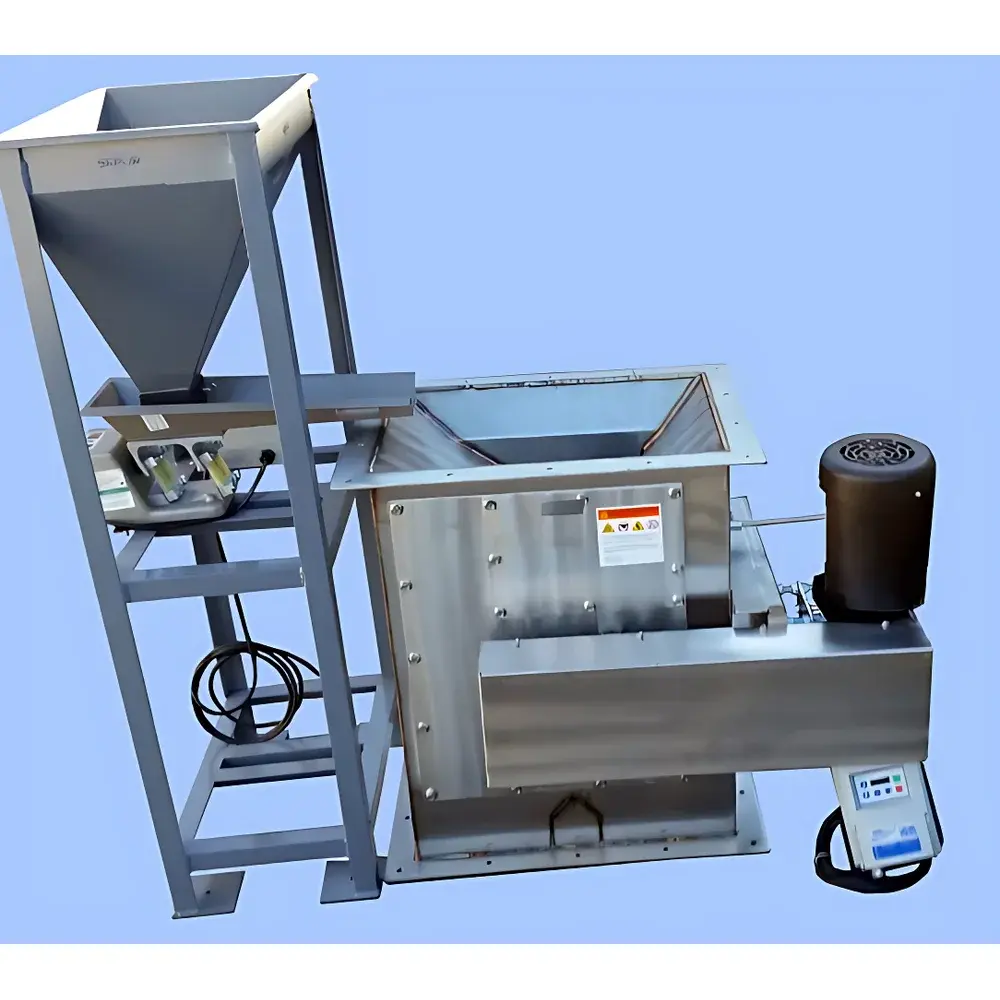
Sepor 060B-003 Dry Drum Magnetic Separator
| Origin | USA |
|---|---|
| Manufacturer Type | Authorized Distributor |
| Origin Category | Imported |
| Model | Sepor 060B-003 |
| Pricing | Upon Request |
Overview
The Sepor 060B-003 Dry Drum Magnetic Separator is an industrial-grade, benchtop-scale magnetic separation system engineered for efficient recovery and purification of ferromagnetic and paramagnetic particles from dry, free-flowing granular or powdered feed streams. Unlike wet-based separation methods, this unit operates without liquid medium—eliminating slurry handling, dewatering, drying, and associated wastewater treatment requirements. Its core principle relies on the differential magnetic susceptibility of materials subjected to a controlled, rotating drum-mounted magnetic field. As material passes over the rotating drum surface, magnetically susceptible particles are attracted and held against the drum’s outer shell until carried beyond the magnetic arc, where they are discharged into a dedicated collection chute. Non-magnetic fractions continue along their natural trajectory into a separate receptacle. This design ensures high-throughput, continuous-duty operation with minimal operator intervention and no consumables.
Key Features
- Compact, self-contained benchtop configuration optimized for laboratory, pilot-scale, and small-batch production environments.
- Electromagnet-powered drum assembly delivering adjustable field strength up to 20,000 Gauss—enabling selective separation of both strongly ferromagnetic (e.g., magnetite, iron filings) and weakly paramagnetic (e.g., ilmenite, hematite, manganese dioxide) species.
- Variable-speed feed control system with optional hopper integration, permitting precise regulation of material residence time and throughput rate (typically 1–5 kg/h for fine powders, scalable via feed rate calibration).
- Stainless-steel drum housing and wear-resistant drum surface engineered for long-term mechanical stability and corrosion resistance under repeated abrasive loading.
- Adjustable splitter plate for real-time optimization of magnetic/non-magnetic product cut points, supporting iterative process development and grade-recovery trade-off analysis.
- No external cooling or hydraulic systems required; powered solely by standard 120 VAC / 60 Hz input with internal thermal protection circuitry.
Sample Compatibility & Compliance
The Sepor 060B-003 accommodates dry, non-cohesive, particle-size distributions ranging from 50 µm to 2 mm—ideal for mineral sands, metallurgical concentrates, recycled battery black mass, catalyst recovery streams, and ceramic raw material purification. It is not suitable for sticky, hygroscopic, or electrostatically charged feeds without prior conditioning (e.g., drying, anti-static treatment). While not certified to specific ISO or ASTM standards as a standalone analytical instrument, its mechanical and electromagnetic architecture conforms to general electrical safety requirements per UL 61010-1 and IEC 61000-6-3 (EMC emissions). When integrated into validated QC workflows—for instance, in battery recycling or rare earth element refining—the system supports traceability and repeatability consistent with GLP-aligned documentation practices.
Software & Data Management
This model operates as a manually tuned, hardware-controlled system with no embedded microprocessor or digital interface. All operational parameters—including drum rotation speed (RPM), feed rate (via analog-adjustable vibratory feeder), and splitter position—are set and monitored physically. For laboratories requiring audit-ready records, users commonly pair the unit with external data loggers (e.g., Omega OM-DAQPRO series) to capture feed mass flow (via load cell), drum RPM (via optical tachometer), and run duration. Raw separation efficiency data (e.g., magnetic fraction yield, Fe recovery %) is calculated offline using gravimetric assay or XRF validation—fully compatible with LIMS integration and 21 CFR Part 11–compliant electronic lab notebooks when supported by institutional SOPs.
Applications
- Mineral processing R&D: Pre-concentration of ilmenite, chromite, and garnet from beach sand feeds.
- Battery recycling: Recovery of ferrous components (steel casings, current collectors) and magnetic cathode active materials (e.g., LiFePO₄) from shredded black mass.
- Catalyst reclamation: Isolation of nickel-, cobalt-, or iron-based heterogeneous catalysts from spent petrochemical or pharmaceutical reaction residues.
- Food & pharma grade assurance: Removal of ferrous contamination from dry APIs, excipients, or powdered nutraceuticals per USP guidance on metallic impurity control.
- Environmental remediation: Extraction of iron oxides and magnetic nanoparticles from contaminated soils during ex-situ treatment protocols.
FAQ
What is the maximum recommended feed particle size for reliable separation?
Particles larger than 2 mm may cause bridging or uneven distribution across the drum surface; optimal performance is achieved with D90 ≤ 1.5 mm and moisture content < 0.5% w/w.
Can the magnetic field strength be calibrated or verified onsite?
Yes—field intensity at the drum surface can be measured using a transverse Hall-effect gaussmeter (e.g., Lake Shore 475 DSP); Sepor provides nominal field maps for each drum configuration upon request.
Is explosion-proof certification available for hazardous environments?
The standard 060B-003 is not intrinsically safe; however, ATEX/IECEx-compliant variants with purged enclosures and spark-resistant drum coatings are available through special order.
How often does the drum require maintenance or demagnetization?
No routine demagnetization is needed; permanent magnet assemblies retain >98% flux density after 10 years per manufacturer aging tests. Drum surface cleaning with non-metallic scrapers is recommended after each batch when processing abrasive feeds.
Does Sepor provide method development support for new feed materials?
Yes—application engineers offer remote test protocol design, including feed characterization guidelines, parameter screening matrices, and recovery efficiency benchmarking reports based on client-submitted sample sets.




