
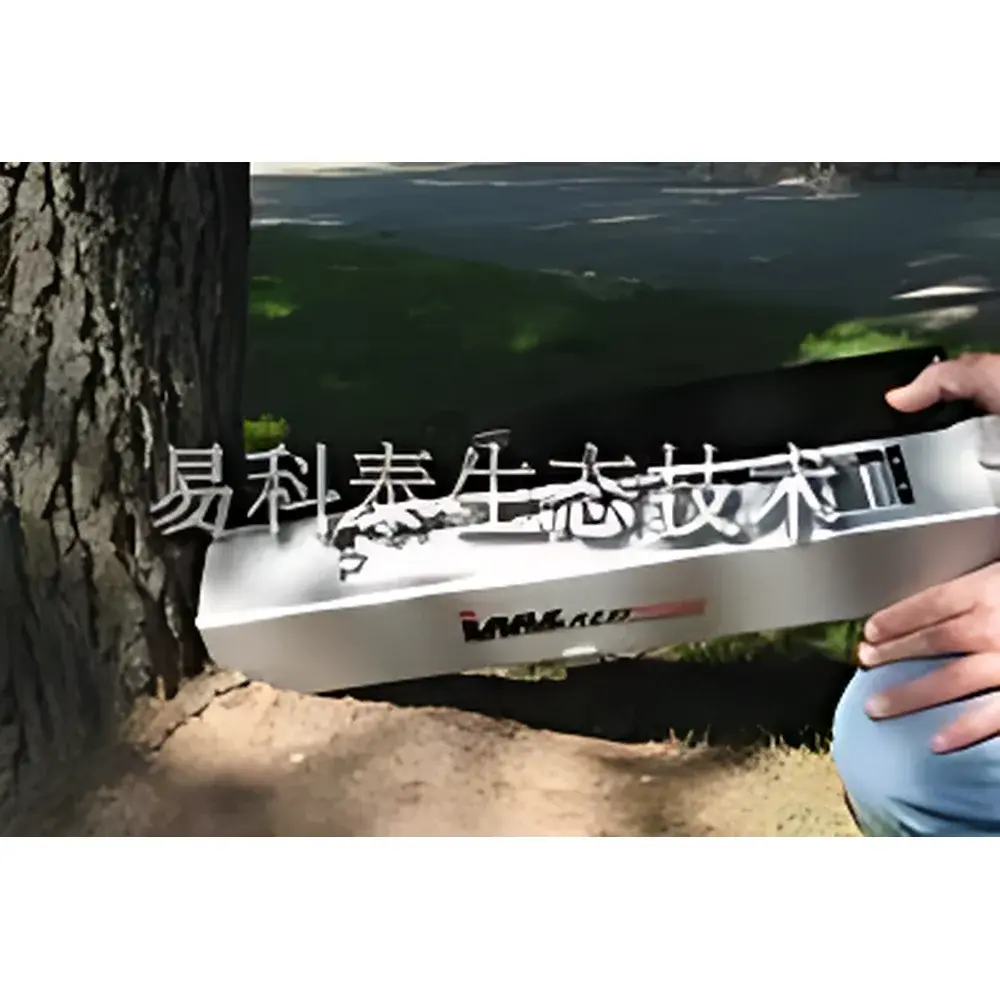
M-Series Rugged Tree Micro-Drill Resistograph
| Origin | Germany |
|---|---|
| Supplier Type | Authorized Distributor |
| Import Status | Imported |
| Model | M-Series Rugged Tree Micro-Drill Resistograph |
| Pricing | Available Upon Request |
| Maximum Penetration Depth | 300 mm |
| Feed Rate | 10–60 cm/min (Standard), 20–60 cm/min (Lightweight) |
| Resolution | 0.1 mm |
| Data Output | Thermal Wax Paper Strip Chart |
| Power Supply | 7.2 V, 1.7/2.0 Ah NiCd Rechargeable Battery |
| Charger Input | 110–220 V AC |
| Operating Environment | Wet, muddy, or uneven terrain (e.g., marshes, steep slopes) |
Overview
The M-Series Rugged Tree Micro-Drill Resistograph is a precision arboricultural diagnostic instrument engineered for non-destructive internal assessment of living trees and standing timber. It operates on the principle of micro-resistography—measuring real-time mechanical resistance encountered by a fine-diameter drill bit (typically 1.5–3.0 mm) as it advances radially into wood tissue at controlled, low-speed penetration. Variations in resistance correlate directly with density gradients, moisture content, decay presence, cavities, growth ring boundaries, and structural anomalies such as fungal degradation or insect tunneling. Unlike destructive coring or visual inspection, this method preserves tree integrity while delivering spatially resolved, quantitative profiles along the drill path. The M-Series is specifically reinforced for high-cycle field use in demanding forestry and urban arboriculture settings—including wetland zones, rocky substrates, and hardwood species with Janka hardness exceeding 1,800 lbf (e.g., oak, hickory, hornbeam). Its robust mechanical architecture ensures long-term repeatability and minimal drift under ambient temperature fluctuations (−10 °C to +45 °C) and humidity up to 95% RH (non-condensing).
Key Features
- Heavy-duty aluminum alloy chassis and sealed gear train engineered for sustained operation in mud, rain, or high-dust environments—validated per IP54 ingress protection rating.
- Manually operated feed wheel with dual-range speed control (10–60 cm/min standard; 20–60 cm/min lightweight configuration), enabling operator-adaptive penetration for variable wood density without stalling or overloading.
- Self-retracting micro-drill probe (1.5 mm or 3.0 mm diameter options) that simultaneously extracts minimal wood shavings and back-fills the bore channel upon withdrawal—reducing wound surface area by >90% compared to conventional increment borers.
- Integrated thermal wax paper strip chart recorder providing immediate, tamper-resistant analog output: resistance profiles are plotted continuously at 0.1 mm resolution, eliminating reliance on external devices or software during field deployment.
- Dual-voltage universal charger (110–220 V AC) and hot-swappable NiCd battery pack (7.2 V, 1.7/2.0 Ah) supporting ≥120 minutes of continuous operation per charge—sufficient for >15 full-depth (300 mm) assessments per session.
- Adjustable three-point tripod mount with telescoping legs and level-indicating bubble vial, ensuring stable alignment on sloped, uneven, or saturated ground surfaces.
Sample Compatibility & Compliance
The M-Series accommodates live trees from 10 cm to >200 cm DBH (diameter at breast height), including broadleaf deciduous, coniferous, and tropical hardwoods. It is routinely deployed in accordance with DIN EN 1995-1-1 (Eurocode 5) for timber structural evaluation and aligns with methodology referenced in ISO 11268-2 (soil biological testing—though adapted for woody tissue impedance correlation). While not a certified medical or pharmaceutical device, its data output supports GLP-aligned documentation practices when paired with standardized field logbooks and timestamped paper records. No regulatory certification (e.g., CE, FDA) applies, as resistographic assessment falls outside scope of directive-based instrumentation mandates—however, all electrical components comply with IEC 61000-6-3 (EMC emission standards) and IEC 60950-1 (safety of information technology equipment).
Software & Data Management
The M-Series operates as a standalone analog system: no firmware, no Bluetooth, no cloud dependency. All measurement data is captured physically on thermal wax paper strips—each bearing a unique batch identifier, date stamp, and manual operator annotation space. This design ensures auditability, eliminates cybersecurity exposure, and satisfies institutions requiring immutable primary records (e.g., municipal arborist departments, heritage tree conservation programs, court-admissible expert testimony). Optional third-party digitization kits (sold separately) enable high-resolution scanning and vector conversion of paper strips into CSV or PDF reports compatible with GIS platforms (ArcGIS, QGIS) and tree inventory databases (i-Tree, Treepad). No proprietary software license or subscription is required.
Applications
- Urban forest health monitoring: early detection of concealed decay in street trees prior to failure risk escalation.
- Historic timber structure assessment: non-invasive evaluation of load-bearing beams in listed buildings or cultural heritage sites.
- Forestry research: longitudinal analysis of growth ring dynamics, reaction wood formation, and drought stress response across species trials.
- Insurance and legal arbitration: objective, field-verifiable evidence for liability claims involving tree-related property damage or personal injury.
- Conservation management: baseline profiling of ancient or veteran trees to inform adaptive preservation strategies and cyclical re-monitoring protocols.
FAQ
Does the M-Series require calibration before each use?
No—factory-calibrated torque sensor and feed-rate encoder ensure traceable accuracy across operating life. Annual verification against NIST-traceable reference wood blocks is recommended but not mandatory for routine field use.
Can the drill needle be sterilized between tree assessments?
Yes. The stainless-steel probe is autoclavable (121 °C, 15 psi, 20 min) or compatible with ethanol immersion (70%) and UV-C surface treatment—critical for phytosanitary compliance in quarantine zones.
Is the wax paper output suitable for archival storage?
Thermal wax paper exhibits >25-year fade resistance under ISO 18902-compliant dark, dry, neutral-pH archival conditions—making it suitable for permanent municipal or institutional record retention.
What maintenance is required in high-humidity environments?
Monthly application of silicone-based lubricant to the feed screw and visual inspection of O-ring seals on the battery compartment cover are sufficient to maintain IP54 integrity in marshland or coastal deployments.






