
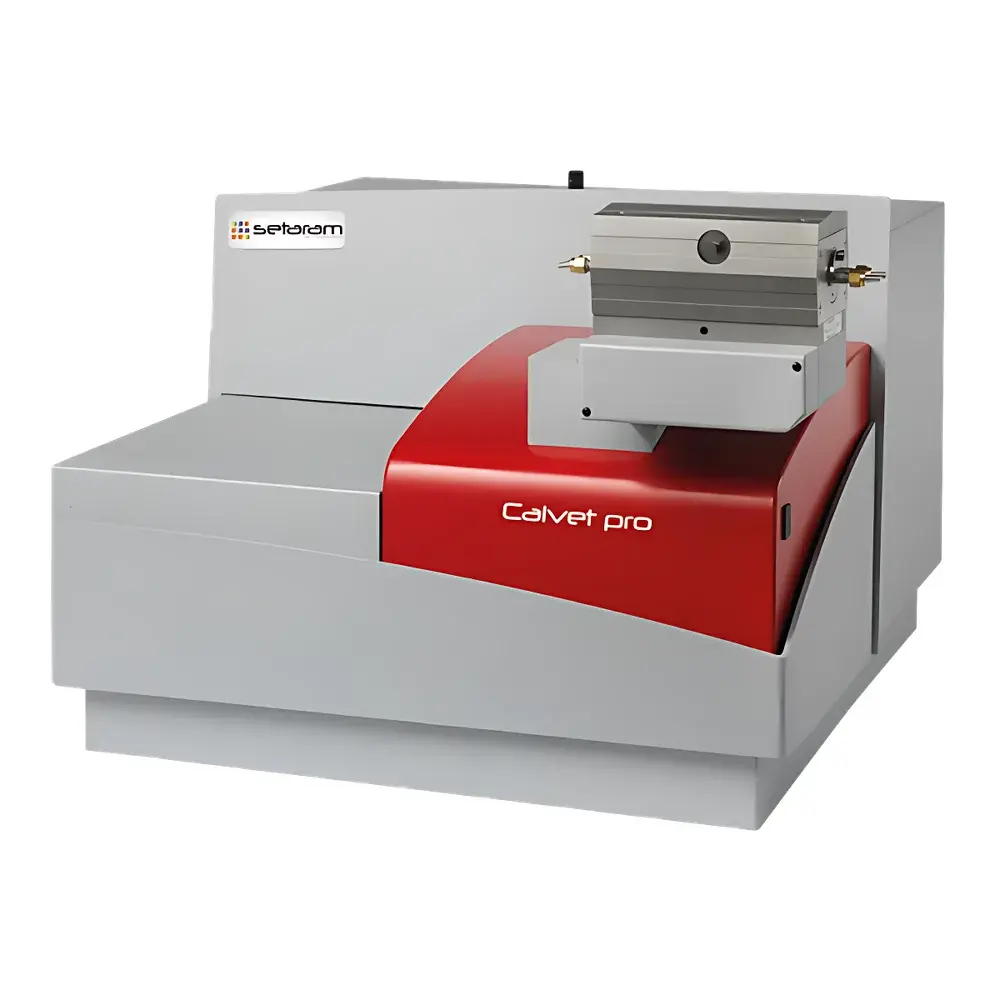
SETARAM Calvet Pro High-Performance Scanning Calorimeter
| Brand | SETARAM |
|---|---|
| Origin | France |
| Model | Calvet Pro |
| Instrument Type | Reaction Calorimeter |
| Measurement Principle | 3D Calvet-type Heat-Flow Calorimetry |
| Sample Mass Range | mg-scale |
| Temperature Range | –120 °C to 830 °C |
| Pressure Capability | Up to 500 bar (with optional high-pressure module) |
| Vacuum Compatibility | Yes |
| Cp Accuracy | High-precision absolute heat capacity measurement |
| Operating Modes | Isothermal, Dynamic Scanning, and Stepwise Temperature Programs |
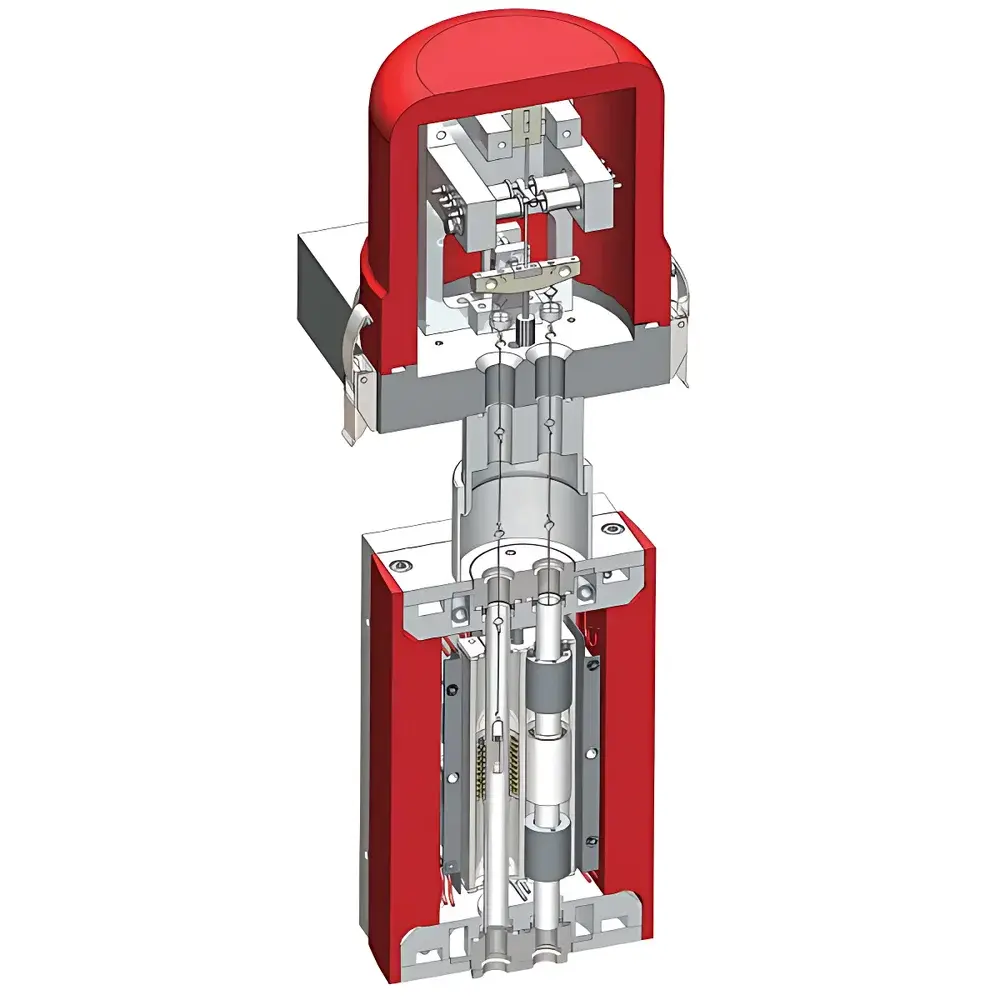
| Sensor Architecture | Symmetric 3D thermopile array surrounding the sample and reference positions |
| Calibration Method | Joule-effect electrical calibration |
| Sample Environment Control | Integrated pressure regulation, monitoring, and control |
Overview
The SETARAM Calvet Pro is a high-precision scanning calorimeter engineered for quantitative thermal analysis of small-mass samples (typically 1–100 mg) across an exceptionally broad temperature range—from –120 °C to 830 °C. Unlike conventional differential scanning calorimeters (DSC), the Calvet Pro employs true 3D Calvet-type heat-flow detection: a symmetric, fully surrounding thermopile sensor array captures radial, axial, and tangential heat fluxes with near-zero thermal loss. This architecture enables absolute, non-differential calorimetric measurements—delivering intrinsically higher accuracy in enthalpy, heat capacity (Cp), and reaction kinetics quantification. The instrument is fundamentally designed for reaction calorimetry applications, supporting both open and sealed environments, including high-pressure (up to 500 bar) and high-vacuum operation. Its modular furnace and interchangeable sample holders accommodate diverse experimental configurations—from standard crucibles to custom-packed bed reactors—making it suitable for rigorous process safety evaluation, catalytic screening, hydrogen storage material characterization, and advanced adsorbent development.
Key Features
- 3D Calvet sensor architecture: Full spherical thermopile coverage ensures >99.5% heat capture efficiency and eliminates baseline drift associated with asymmetric heat leakage.
- Wide operational temperature range: –120 °C to 830 °C, enabled by dual-zone furnace design and cryogenic cooling integration (liquid nitrogen or mechanical cryocooler options).
- High-fidelity Cp determination: Absolute heat capacity measured via Joule-effect calibration traceable to SI units; uncertainty < ±1.5% over full range.
- Modular pressure & atmosphere control: Optional high-pressure kit includes pressure transducers, mass flow controllers, and automated valve sequencing compliant with PED 2014/68/EU.
- Symmetric suspension microbalance: Integrated high-resolution balance (±0.1 µg readability) maintains positional stability during thermal scans and pressure transients.
- Multi-mode operation: Supports isothermal hold, linear heating/cooling ramps, step-isothermal sequences, and user-defined dynamic profiles—all with synchronized pressure, gas flow, and temperature logging.
Sample Compatibility & Compliance
The Calvet Pro accommodates a wide spectrum of sample formats—including powders, pellets, thin films, gels, and heterogeneous catalysts—within chemically inert crucibles (Al2O3, Pt, Ta, graphite) and reactor cells (stainless steel, Inconel, Hastelloy). High-pressure configurations meet ISO 17025-accredited testing requirements for process safety studies (e.g., adiabatic runaway screening per ASTM E2042, RC1/RC2 correlation). All pressure-rated components conform to ASME BPVC Section VIII Div. 2 and are CE-marked under the Pressure Equipment Directive. Data acquisition complies with GLP and GMP principles; audit trails, electronic signatures, and 21 CFR Part 11–ready software modules are available upon configuration.
Software & Data Management
SETARAM’s Cahn™ software provides full instrument control, real-time visualization, and post-processing workflows aligned with ASTM E1269, ISO 11357-4, and USP <1163>. It supports multi-parameter synchronization (T, P, dH/dt, m, Δm), automatic peak deconvolution, kinetic modeling (e.g., Ozawa-Flynn-Wall, Friedman), and Cp curve fitting using polynomial or spline interpolation. Raw data are stored in vendor-neutral HDF5 format with embedded metadata (instrument ID, calibration history, operator, timestamp, environmental logs). Export options include CSV, Excel, and ASCII for third-party analysis (Origin, MATLAB, Thermo-Calc). Software validation packages (IQ/OQ/PQ documentation) and cybersecurity-compliant deployment (TLS 1.2+, role-based access control) are available for regulated laboratories.
Applications
- Thermodynamic characterization of hydrogen storage materials (e.g., metal hydrides, MOFs) under controlled H2 pressure and cycling conditions.
- Reaction enthalpy and heat release rate quantification for energetic materials (propellants, explosives) per UN Test Series 3 and DOT-E 49 CFR §173.50.
- Catalyst deactivation profiling via in situ thermal oxidation/reduction coupled with mass spectrometry (TPO/TPR-MS interfacing supported).
- Adsorption/desorption isotherms and isosteric heat of adsorption (Qst) for CO2 capture sorbents under variable pCO2.
- Heat capacity mapping of battery electrode materials (NMC, LFP, Si-anodes) across charge/discharge-relevant thermal windows.
- Process safety assessment: thermal stability screening (TSU, TD24), decomposition onset identification, and adiabatic temperature rise prediction (ΔTad) for chemical manufacturing scale-up.
FAQ
What distinguishes Calvet calorimetry from DSC?
Calvet calorimetry uses a 3D thermopile sensor that surrounds the sample, enabling absolute heat flow measurement with minimal thermal lag and no reference-subtraction artifacts—unlike DSC, which relies on differential temperature sensing between sample and reference pans.
Can the Calvet Pro perform simultaneous TGA-like mass tracking?
Yes—the integrated high-stability microbalance continuously records sample mass (±0.1 µg) synchronized with thermal and pressure signals, enabling concurrent calorimetric and gravimetric analysis without external coupling.
Is high-pressure calibration traceable to national standards?
All pressure transducers are factory-calibrated against NIST-traceable deadweight testers; in-house recalibration certificates include uncertainty budgets per ISO/IEC 17025.
How is data integrity ensured in regulated environments?
Cahn™ software offers configurable audit trails, electronic signatures, user access levels, and data encryption at rest and in transit—fully supporting FDA 21 CFR Part 11 and EU Annex 11 compliance when validated.
What sample containment options exist for corrosive or reactive atmospheres?
Inconel 625 and Hastelloy C-276 reactor cells, sapphire viewports, and gold-plated sealing surfaces are available for halogen-rich, sulfidizing, or reducing gas environments up to 500 bar and 830 °C.



