
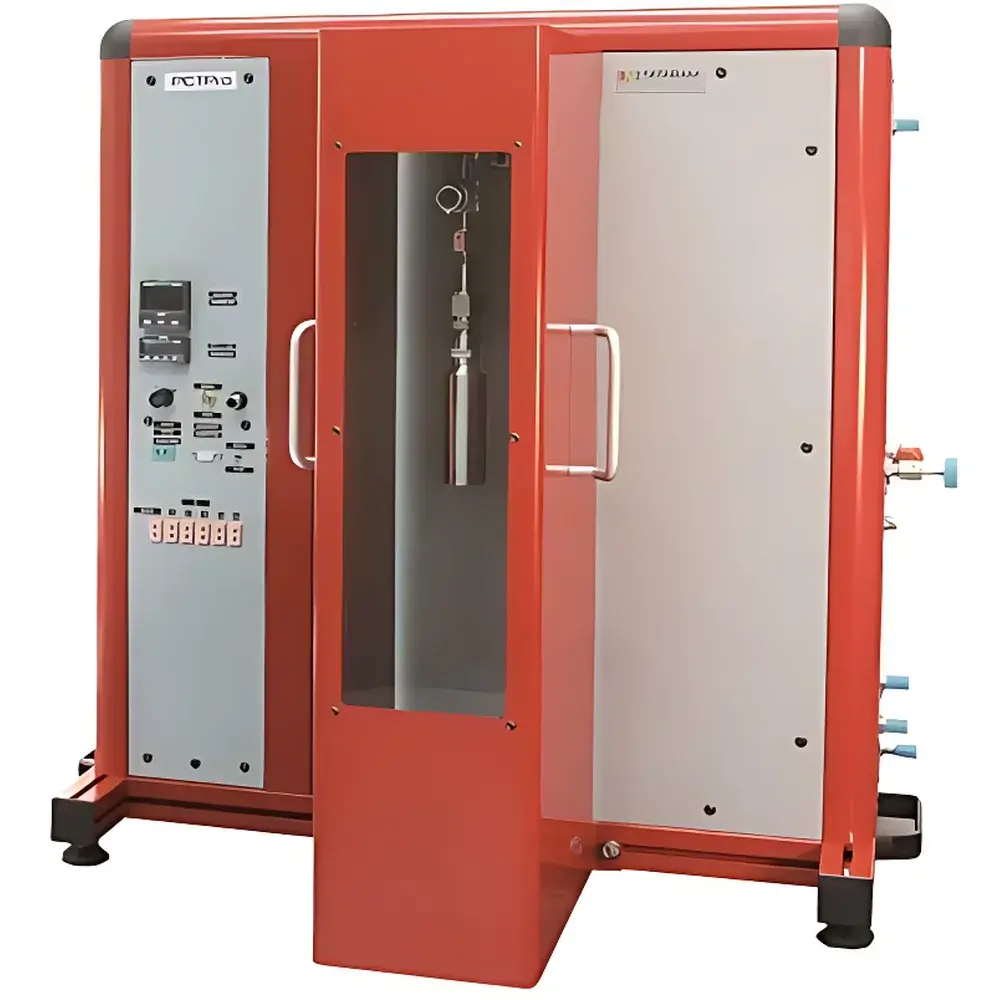
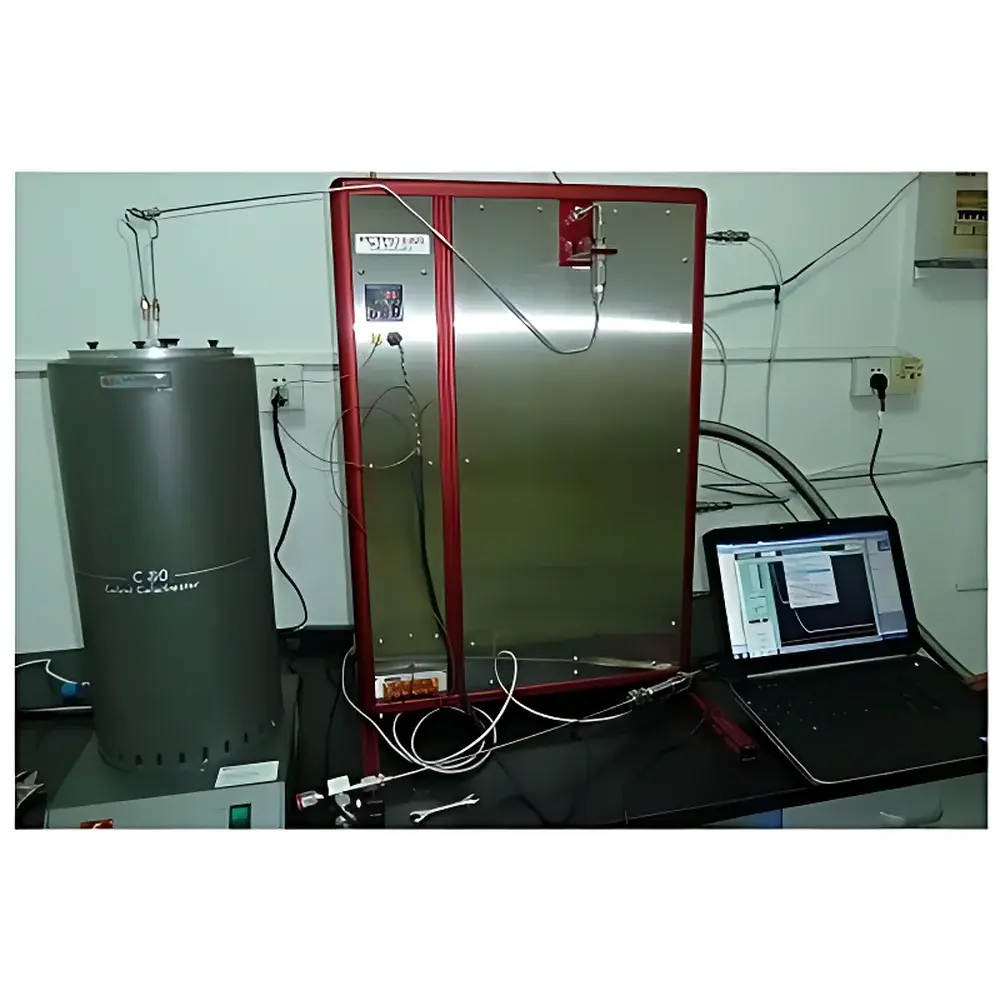
Setaram PCTPro-Evo Chemisorption Analyzer
| Brand | Setaram |
|---|---|
| Origin | USA |
| Model | PCTPro-Evo |
| Temperature Range | –269 °C to 500 °C |
| Pressure Range | Vacuum to 200 bar |
| Pressure Accuracy | ±1% |
| Detection Limit | 3 µg (equivalent to 0.3 wt% gas uptake on 1 mg sample) |
| Gas Compatibility | H₂ only |
| Sensor Configuration | Four auto-switching pressure transducers with dual-range capability |
| Sample Cell Options | Six interchangeable cells (standard, high-temperature, liquid, thin-film, cryogenic, micro-dosing) |
| Safety Systems | Integrated combustible gas detection, multi-point temperature/pressure monitoring, inert-gas purged transfer pathway |
| Software Platform | LabVIEW-based real-time control and analysis suite |
Overview
The Setaram PCTPro-Evo is a fully automated Sieverts-type high-pressure gas sorption analyzer engineered for quantitative thermodynamic and kinetic characterization of solid–gas interactions under rigorously controlled temperature and pressure conditions. Based on the classical volumetric Sieverts principle—measuring pressure differentials in calibrated reference and sample volumes before and after gas dosing—the instrument delivers high reproducibility in equilibrium pressure–composition–temperature (PCT) isotherms, absorption/desorption kinetics, and multi-cycle stability profiling. Its design heritage traces directly to Hy-Energy, Inc., a U.S. enterprise founded by Dr. Karl Cross of Sandia National Laboratories, with over three decades of dedicated R&D in hydrogen storage materials. Acquired by Setaram in 2017, the PCTPro platform has been refined into the PCTPro-Evo to meet evolving demands in advanced energy materials research—including metal hydrides, complex hydrides, porous carbons, MOFs, and catalytic supports—under stringent safety and metrological requirements.
Key Features
- Ultra-broad operational envelope: continuous temperature control from 4 K (–269 °C) to 773 K (500 °C), enabling cryogenic H₂ physisorption and high-temperature metal hydride decomposition studies;
- Full-pressure-range autonomy: seamless operation from high vacuum (≤10–3 mbar) up to 200 bar, supported by PID-regulated gas dosing that maintains constant pressure (P), constant pressure increment (ΔP), or user-defined ΔP functions;
- Multi-transducer pressure architecture: four integrated piezoresistive sensors covering overlapping ranges (e.g., 0–1 bar, 0–10 bar, 0–100 bar, 0–200 bar), automatically selected based on current system pressure to maximize signal-to-noise ratio and minimize drift;
- Sub-microgram mass resolution: detection limit of 3 µg absolute gas uptake, validated per ISO 15901-2 for microporous material characterization and trace-level hydride formation quantification;
- Modular sample cell ecosystem: six mechanically and thermally isolated cell variants—standard stainless-steel, high-temperature Inconel®, liquid-immersion, thin-film quartz, cryostat-integrated, and micro-dosing—each certified for leak integrity to ASTM E499 and calibrated per NIST-traceable protocols;
- Integrated safety-by-design: real-time H₂ concentration monitoring via catalytic bead sensor (0–100% LEL), redundant pressure relief valves, interlocked glovebox-compatible transfer ports, and inert-gas-purged sample loading chamber compliant with NFPA 55 and OSHA 1910.103;
- External coupling interface: standardized flange ports (CF-35/CF-63) permit in situ synchrotron XRD, FTIR, Raman, or residual gas analysis (RGA) during active sorption cycles without breaking vacuum or thermal equilibrium.
Sample Compatibility & Compliance
The PCTPro-Evo accommodates sample masses ranging from 1 mg to 2 kg, supporting powder, pellet, foil, monolithic, and slurry-phase specimens. It is routinely deployed in laboratories adhering to GLP and GMP frameworks for catalyst qualification (per ASTM D3907), pharmaceutical excipient screening (USP <1217>), and battery anode validation (IEC 62660-2). All pressure calibration routines follow ISO 9001:2015-certified procedures, and raw data files include embedded metadata for full auditability—supporting 21 CFR Part 11-compliant electronic signatures when paired with validated LabVIEW runtime environments. The system conforms to IEC 61000-6-3 (EMC) and IEC 61010-1 (safety) standards for laboratory instrumentation.
Software & Data Management
Control and analysis are executed through a native LabVIEW-based application featuring modular, scriptable test sequences. Thirteen pre-validated workflows cover sample degassing (ramp-hold-vacuum), isothermal PCT acquisition, stepwise kinetic profiling, cyclic aging protocols, and multi-step pressure ramping with automatic sensor switching. Real-time data visualization includes live P–t, n–t, and ΔH–P plots with baseline correction, polynomial fitting, and van’t Hoff linearization. Export formats include CSV, HDF5, and XML, with optional integration into LIMS via OPC UA. All measurement logs contain timestamps, operator IDs, environmental parameters (ambient T/P), and hardware status flags—enabling full traceability across instrument lifetime.
Applications
- Quantitative determination of enthalpy and entropy of hydride formation (ΔHf, ΔSf) from van’t Hoff analysis of multiple isotherms;
- Assessment of reversible H₂ capacity, plateau pressure hysteresis, and disproportionation behavior in AB5, AB2, and A2B-type metal hydrides;
- Long-term cyclability testing of Mg-based composites under repeated absorption/desorption at 100–150 °C and 30–50 bar;
- Kinetic modeling of surface diffusion and bulk phase transformation using Johnson–Mehl–Avrami (JMA) formalism;
- CO₂ capture screening of amine-grafted mesoporous silicas under simulated flue-gas conditions (10–15% CO₂, 40–80 °C);
- Pharmaceutical solid-form stability assessment via water vapor sorption isotherms (0–90% RH, 5–40 °C).
FAQ
What gases can be analyzed on the PCTPro-Evo?
Hydrogen (H₂) is the primary and fully validated analyte. While the hardware architecture permits inert gas (e.g., Ar, He) use for dead-volume calibration, reactive or corrosive gases (e.g., NH₃, SO₂, Cl₂) are not supported due to material compatibility constraints and absence of validation data.
Is the system compatible with ultra-high vacuum (UHV) conditions?
The base vacuum capability is ≤1×10⁻³ mbar using a turbomolecular pump; UHV (<1×10⁻⁷ mbar) requires external pumping infrastructure and is not part of standard configuration or factory calibration.
Can the PCTPro-Evo perform simultaneous TGA–PCT measurements?
No—thermal gravimetric analysis is not integrated. However, mass change during sorption can be inferred indirectly via precise pressure–volume–temperature (PVT) modeling using the known compressibility factor (Z) of H₂ at each state point.
Does the software support automated reporting per ISO standards?
Yes—customizable report templates align with ISO 15901-2 (physisorption), ISO 20595 (metal hydrides), and ASTM D7215 (kinetic analysis), including uncertainty propagation per GUM (JCGM 100:2008).
What maintenance intervals are recommended?
Pressure sensor recalibration every 12 months; O-ring replacement and leak-checking every 6 months; full system verification (including volume calibration and thermal uniformity mapping) annually or after major component service.



