
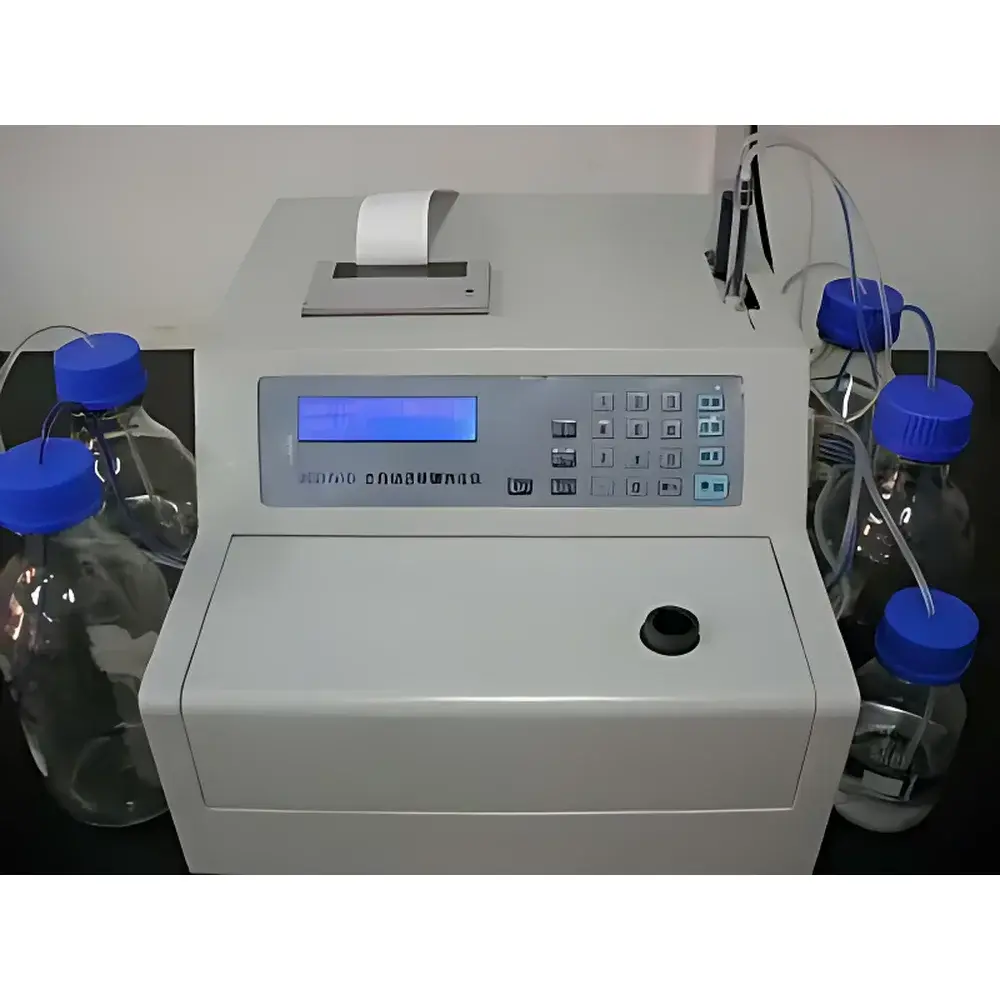
SGD-IV-D Automated Low-Concentration Reducing Sugar Analyzer
| Origin | Shandong, China |
|---|---|
| Manufacturer Type | Authorized Distributor |
| Origin Category | Domestic (PRC) |
| Model | SGD-IV-D |
| Pricing | Available Upon Request |
| Power Supply | 220 V, 50 Hz |
| Dimensions (L×W×H) | 421 × 342 × 230 mm |
| Weight | 12 kg |
| Display | LCD Panel |
| Sensitivity | 0.01 g/L reducing sugar |
| Linear Range | 0.01–1.00 g/L reducing sugar |
| Analysis Time | ≤3 minutes |
Overview
The SGD-IV-D Automated Low-Concentration Reducing Sugar Analyzer is a dedicated photometric titration instrument engineered for precise, rapid quantification of reducing sugars in complex, low-concentration matrices—particularly where sample coloration, turbidity, or matrix interference compromises conventional methods. It operates on the Fehling’s reagent principle—a standardized redox titration method codified in ISO 5765, GB/T 5009.7 (China National Standard), and aligned with AOAC Official Method 982.14 for reducing sugar determination. Unlike classical manual titrations or spectrophotometric assays requiring extensive derivatization or dilution, the SGD-IV-D implements patented complementary-color photometric thermal titration (CCPTT), wherein reaction exothermicity and stoichiometric color depletion are simultaneously monitored via dual-wavelength photodetection. This enables real-time endpoint discrimination with minimal reagent consumption and no subjective visual interpretation. The system is fully automated: microprocessor-controlled reagent dispensing, air bubble purging of both Fehling A/B reagent pumps and titrant delivery lines, thermally stabilized reaction cell, and integrated thermal compensation ensure high reproducibility (<2% RSD across 0.05–0.8 g/L range) under variable ambient conditions.
Key Features
- Fully automated CCPTT (Complementary-Color Photometric Thermal Titration) with embedded endpoint algorithm—eliminates operator-dependent endpoint judgment
- Integrated auto-degassing for Fehling A and B reagent pumps and titrant delivery system—reduces baseline drift and improves long-term calibration stability
- LCD interface with intuitive menu navigation and on-device result display—including concentration (g/L), %RSD, timestamp, and calibration status
- Optimized optical path design featuring dual-wavelength LED photometry (610 nm/470 nm) to compensate for inherent sample absorbance and chromophore interference
- Reaction cell with Peltier-assisted thermal stabilization (±0.2 °C) ensuring consistent reaction kinetics across ambient temperatures from 15–30 °C
- Compact benchtop architecture (421 × 342 × 230 mm; 12 kg) compliant with ISO/IEC 17025 laboratory spatial requirements
Sample Compatibility & Compliance
The SGD-IV-D is validated for direct analysis of undiluted or minimally pre-treated samples containing interfering pigments (e.g., soy sauce, fruit extracts, herbal decoctions, fermentation broths) without prior decolorization or filtration. Its linear dynamic range (0.01–1.00 g/L reducing sugar as glucose equivalent) meets the sensitivity requirements for early-stage microbial and mammalian cell culture monitoring per ICH Q5D and USP . Instrument performance complies with GLP data integrity expectations: all measurements include embedded audit trail metadata (operator ID, date/time stamp, method version, raw photometric curves). While not FDA 21 CFR Part 11–certified out-of-the-box, the device supports export of CSV-formatted reports traceable to NIST-traceable glucose standards (SRM 84d), facilitating integration into validated QC workflows under ISO 9001 and GMP Annex 11 environments.
Software & Data Management
Data output is generated in plain-text CSV format via RS-232 serial interface (USB-to-serial adapter optional), enabling seamless ingestion into LIMS platforms (e.g., LabWare, Thermo SampleManager) or statistical process control tools (JMP, Minitab). No proprietary software installation is required. Each assay record includes: raw photometric signal vs. time, derivative curve, calculated endpoint volume, temperature-corrected concentration, and pass/fail flag against user-defined acceptance criteria. Calibration verification is performed using three-point glucose standard series (0.02, 0.20, 0.80 g/L); calibration curves are stored with expiration dates and technician signatures (via alphanumeric login).
Applications
- Real-time monitoring of reducing sugar depletion in aerobic/anaerobic bioreactors (E. coli, S. cerevisiae, CHO cultures)
- In-process control of enzymatic hydrolysis in starch-based bioethanol production
- Quality release testing of traditional Chinese medicine extracts and decoctions per Pharmacopoeia of the People’s Republic of China (ChP) Vol. IV
- Raw material verification of potato tubers, sweet potato flour, and cassava derivatives
- Batch consistency assessment in soy sauce, malt vinegar, and fruit juice concentrate manufacturing
- Stability-indicating assay for reducing sugar content in lyophilized biopharmaceutical intermediates
FAQ
What detection principle does the SGD-IV-D employ, and how does it differ from standard DNS or Somogyi-Nelson assays?
It uses complementary-color photometric thermal titration (CCPTT) based on Fehling’s chemistry—measuring both color loss and heat evolution simultaneously. Unlike colorimetric endpoints (DNS) or copper reduction stoichiometry alone (Somogyi-Nelson), CCPTT delivers superior specificity in colored matrices and eliminates need for post-reaction cooling or arsenomolybdate development.
Is the instrument suitable for regulatory submissions under FDA or EMA guidelines?
While the hardware meets ISO/IEC 17025 metrological requirements and supports ALCOA+ data integrity principles, formal 21 CFR Part 11 compliance requires site-specific validation documentation and procedural controls—not inherent to the base unit.
Can the SGD-IV-D quantify sucrose or other non-reducing sugars?
No—it measures only reducing sugars (glucose, fructose, maltose, lactose). For sucrose, acid hydrolysis must be performed off-line prior to analysis.
What maintenance is required to sustain accuracy over extended operation?
Monthly verification with NIST-traceable glucose standards and quarterly cleaning of the reaction cell and optical windows using deionized water and lint-free wipes. Reagent pump tubing should be replaced every 6 months under continuous use.
Does the system support multi-user access control or electronic signatures?
No—the device lacks built-in user authentication. Access control and signature enforcement must be implemented at the LIMS or SOP level during data import and review.



