
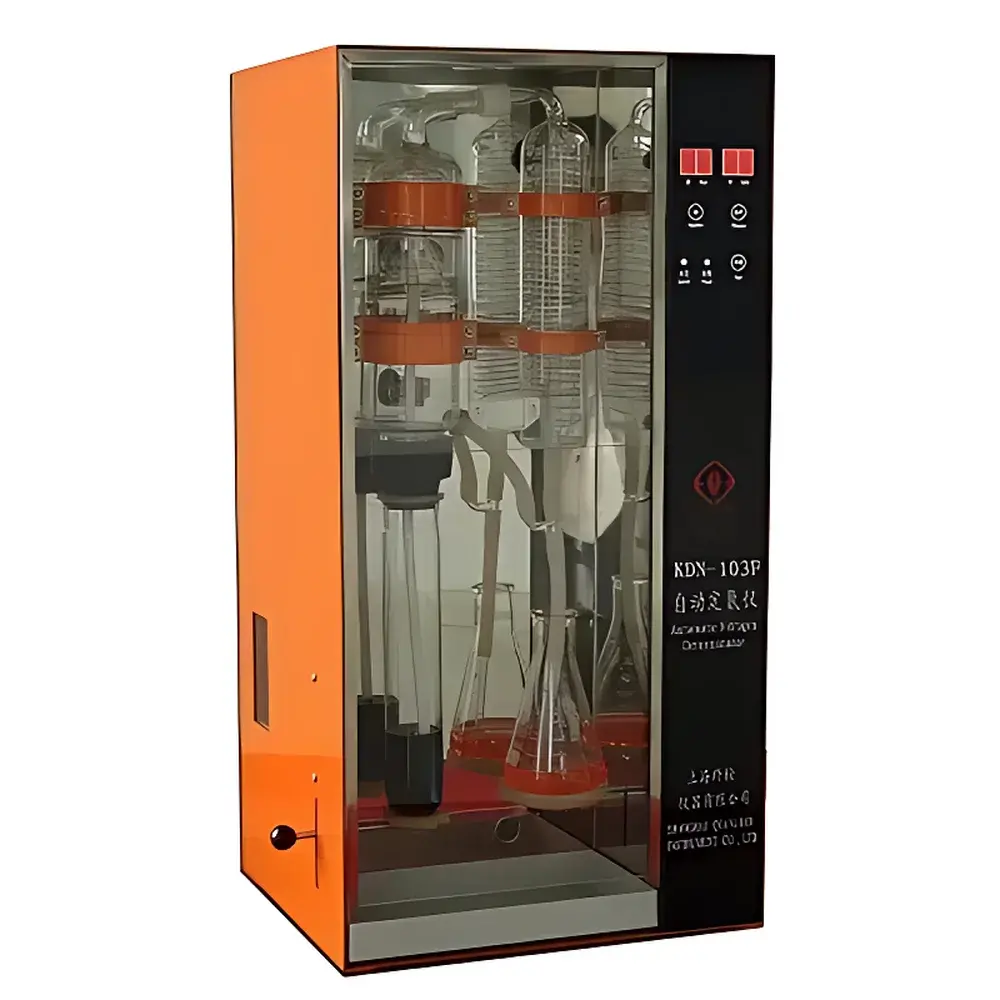
Truelab KDN-2008 Fully Automated Kjeldahl Nitrogen Determinator
| Brand | Truelab |
|---|---|
| Origin | Shanghai, China |
| Model | KDN-2008 |
| Automation Level | Fully Automated |
| Nitrogen Determination Range | 0.1–200 mg N |
| Sample Capacity | 8 samples per run |
| Steam Distillation Rate | 25 mL/min |
| Relative Standard Deviation (RSD) | ≤1% |
| Nitrogen Recovery Rate | ≥99.5% |
| Power Consumption | 1200 W |
| Dimensions (L×W×H) | 310 × 300 × 690 mm |
| Net Weight | 28 kg |
| Compliance | ASTM D1142, ISO 8968-1, AOAC 981.10, GB/T 6423–2022 |
Overview
The Truelab KDN-2008 Fully Automated Kjeldahl Nitrogen Determinator is an engineered solution for precise, reproducible total nitrogen quantification in organic matrices—primarily applied to protein content determination in food, feed, agricultural, and environmental laboratories. Based on the classical Kjeldahl method (ISO 8968-1, AOAC 981.10, ASTM D1142), the instrument integrates digestion-derived sample preparation with fully automated steam distillation, reagent delivery, condensate collection, and post-run system cleaning. Unlike semi-automated or manual systems, the KDN-2008 executes all critical distillation-phase operations—including alkali addition, boric acid dosing, steam generation, condensate transfer, and internal line rinsing—without operator intervention after sample loading. Its modular architecture separates high-temperature digestion (performed off-instrument) from low-risk, high-reproducibility distillation, ensuring compliance with GLP and routine QC workflows where traceability, audit readiness, and operator safety are prioritized.
Key Features
- Fully automated distillation cycle: integrated control of NaOH injection, boric acid delivery, steam generation, condensate collection, and automatic post-run tube flushing—eliminating manual reagent handling and reducing procedural variability.
- Five independent micro-peristaltic pumps: enable precise, isolated metering of alkali, boric acid, distilled water, and cleaning solutions—minimizing cross-contamination and supporting multi-step protocol flexibility.
- Interlocked transparent safety door: halts distillation immediately upon opening; resumes automatically upon closure—ensuring operator protection during visual monitoring without workflow interruption.
- Real-time process monitoring: large backlit LCD display shows step-by-step progress, elapsed time, reagent volume dispensed, and active status flags (e.g., “Alkali Adding”, “Steam Active”, “Rinse in Progress”).
- Intelligent safety protocols: automatic shutdown triggered by low coolant level, steam pressure anomaly, or liquid leakage; audible and visual alarms accompany each event with fault-code identification.
- Dedicated corrosion-resistant fluid path: borosilicate glass condenser, mirror-finish 316 stainless steel reaction chamber, and one-piece molded acid/alkali-resistant polymer splash guard—designed for long-term exposure to concentrated H2SO4, 40% NaOH, and saturated boric acid.
Sample Compatibility & Compliance
The KDN-2008 accommodates solid samples (0.3–8 g) and liquid samples (5–30 mL) following standardized digestion per ISO 8968-1 or AOAC 981.10. It supports nitrogen quantification across a validated linear range of 0.1–200 mg N per sample, delivering RSD ≤1% (n=6) and recovery ≥99.5% using certified reference materials (e.g., BCR-185R skim milk powder). The system meets requirements for routine testing under ISO/IEC 17025-accredited laboratories and aligns with FDA 21 CFR Part 11 data integrity principles through timestamped, non-erasable operation logs stored internally. All wetted components comply with USP material classification for pharmaceutical-grade reagent contact surfaces.
Software & Data Management
While the KDN-2008 operates via embedded firmware (no external PC dependency), it stores up to 10 user-defined method programs—including alkali volume, boric acid concentration, steam duration, and rinse sequence—with full parameter recall and edit capability. Each analysis generates a tamper-evident digital record containing sample ID, start/stop timestamps, reagent volumes dispensed, distillation duration, and final status flag (e.g., “Completed”, “Aborted – Low Water”). Logs are exportable via USB interface in CSV format for integration into LIMS or QA documentation systems. Audit trails include operator ID (if enabled via optional keypad login), method version, and any manual override events—supporting GMP/GLP traceability requirements.
Applications
This instrument is routinely deployed in quality control laboratories for protein content verification in dairy products (cheese, whey, infant formula), cereals and flours, meat and fish meal, fertilizers, soil extracts, and wastewater sludge. Its robustness and repeatability make it suitable for regulatory submissions under EU Regulation (EC) No 152/2009 (feed analysis), USDA-FNS commodity testing, and China’s GB/T 6423–2022 standard for feed nitrogen determination. In research settings, it serves as a reference method for validating rapid alternatives (e.g., Dumas combustion analyzers) due to its metrological traceability to primary nitrogen standards.
FAQ
Does the KDN-2008 include digestion functionality?
No. Digestion must be performed separately using a dedicated block digester or microwave system prior to loading digested samples into the KDN-2008 for distillation.
Can the instrument perform titration?
No. The KDN-2008 completes only the distillation and condensate collection phase; endpoint titration (e.g., with HCl and mixed indicator) is conducted manually or via external autotitrator.
Is method validation documentation available?
Yes. Truelab provides a Factory Performance Qualification (PQ) report including precision, accuracy, linearity, and recovery data against NIST-traceable CRM materials.
What maintenance intervals are recommended?
Daily: visual inspection of seals and tubing; weekly: pump tubing replacement and condenser descaling with 5% citric acid; annually: steam generator pressure calibration and safety valve verification.
Can the system be integrated into a laboratory network?
Not natively—data export is USB-based only. For networked environments, third-party middleware or custom scripting may be used to ingest CSV logs into centralized databases.




