
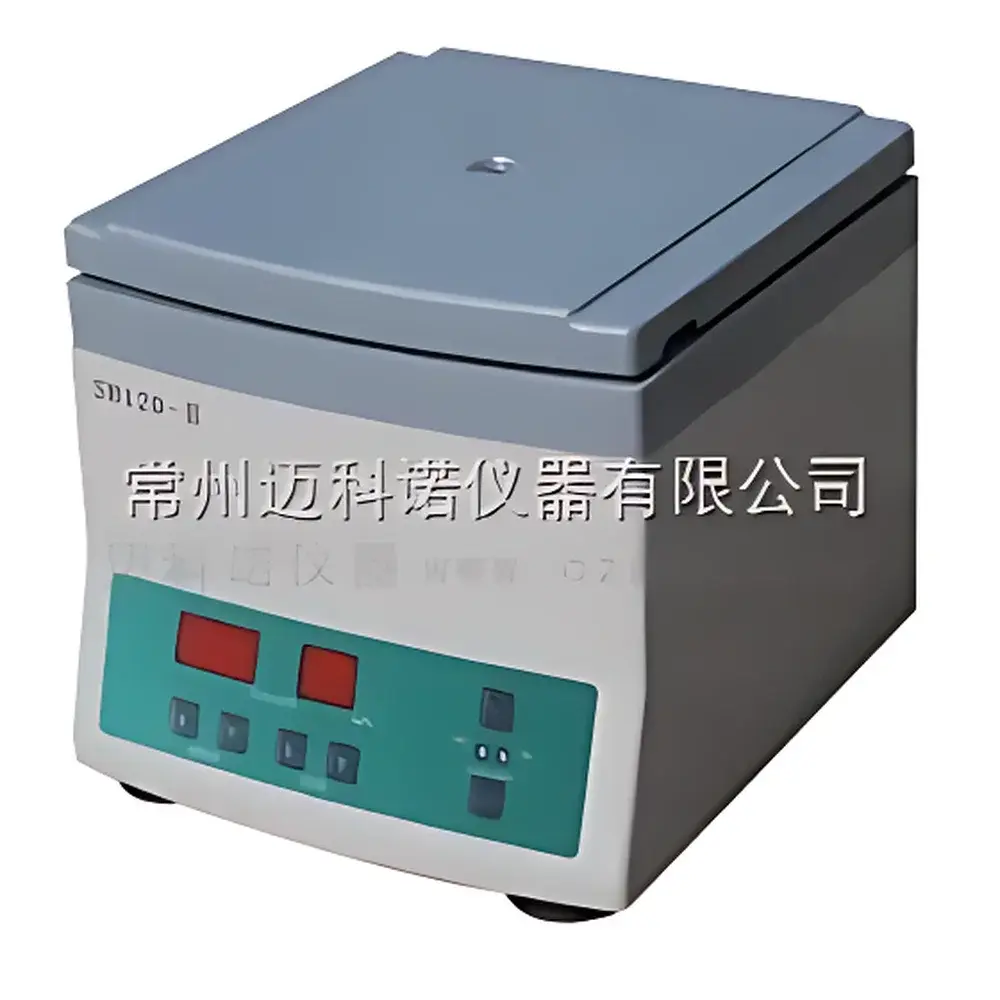
SH120-2 Microhematocrit Centrifuge
| Origin | Zhejiang, China |
|---|---|
| Manufacturer Type | Authorized Distributor |
| Origin Category | Domestic (PRC) |
| Model | SH120-2 |
| Price Range | USD 1–720 |
| Centrifugation Class | Clinical Microcentrifuge |
| Max Capacity | 24 × capillary tubes (Φ1.5 mm × 75 mm) |
| Max Speed | 12,000 rpm |
| RCF | 13,500 × g |
| Power Input | 230 VA |
| Power Output | 100 W |
| Acceleration Time | <60 s |
| Deceleration Time | <120 s |
| Timer Range | 0–99 min |
| Dimensions | 280 × 310 × 265 mm (L×W×H) |
| Net Weight | 10 kg |
| Voltage/Frequency | 110 V / 60 Hz & 220 V / 60 Hz |
| Drive System | Brushless DC Motor |
| Control Interface | Intelligent Touch Panel |
| Speed Regulation | Continuous Variable (0–12,000 rpm) |
Overview
The SH120-2 Microhematocrit Centrifuge is a compact, high-precision clinical centrifuge engineered for rapid and reproducible separation of whole blood in capillary format—primarily supporting hematocrit (HCT), plasma volume, and microvolume serum/plasma isolation protocols. It operates on the principle of sedimentation under controlled relative centrifugal force (RCF), where rotational motion generates radial acceleration that drives cellular components—erythrocytes, leukocytes, and platelets—toward the tube bottom at rates proportional to their density, size, and shape. Designed specifically for point-of-care laboratories, small clinical settings, and field-deployable diagnostics, the SH120-2 delivers consistent 13,500 × g performance within a footprint under 0.025 m³. Its brushless DC motor ensures low thermal drift, minimal vibration, and extended service life—critical for maintaining integrity of temperature-sensitive analytes during short-duration spins (<2 min total cycle time). Unlike general-purpose benchtop centrifuges, the SH120-2 features an optimized rotor geometry accommodating standardized 75 mm capillary tubes (1.5 mm internal diameter), aligning with CLSI EP5-A3 and ISO 15189 preanalytical requirements for microhematocrit determination.
Key Features
- Intelligent touch-panel interface with real-time rpm/RCF display and programmable timer (0–99 minutes in 1-second increments)
- Brushless DC motor delivering silent, maintenance-free operation and precise speed regulation from 0 to 12,000 rpm (continuous variable control)
- Dedicated fixed-angle rotor designed exclusively for 24 × Φ1.5 mm × 75 mm capillary tubes—ensuring balanced loading and uniform sedimentation profiles
- Fast acceleration (<60 s to full speed) and active braking (<120 s stop time), minimizing turnaround time for STAT hematocrit testing
- Dual-voltage compatibility (110 V / 60 Hz and 220 V / 60 Hz) with universal power input (230 VA), supporting global deployment without transformer dependency
- Compact ergonomic housing (280 × 310 × 265 mm) constructed from reinforced ABS with integrated vibration-damping feet and safety interlock lid switch
- Energy-efficient design (100 W nominal output) compliant with IEC 61010-1:2010 for laboratory electrical safety
Sample Compatibility & Compliance
The SH120-2 accepts only sealed or heparinized glass or plastic capillary tubes conforming to ASTM E2758–19 specifications for microhematocrit collection. It supports fingerstick, earlobe, or heel-prick blood volumes as low as 10–20 µL—enabling pediatric, geriatric, and resource-limited applications where venipuncture is contraindicated. The rotor’s symmetrical 24-position layout enforces mandatory paired loading, eliminating imbalance risk and ensuring ISO 20958-2:2019-compliant run stability. Device firmware incorporates automatic rotor recognition logic and over-speed protection. While not FDA-cleared as an IVD device, its operational parameters satisfy analytical validation prerequisites outlined in CLIA ’88 Subpart M and EU IVDR Annex I General Safety and Performance Requirements (GSPR) for ancillary instrumentation used in quantitative hematologic assays.
Software & Data Management
The SH120-2 operates as a standalone instrument with no embedded data logging or network connectivity. All operational parameters—including speed setpoint, elapsed time, and final RCF—are displayed locally but not stored or exportable. For GLP/GMP environments requiring audit trails, external documentation (e.g., lab notebook entries, printed timer logs) must be maintained per 21 CFR Part 11 §11.10(a) for non-electronic records. Optional third-party USB-connected timers with timestamped CSV output may be integrated externally; however, the centrifuge itself provides no API, Bluetooth, or RS-232 interface. Firmware updates are performed solely via factory service—no user-upgradable software architecture exists.
Applications
- Routine hematocrit measurement in outpatient clinics, mobile health units, and veterinary field stations
- Preparation of microvolume plasma for point-of-care immunoassays (e.g., CRP, troponin I) and electrolyte panels
- Sedimentation rate estimation using modified Westergren-capillary methods
- Isolation of buffy coat layers for malaria parasite detection or flow cytometry screening
- Quality control of capillary tube filling consistency in multicenter clinical trials
- Training platforms for biomedical students mastering microcentrifugation physics and preanalytical error mitigation
FAQ
Does the SH120-2 support rotor calibration or speed verification?
No—speed accuracy is factory-certified per ISO 15195:2021 Annex B, and no user-accessible calibration routine is provided.
Can I use non-standard capillary tubes (e.g., 1.0 mm ID or 100 mm length)?
No—only Φ1.5 mm × 75 mm capillaries are mechanically and dynamically validated for safe operation; deviation risks imbalance, tube fracture, or rotor damage.
Is the device suitable for centrifuging urine or CSF samples?
Not recommended—the rotor geometry and RCF profile are optimized exclusively for whole blood sedimentation; alternative sample types require validation per CLSI GP47-A4.
What safety certifications does the SH120-2 hold?
It complies with IEC 61010-1:2010 (Safety Requirements for Electrical Equipment for Measurement, Control, and Laboratory Use) and bears CE marking under the Low Voltage Directive 2014/35/EU.
Is maintenance required beyond routine cleaning?
Yes—annual inspection of bearing integrity, lid latch mechanism, and motor brushless commutation electronics is advised by the distributor; no consumable parts are field-replaceable.



