
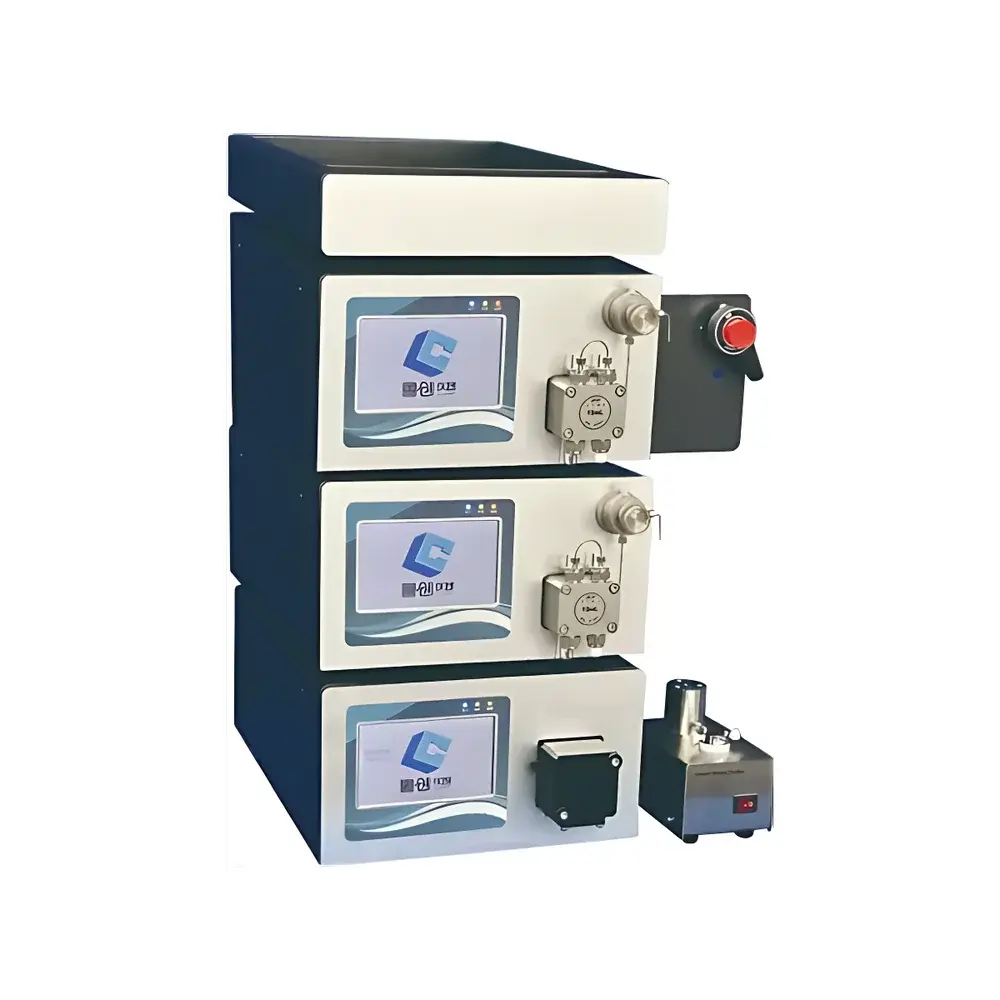
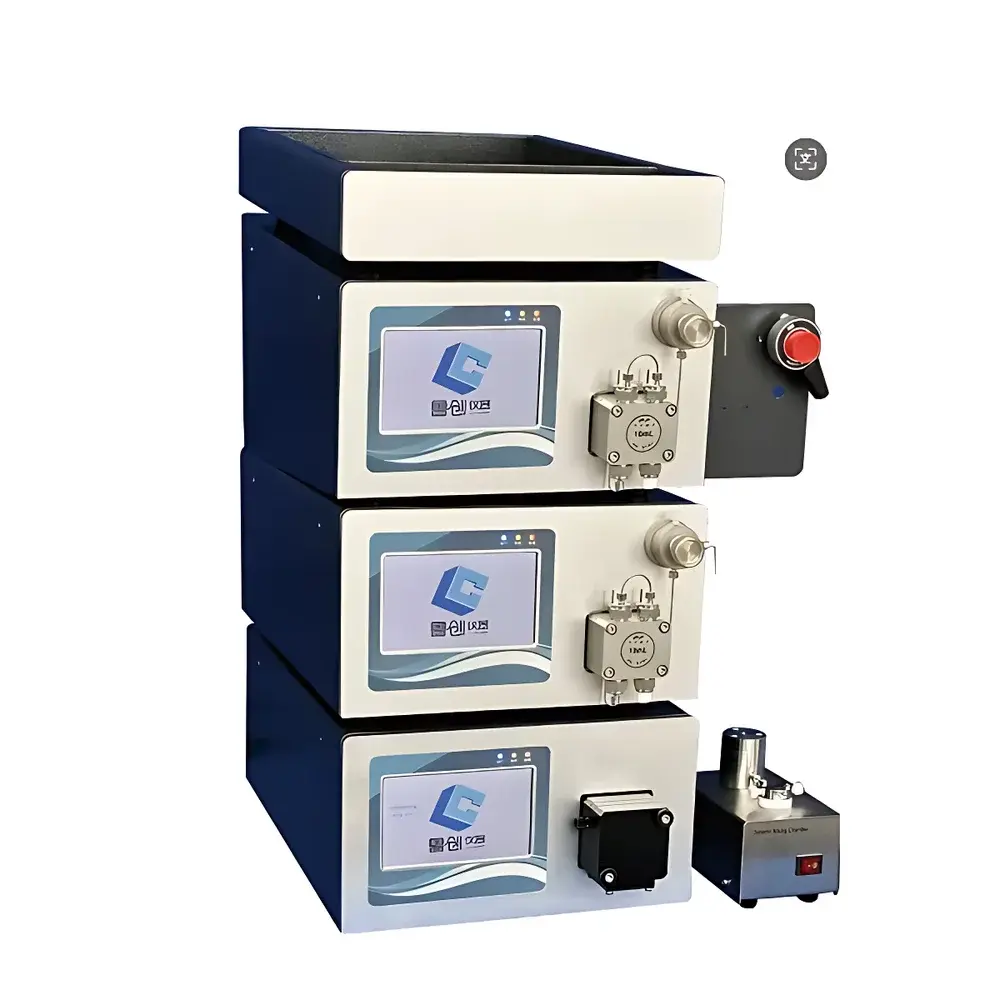
Shandong Luchuang LC-3000 Dual-Pump High-Performance Liquid Chromatograph (HPLC) with Touchscreen Interface
| Brand | Shandong Luchuang |
|---|---|
| Origin | Shandong, China |
| Manufacturer Type | OEM Manufacturer |
| Instrument Type | Conventional HPLC System |
| Model | LC-3000 (Dual-Pump Configuration) |
| Flow Rate Range | 0.001–10.000 mL/min (0.001 mL/min increment) |
| Maximum Pressure | 40 MPa |
| Flow Accuracy | <0.1% RSD |
| Injection Volume Range | 1–50 µL |
| Sample Tray Capacity | 100 positions (1.5 mL vials) or 80 positions (4 mL vials) |
| Column Oven Temperature Range | Ambient +10°C to 60°C |
| UV-Vis Wavelength Range | 190–700 nm |
| Data Acquisition Rate | 100 Hz |
Overview
The Shandong Luchuang LC-3000 is a dual-pump high-performance liquid chromatograph engineered for precision, reliability, and ease of operation in routine analytical laboratories. Based on classical reversed-phase and normal-phase HPLC principles, the system utilizes high-pressure gradient elution to achieve robust separation of small-molecule analytes—including pharmaceutical actives, agrochemical residues, organic intermediates, and environmental contaminants. Its modular architecture integrates two independently controlled P3000 high-pressure reciprocating piston pumps, a UV3000 variable-wavelength absorbance detector, a manual Rheodyne-style injection valve, solvent reservoir tray, thermostatted column compartment, and CXTH-3000 chromatographic data system. Designed for compliance-ready workflows, the LC-3000 supports method development, QC release testing, stability-indicating assays, and impurity profiling under ISO/IEC 17025 and GLP-aligned laboratory practices.
Key Features
- Dual-pump gradient capability with real-time pressure monitoring and programmable gradient profiles—enabling precise binary or quaternary solvent mixing without external low-pressure mixing modules.
- P3000 pump system featuring CPLD-based digital control, stainless steel/PEEK dual-piston heads (10 mL analytical / 50 mL semi-preparative options), and slow-start/pressure-limit protection algorithms to extend seal life and ensure long-term flow stability.
- UV3000 detector with deuterium/tungsten dual-lamp source, ±2 nm wavelength accuracy, and selectable time constants (0.1–10 s) to optimize signal-to-noise ratio across diverse detection requirements.
- Integrated column oven maintaining temperature uniformity within ±0.5°C across the 20–60°C operating range—critical for retention time reproducibility in regulated environments.
- Touchscreen-enabled front panel interface with 320×240 pixel backlit LCD, supporting standalone method setup, real-time chromatogram display, and gradient curve verification without PC dependency.
- RS232 serial communication protocol compliant with legacy lab infrastructure; no proprietary data acquisition cards required—detector analog outputs (±0.1 V / ±1.0 V / ±10 V) connect directly to standard DAQ hardware or third-party software platforms.
Sample Compatibility & Compliance
The LC-3000 accommodates standard 4.6 mm ID analytical columns (e.g., C18, C8, phenyl-hexyl, HILIC) up to 250 mm length and supports both isocratic and linear/non-linear gradient elution. Its 1–50 µL injection range and 100-position 1.5 mL vial tray suit batched sample analysis in pharmaceutical QC, food safety screening, and academic research. The system meets essential performance criteria outlined in USP , EP 2.2.46, and ASTM D7486 for HPLC instrument qualification. Built-in GLP logging records lamp usage hours, total ignitions, and detector calibration events. While not natively 21 CFR Part 11 compliant, the CXTH-3000 workstation supports audit trail configuration, electronic signature integration, and user-access-level controls when deployed on validated Windows OS environments per GMP Annex 11 guidance.
Software & Data Management
CXTH-3000 chromatography workstation provides full method building, sequence definition, peak integration, calibration curve generation (linear, quadratic, weighted), and report export (PDF, CSV, XML). Raw data files are stored in vendor-neutral formats compatible with third-party review tools. The software implements automatic baseline correction, noise filtering, and retention time locking—reducing manual intervention during multi-day stability studies. All instrument parameters—including pump flow, gradient program, detector wavelength, and oven setpoint—are saved with each run, ensuring full traceability. Data integrity safeguards include write-protected raw folders, timestamped audit logs, and password-protected method editing privileges.
Applications
- Pharmaceutical quality control: assay determination of APIs, related substances testing per ICH Q2(R2), dissolution profile analysis.
- Agrochemical residue analysis: multi-residue screening of organophosphates, carbamates, and neonicotinoids in crops and soil extracts.
- Chemical manufacturing: purity assessment of synthesis intermediates, catalyst leaching studies, and polymer additive quantification.
- Academic research: natural product isolation validation, metabolite profiling in plant extracts, and kinetic study of hydrolysis/degradation pathways.
- Food & beverage testing: preservative (sorbic acid, benzoic acid), sweetener (aspartame, sucralose), and mycotoxin (aflatoxin B1) quantification.
FAQ
Is the LC-3000 compatible with modern LIMS or ELN systems?
Yes—the RS232 interface and ASCII-based command protocol enable integration with laboratory information management systems via middleware drivers; custom API wrappers are supported upon request.
Can the system operate in isocratic mode without gradient programming?
Absolutely—the P3000 pumps support fixed-ratio solvent delivery and single-channel isocratic methods with identical flow accuracy and pressure stability.
What maintenance intervals are recommended for the P3000 pump seals and UV3000 lamp?
Pump seals: replace every 6–12 months depending on mobile phase aggressiveness and daily runtime; UV lamp: typical lifetime is 1,000–2,000 hours, with built-in usage tracking in the detector’s GLP log.
Does the column oven support rapid temperature ramping?
The oven achieves ≤10 min equilibration from ambient to 60°C; however, it is optimized for isothermal operation rather than dynamic thermal programming.
Is post-run needle wash functionality included?
No—this is a manually operated system; automated needle wash requires optional upgrade to an autosampler module, which is not part of the base LC-3000 configuration.




