
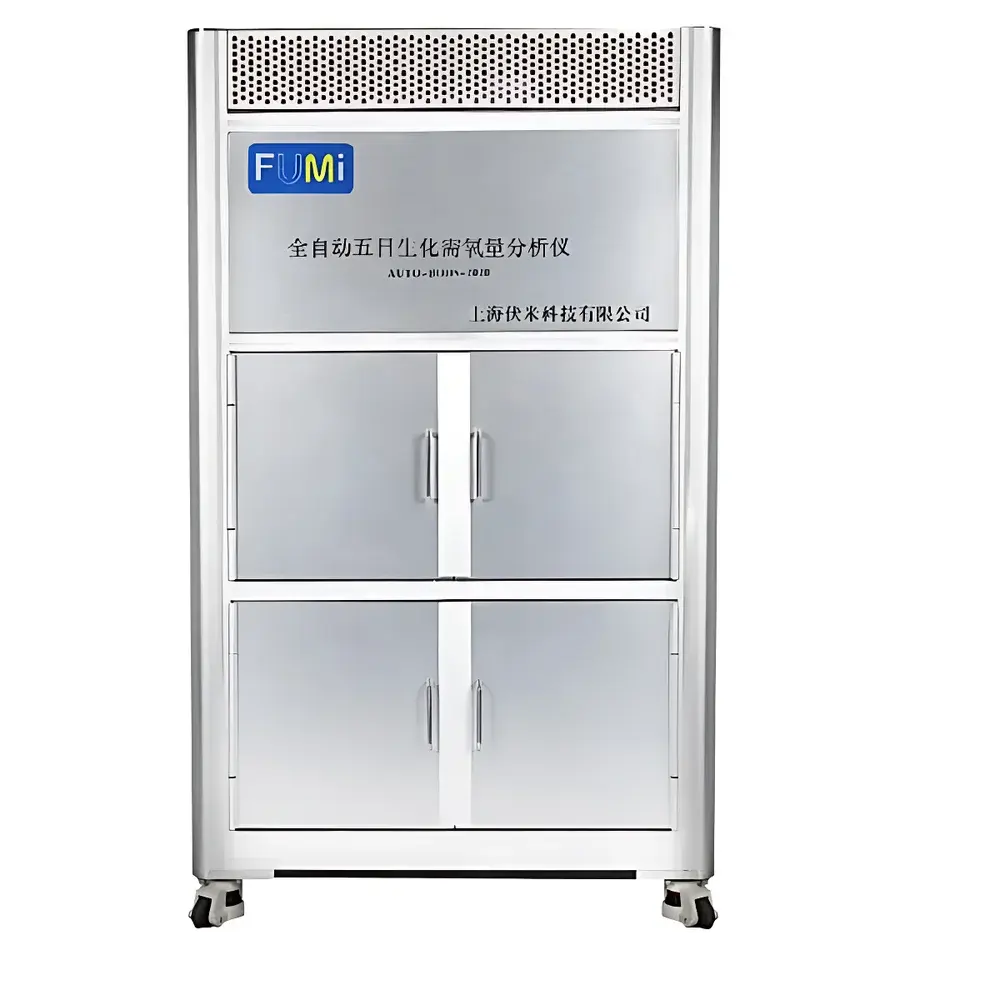
Shanghai Fumi BOD-5000 Fully Automated 5-Day Biochemical Oxygen Demand (BOD₅) Analyzer
| Brand | Shanghai Fumi |
|---|---|
| Origin | Shanghai, China |
| Manufacturer Type | Authorized Distributor |
| Country of Origin | China |
| Model | BOD-5000 |
| Instrument Type | Laboratory BOD Analyzer |
| Measurement Principle | Dissolved Oxygen (DO) Depletion Method per HJ 505–2009 |
| Measurement Range | 0.00–6000.00 mg/L |
| Resolution | 0.01 mg/L |
| Accuracy | ±0.01 mg/L (at 20 °C, calibrated with traceable DO standards) |
| Sample Capacity | 62 positions |
| Incubation Temperature | 20.0 ± 0.1 °C (PID-controlled water-jacketed chamber) |
| Automatic Dilution | Yes, via stepper-motor-driven 50 mL syringe dispenser |
| Auto Sealing | Yes, proprietary gas-tight cap system eliminating water seal requirement |
| Nutrient & Inhibitor Addition | Automated, programmable dosing |
| DO Electrode Type | Polarographic membrane electrode with integrated magnetic stirrer (adjustable pre-measurement agitation duration) |
| Data Output | Ethernet-enabled LIMS integration, local PC (Windows 10), and mobile app (iOS/Android) |
| Power Supply | 220 V AC, 50 Hz, 1500 W |
| Dimensions | 100 × 80 × 185 cm (with casters) |
| Compliance | HJ 505–2009, GB/T 5750.7–2023, GB 17378.4–2007 |
Overview
The Shanghai Fumi BOD-5000 is a fully automated, regulatory-compliant 5-day biochemical oxygen demand (BOD5) analyzer engineered for precision, reproducibility, and unattended operation in environmental laboratories. It implements the dissolved oxygen (DO) depletion method—specifically aligned with the Chinese national standard HJ 505–2009, “Determination of Biochemical Oxygen Demand (BOD5) in Water Quality—Dilution and Seeding Method”—as well as supplementary protocols including GB/T 5750.7–2023 (drinking water) and GB 17378.4–2007 (marine water). Unlike traditional manual or semi-automated BOD systems requiring daily operator intervention, water-seal maintenance, or external incubators, the BOD-5000 integrates temperature-controlled incubation, automated dilution, seeding, nutrient/inhibitor dosing, DO measurement, and data reporting into a single platform. Its core measurement principle relies on high-stability polarographic DO electrodes with integrated paddle-type stirring to ensure uniform oxygen diffusion at the membrane surface prior to each reading. All incubation occurs within a PID-regulated, water-jacketed chamber maintained at 20.0 ± 0.1 °C—meeting ISO 5815-1:2019 requirements for thermal stability during BOD5 assays.
Key Features
- Fully automated workflow—from sample loading to final BOD5 report generation—requiring no manual water sealing or daily DO readings.
- 62-position sample carousel with auto-capping mechanism and proprietary gas-tight caps that eliminate evaporation and CO2 loss, satisfying ASTM D5210–92 criteria for sealed-system BOD testing.
- Stepper-motor-driven 50 mL syringe dispenser enabling precise, programmable sample dilution (including variable dilution factors per vial) and automatic addition of nitrification inhibitors (e.g., allylthiourea) and nutrient solutions.
- Integrated DO measurement system featuring dual-membrane polarographic electrodes, real-time temperature compensation, and user-configurable pre-measurement agitation (1–120 seconds) to ensure equilibrium at the electrode surface.
- Onboard incubation chamber with continuous temperature logging (recorded every 5 minutes) and overtemperature/undercooling alarms—fully traceable for GLP/GMP audit readiness.
- Remote monitoring and control via secure web interface and native iOS/Android application, supporting real-time status updates, alarm notifications, and ad-hoc sample insertion during ongoing runs.
- Comprehensive data integrity architecture: full electronic audit trail, user-access logs, instrument event history, and 21 CFR Part 11–compliant digital signatures when paired with validated LIMS software.
Sample Compatibility & Compliance
The BOD-5000 accommodates standard 300 mL BOD bottles and supports heterogeneous sample matrices—including raw sewage, treated effluent, surface water, groundwater, drinking water, and marine samples—without modification. Its automated seeding module uses a stepper-controlled diluter to introduce standardized microbial inoculum (e.g., domestic wastewater supernatant or commercial seed culture) with volumetric accuracy ≤±0.5% RSD. The system complies with critical regulatory frameworks governing environmental testing: HJ 505–2009 (China MEP), GB/T 5750.7–2023 (CNAS-accredited drinking water labs), and GB 17378.4–2007 (State Oceanic Administration). For international equivalence, its operational parameters align with ISO 5815-1:2019 (water quality—determination of BOD5) and EPA Method 405.1 (for non-potable waters). All DO measurements are traceable to NIST-certified calibration standards; temperature control is verified annually using accredited PT100 reference probes.
Software & Data Management
The embedded Windows 10 operating system hosts FumiBOD Suite v4.2—a validated laboratory application supporting method setup, run scheduling, real-time monitoring, and automated report generation in PDF, CSV, and XML formats. The software enforces role-based access control (RBAC), configurable electronic signatures, and immutable audit trails compliant with FDA 21 CFR Part 11 Annex 11 and ISO/IEC 17025:2017 clause 7.11. Data export is enabled via TCP/IP Ethernet to LIMS platforms using ASTM E1384 or HL7 ADT messaging. All raw sensor data—including DO1, DO2, temperature logs, agitation cycles, and dilution volumes—is stored locally with RAID-1 redundancy and synchronized to network storage. Remote diagnostics and firmware updates are performed over TLS-encrypted channels with certificate-based authentication.
Applications
- Regulatory compliance monitoring for municipal wastewater treatment plants (WWTPs) under discharge permit requirements.
- Environmental impact assessment (EIA) studies for industrial effluent characterization and baseline water quality surveys.
- Drinking water source protection programs, including reservoir and aquifer vulnerability assessments.
- Marine and coastal zone management—supporting BOD5 evaluation in estuarine and nearshore environments per GB 17378.4–2007.
- Research applications in limnology, biogeochemistry, and microbial ecology requiring high-throughput, low-variance BOD5 datasets.
- Third-party certification labs seeking CNAS or CMA accreditation for water quality testing scope expansion.
FAQ
Does the BOD-5000 require manual water sealing during incubation?
No. It employs a patented gas-tight cap design that prevents oxygen ingress and CO2 egress, eliminating the need for paraffin wax or water seals.
Can the system handle samples with high suspended solids or toxicity?
Yes. The automated dilution module supports up to 1:1000 dilution ratios, and nitrification inhibition is programmable per vial to isolate carbonaceous BOD.
Is temperature stability validated across all 62 positions?
Yes. Independent verification using 62-channel thermocouple mapping confirms uniformity within ±0.1 °C across the entire chamber volume.
How is data integrity ensured for regulatory submissions?
All measurements include time-stamped metadata, operator ID, calibration history, and instrument configuration logs—exportable in ALCOA+ compliant format.
What maintenance is required for the DO electrodes?
Electrodes undergo automatic cleaning via periodic zero-point verification and electrolyte replenishment alerts; membrane replacement is recommended every 90 days under continuous use.
Related Products







