
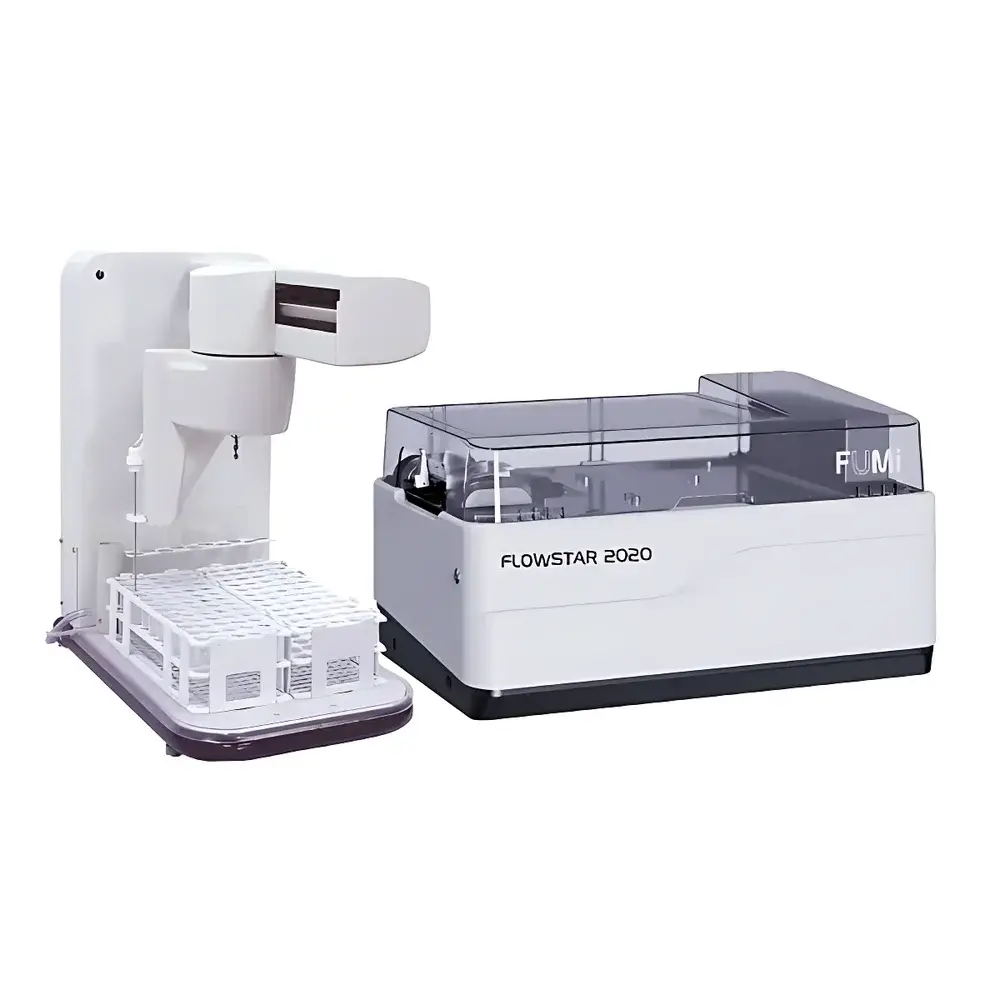
Shanghai Fumi FLOWSTAR 2020HS Seawater Nutrient Auto Analyzer
| Brand | Shanghai Fumi |
|---|---|
| Origin | Shanghai, China |
| Model | FLOWSTAR 2020HS |
| Product Type | Continuous Flow Analyzer (CFA) |
| Wavelength Range | 270–1100 nm |
| Sample Volumes | 5 mL / 8 mL / 10 mL |
| Sample Rack Capacity | 100 / 180 / 270 positions |
| Reagent Positions | 100 / 180 / 270 |
| Flow Cell Path Lengths | 10 mm / 30 mm / 50 mm |
| Light Source | LED or Krypton Lamp |
| Detection Principle | Segmented Flow Analysis (SFA) with Air Segment Isolation, Dual-Beam Dual-Wavelength Photometry |
| Compliance | HY/T 147.1, GB 5750, HJ 665/667/670, SL/T 788, CJ/T 141, ISO 6878, ISO 11905-1, EPA 353.2, APHA 4500-N, AOAC Official Methods |
Overview
The Shanghai Fumi FLOWSTAR 2020HS Seawater Nutrient Auto Analyzer is a third-generation continuous flow analyzer engineered for high-precision, fully automated quantification of inorganic and organic nutrients and contaminants in marine, freshwater, wastewater, and environmental solid matrices. It implements segmented flow analysis (SFA) — a robust, ISO-standardized technique wherein discrete air segments isolate sample and reagent zones within narrow-bore tubing (2 mm i.d.), eliminating cross-contamination and enabling precise control over reaction timing (up to 40 minutes), mixing efficiency, and thermal equilibration. Unlike flow injection analysis (FIA), SFA provides superior reproducibility for multi-step, time-sensitive protocols such as online distillation, UV digestion, cadmium reduction, and dialysis-based matrix cleanup — all executed autonomously without manual intervention. The system is explicitly validated for compliance with HY/T 147.1 (Chinese Marine Monitoring Standard for Nutrients), and supports over 150 standardized methods across water, soil, plant tissue, food, and industrial samples.
Key Features
- True end-to-end automation: integrated autosampler, peristaltic pumping, air-segment generation, reaction coil heating/cooling, dialysis membrane interfacing, UV photolysis, and high-pressure autoclave digestion modules
- Dual-beam, dual-wavelength photometer with selectable path lengths (10/30/50 mm) and stable LED or krypton lamp sources (270–1100 nm), ensuring high signal-to-noise ratio and minimal drift
- Electromagnetically actuated air-segment valves for precise bubble injection and segmentation repeatability
- Cadmium-ring reduction module replacing traditional cadmium columns — reducing maintenance, improving longevity, and enhancing nitrate-to-nitrite conversion consistency
- Onboard dialysis unit eliminates interferences from turbidity, color, and particulates without pre-filtration or centrifugation
- 2 mm internal diameter flow manifold — highly tolerant of suspended solids and low-viscosity slurries (e.g., digested soil extracts or filtered seawater)
- Air-driven pneumatic system using oil-free compressor — eliminating solvent vapor contamination and simplifying gas supply infrastructure
- Modular reagent rack (100/180/270 positions) and sample carousel (100/180/270 vials) with configurable volume options (5/8/10 mL)
- Peak-height and peak-area dual quantification algorithms for enhanced method flexibility and outlier detection
Sample Compatibility & Compliance
The FLOWSTAR 2020HS is designed for direct analysis of unfiltered, non-degassed liquid samples — including seawater, estuarine water, groundwater, municipal effluent, and digested biological or soil extracts. Its dialysis interface and UV digestion module meet ISO 11905-1 (total cyanide), ISO 6878 (total phosphorus), and EPA Method 353.2 (nitrate/nitrite). For marine applications, it fulfills the measurement requirements of HY/T 147.1 for ammonia nitrogen, nitrate, nitrite, phosphate, silicate, and total nitrogen/phosphorus. Additional validated protocols align with GB 5750 (drinking water), HJ 665–670 (China’s environmental monitoring standards), SL/T 788 (hydrological analysis), CJ/T 141 (urban water supply), and APHA Standard Methods 4500-N and 4500-P. All analytical sequences support full audit trail generation required under GLP and GMP frameworks.
Software & Data Management
Control and data acquisition are managed via FumiFlow™ v4.x software — a Windows-based platform compliant with FDA 21 CFR Part 11 for electronic records and signatures. The software provides real-time chromatogram visualization, method editor with drag-and-drop protocol builder, automatic calibration curve fitting (linear, quadratic, or cubic), QC flagging (e.g., %RSD, recovery, drift), and LIMS-ready CSV/Excel export. Audit logs record user actions, parameter changes, calibration events, and instrument status — traceable to timestamp, operator ID, and method version. Raw absorbance data, peak integrations, and diagnostic reports are stored in encrypted binary format with optional cloud backup integration.
Applications
- Marine nutrient monitoring: NH₄⁺-N, NO₂⁻-N, NO₃⁻-N, PO₄³⁻-P, SiO₂, total N/P in coastal and open-ocean surveys
- Wastewater treatment: COD, permanganate index, sulfide, chloride, sulfate, alkalinity, acidity, urea
- Environmental QA/QC: Total cyanide, phenols, volatile organic acids in regulatory compliance testing
- Agricultural & food analysis: Nitrate in leafy vegetables, phosphate in fertilizers, silicate in brewing water
- Soil and sediment leachates: Extractable ammonium, orthophosphate, and reactive silica following standardized digestion
FAQ
Does the FLOWSTAR 2020HS require sample filtration or degassing prior to analysis?
No — the integrated dialysis module and air-segment isolation eliminate the need for pre-filtration or vacuum degassing.
What is the typical throughput for nutrient analysis?
≥30 samples per hour per channel, scalable via multi-channel configuration.
Can the system perform UV digestion and high-pressure autoclave digestion simultaneously?
Yes — both modules operate independently and can be scheduled in sequence within a single method.
Is the software validated for regulated environments (e.g., ISO 17025 labs)?
Yes — FumiFlow™ supports full 21 CFR Part 11 compliance, including electronic signatures, audit trails, and secure user access levels.
What maintenance intervals are recommended for long-term reliability?
Pump tubing replacement every 3–6 months (depending on usage); optical cell cleaning every 2 weeks; annual photometer calibration and valve inspection.





