
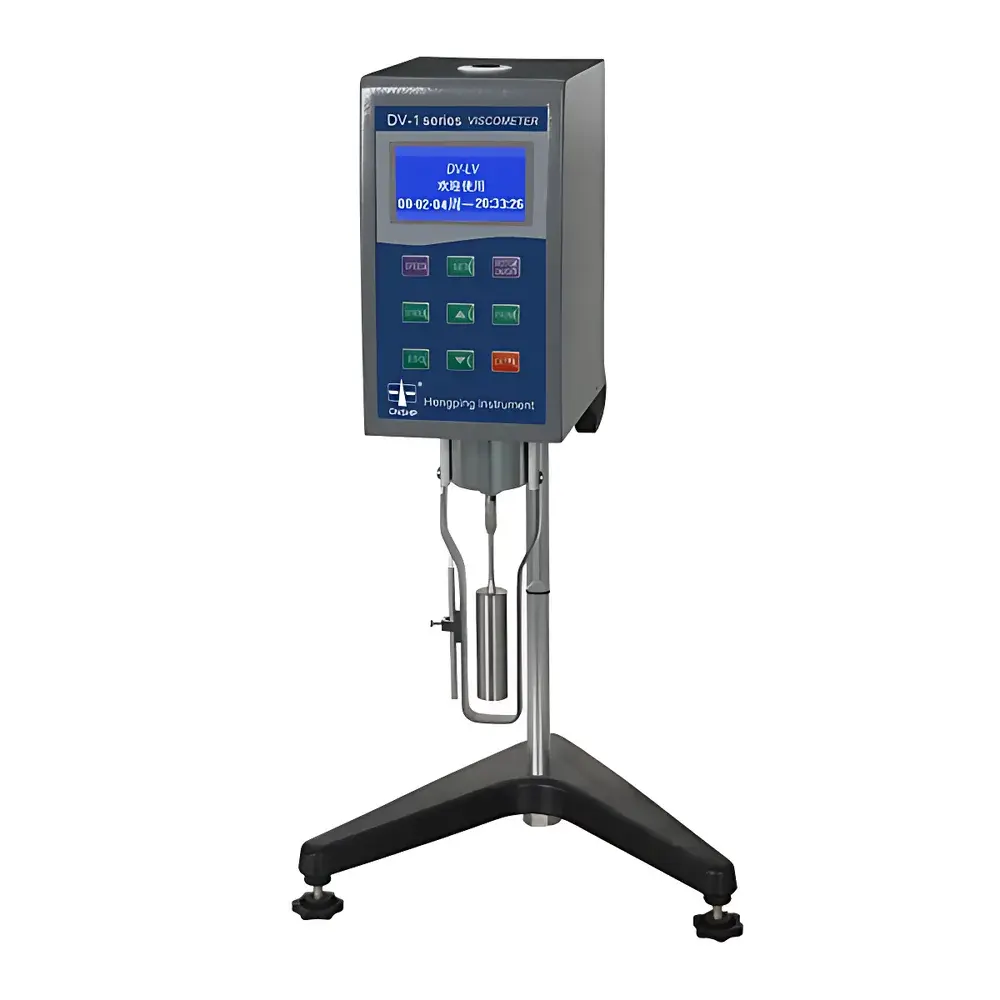
Shanghai Hengping DV-2MLV Advanced Rotational Viscometer for Asphalt and Thermoplastic Materials
| Brand | Hengping |
|---|---|
| Origin | Shanghai, China |
| Model | DV-2MLV |
| Viscosity Range | 0.1–6×10⁶ mPa·s (with optional #0 spindle) |
| Spindle Speeds | 10 speeds (0.1–60 rpm) |
| Accuracy | ±1.0% for Newtonian fluids |
| Power Supply | 110–240 VAC, 50/60 Hz |
| Operating Temperature | 5–35 °C |
| Dimensions | 380 × 320 × 390 mm |
| Net Weight | 4.5 kg |
| Standard Spindles | LV #1–#4 |
| Optional Accessory | #0 spindle (for 0.1–10 mPa·s) |
| RS232 Interface | Yes |
| Printer Interface | Built-in thermal micro-printer |
| Temperature Sensor Interface | Optional |
| Display | Backlit LCD |
Overview
The Shanghai Hengping DV-2MLV is a precision-engineered rotational viscometer designed for reliable, repeatable viscosity characterization of thermally sensitive and structurally complex fluids—particularly asphalt binders, hot-melt adhesives, molten waxes, polymer melts, and other non-Newtonian materials encountered in pavement engineering, coatings R&D, and polymer processing labs. Based on the Couette principle, the instrument measures torque generated by fluid resistance to rotation of a cylindrical spindle immersed in a controlled-volume sample chamber. Its microprocessor-controlled motor drive delivers stable, stepwise speed selection across ten discrete rates (0.1–60 rpm), enabling shear-rate-dependent profiling essential for evaluating shear-thinning behavior, yield stress estimation (via flow curve analysis), and temperature-viscosity correlation studies. The DV-2MLV’s modular architecture supports both standard LV spindles (#1–#4) and the optional #0 spindle—specifically engineered for ultra-low-viscosity liquids down to 0.1 mPa·s—making it uniquely suited for characterizing cutback asphalts, solvent-diluted bitumens, and low-molecular-weight resins.
Key Features
- Microprocessor-based control system with real-time torque and viscosity calculation, ensuring high reproducibility across repeated measurements.
- Backlit high-contrast LCD display for clear visibility under laboratory lighting conditions; all parameters—including current speed, spindle ID, measured viscosity, % torque, and temperature (when sensor is connected)—are simultaneously shown.
- Built-in thermal micro-printer enables immediate hard-copy output of test results without external peripherals; data includes timestamp, spindle number, rotational speed, viscosity value, and torque percentage.
- RS232 serial interface compliant with standard PC communication protocols, facilitating integration into lab-wide data acquisition systems or custom LIMS environments.
- Modular spindle configuration: Standard LV #1–#4 spindles cover the primary range (1–6×10⁶ mPa·s); optional #0 spindle extends measurement capability to 0.1–10 mPa·s with only 20–25 mL sample volume—critical for scarce or expensive asphalt fractions.
- Rugged mechanical design with aluminum alloy housing and precision-machined spindle shaft ensures long-term dimensional stability and minimal thermal drift during extended testing cycles.
Sample Compatibility & Compliance
The DV-2MLV accommodates a wide range of sample geometries and thermal requirements. It operates with both bottomed and open-bottom sample cups (standard outer cylinder dimensions: Ø34 mm × 75 mm height), and includes dedicated mounting hardware for secure alignment of the #0 spindle assembly—eliminating air entrapment and wall-slip artifacts common in low-viscosity measurements. For asphalt applications, the instrument supports ASTM D2170 (Standard Test Method for Kinematic Viscosity of Asphalts), ASTM D4402 (Standard Test Method for Viscosity Determination of Asphalt at Elevated Temperatures Using a Rotational Viscometer), and AASHTO T 316. When used with an optional PT100 temperature probe and calibrated bath, it meets GLP traceability requirements for viscosity reporting in QA/QC workflows. All firmware and calibration routines are internally stored and do not require external software activation.
Software & Data Management
While the DV-2MLV functions autonomously via its onboard controller, the RS232 port allows bidirectional communication with Windows-based terminal emulators or custom Python/Excel VBA scripts for automated batch logging. Raw output includes ASCII-formatted strings containing viscosity (mPa·s), shear rate (s⁻¹), torque (%), temperature (°C), spindle ID, and speed (rpm). No proprietary drivers or cloud dependencies are required. For regulated environments, users may implement local audit trails using timestamped CSV exports—fully compatible with FDA 21 CFR Part 11-compliant electronic record systems when paired with appropriate access controls and electronic signatures.
Applications
- Characterization of unmodified and polymer-modified asphalt binders across service temperatures (e.g., 60–135 °C) per Superpave specifications.
- Quality control of hot-melt adhesives during formulation development and production release testing.
- Viscosity profiling of paraffin and microcrystalline wax blends used in packaging and candle manufacturing.
- Rheological screening of thermoplastic elastomers (TPEs) and polyolefin melts prior to extrusion or injection molding.
- Evaluation of cutback and emulsified asphalt stability through time-dependent viscosity monitoring.
- Teaching laboratories requiring robust, entry-level instrumentation for hands-on rheology fundamentals instruction.
FAQ
What is the minimum sample volume required when using the #0 spindle?
20–25 mL of liquid sample is sufficient for accurate measurement with the #0 spindle configuration.
Can the DV-2MLV be used for non-Newtonian fluid analysis?
Yes—the instrument supports multi-speed flow curve acquisition, enabling calculation of apparent viscosity vs. shear rate and qualitative assessment of shear-thinning or thixotropic behavior.
Is temperature control built into the instrument?
No—temperature regulation requires an external heated bath or environmental chamber; however, the optional PT100 interface allows real-time temperature input for compensated viscosity reporting.
Does the device meet ISO/IEC 17025 calibration requirements?
When operated with NIST-traceable spindle geometry and verified reference oils (e.g., Cannon-Manning series), the DV-2MLV supports compliance with ISO 2555 and ASTM D2196 calibration protocols.
How is data integrity maintained during RS232 transmission?
All serial communications use hardware handshaking (RTS/CTS) and configurable parity/error-checking modes to prevent packet loss in electrically noisy lab environments.



