
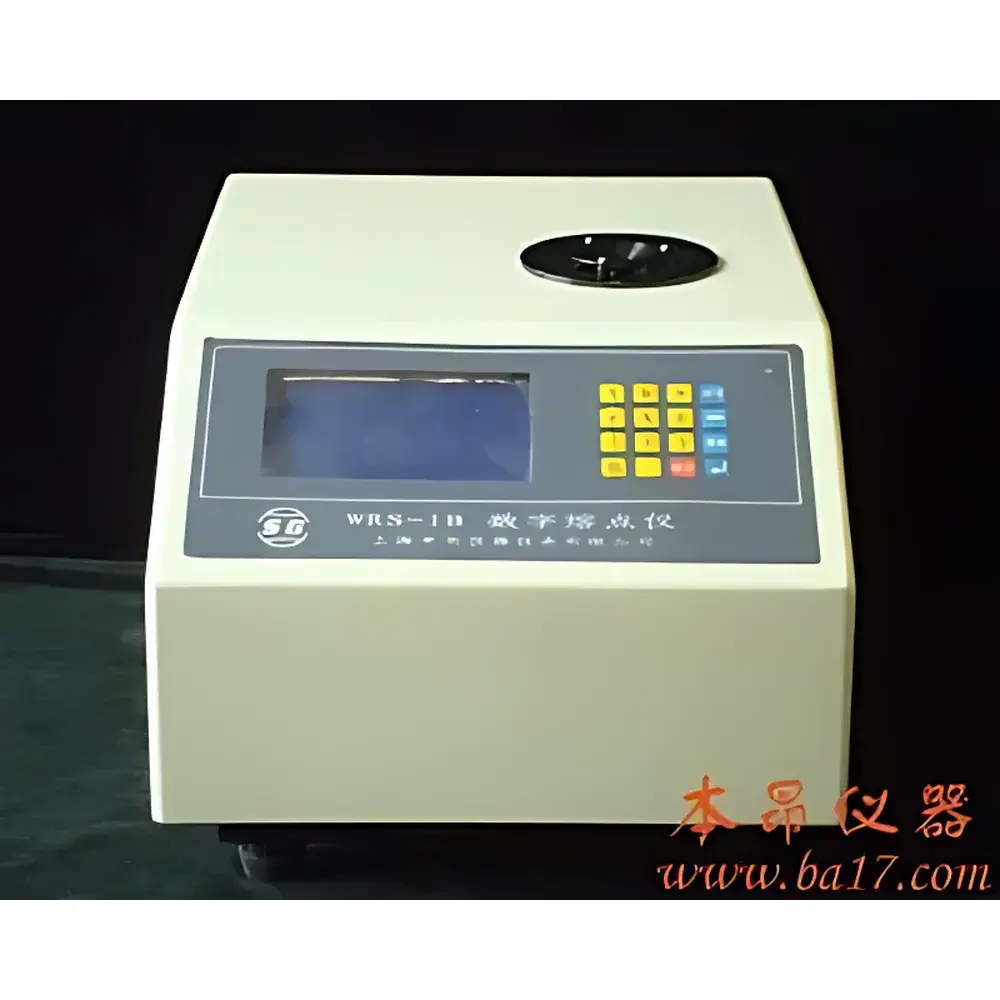
Shanghai Hengping WRS-1B Digital Melting Point Apparatus
| Origin | Shanghai, China |
|---|---|
| Manufacturer Type | Authorized Distributor |
| Origin Category | Domestic (PRC) |
| Model | WRS-1B |
| Price | USD 1,700 (FOB Shanghai) |
| Temperature Range | Ambient to 300 °C |
| Minimum Display Resolution | 0.1 °C |
| Linear Heating Rates | 0.2, 0.5, 1.0, 1.5, 2.0, 3.0, 4.0, 5.0 °C/min (8 selectable rates) |
| Accuracy | ±0.5 °C below 200 °C |
| Weight | 11 kg |
| Dimensions | 398 × 280 × 170 mm |
| Interface | RS-232 serial port |
| Data Output | Automatic onset/melting end calculation with mean value reporting |
| Display | Backlit LCD with real-time melting curve visualization |
| Detection Method | Photoelectric detection of solid–liquid phase transition |
Overview
The Shanghai Hengping WRS-1B Digital Melting Point Apparatus is a precision thermal analysis instrument engineered for the accurate determination of melting point ranges in crystalline organic compounds. It operates on the principle of photoelectric detection of optical transmittance changes during solid-to-liquid phase transition—where a precisely heated capillary sample undergoes progressive loss of crystalline structure, resulting in measurable attenuation of incident light. This method provides objective, operator-independent endpoint identification without reliance on visual interpretation. Designed for routine quality control and material characterization in pharmaceutical, fine chemical, agrochemical, and academic laboratories, the WRS-1B delivers reproducible results under standardized thermal ramping conditions. Its ambient-to-300 °C operating range covers the majority of small-molecule organics—including active pharmaceutical ingredients (APIs), intermediates, dyes, fragrances, and polymer additives—making it compatible with pharmacopoeial testing requirements (e.g., USP , EP 2.2.17, and ChP IV).
Key Features
- Eight programmable linear heating rates (0.2–5.0 °C/min), enabling method optimization for samples with narrow or broad melting intervals
- High-resolution backlit LCD display showing real-time temperature, heating rate, and dynamic melting curve—facilitating immediate visual verification of thermal behavior
- Integrated photoelectric sensor system with calibrated optical path geometry, minimizing subjective bias and improving inter-operator consistency
- Automatic calculation and display of onset temperature (Tonset), clear-point temperature (Tclear), and their arithmetic mean—reducing manual data transcription errors
- RS-232 serial interface compliant with standard laboratory data acquisition protocols, supporting integration into LIMS or custom scripting environments
- Robust aluminum-alloy housing with thermally isolated sample chamber, ensuring stable baseline performance and resistance to ambient drafts
- Compact benchtop footprint (398 × 280 × 170 mm) and lightweight design (11 kg) for flexible placement in QC labs, teaching laboratories, or regulatory-compliant cleanroom annexes
Sample Compatibility & Compliance
The WRS-1B accepts standard 1.0 mm OD glass capillaries (1–3 mg sample load), compatible with both dry and solvent-dried crystalline powders. It supports compliance with internationally recognized monograph methods requiring controlled ramp rates and documented thermal profiles. While not intrinsically 21 CFR Part 11–compliant (lacking electronic signature and audit trail functionality), its RS-232 output enables traceable data export to validated third-party software platforms used in GLP/GMP environments. The instrument meets general safety standards per IEC 61010-1 for electrical equipment for measurement, control, and laboratory use. Calibration verification can be performed using NIST-traceable reference standards (e.g., indium, caffeine, phenacetin), and users are advised to conduct periodic accuracy checks per ISO/IEC 17025 internal calibration procedures.
Software & Data Management
The WRS-1B operates as a standalone instrument with embedded firmware—no proprietary PC software is required for basic operation. All parameters (heating rate, target range, hold time) are configured via membrane keypad with intuitive menu navigation. Real-time melting curves and numeric results are retained on-screen until manually cleared or overwritten. For extended data handling, the RS-232 interface permits connection to terminal emulators (e.g., Tera Term, PuTTY) or custom Python/Excel VBA scripts that parse ASCII-formatted output packets (temperature, time, status flags). Laboratories implementing digital quality systems may route this stream into validated data loggers or ELN platforms, satisfying ALCOA+ principles when combined with procedural controls for data review and retention.
Applications
- Pharmaceutical QC: Identity confirmation and purity assessment of APIs and excipients per USP/EP monographs
- Organic synthesis: Monitoring reaction completion and intermediate purity during process development
- Academic instruction: Teaching fundamental concepts of phase transitions, eutectic behavior, and polymorphism
- Regulatory submissions: Generating documentary evidence for DMF filings where melting point serves as a critical quality attribute
- Material screening: Preliminary evaluation of thermal stability in dye chemistry, liquid crystal research, and specialty polymer additives
FAQ
Does the WRS-1B support automatic calibration or self-diagnostic routines?
No—the instrument requires manual calibration using certified reference materials. Users must perform periodic verification against traceable standards and document deviations per internal SOPs.
Can the melting curve be exported as a graphical file (e.g., PNG or CSV)?
The device outputs only ASCII-encoded temperature/time/status data via RS-232. Graph generation and export require external software parsing the serial stream.
Is the capillary holder interchangeable for different diameters?
It is optimized exclusively for 1.0 mm outer diameter capillaries; no adapter kits are supplied or supported.
What maintenance is recommended for long-term accuracy?
Annual cleaning of the optical path with lint-free swabs and isopropanol, inspection of heater block integrity, and verification of thermistor linearity using a calibrated dry-block calibrator are advised.
Does the WRS-1B comply with GMP documentation requirements out-of-the-box?
No—it lacks built-in electronic signatures, user access control, or audit trail functionality. Integration with compliant data management systems is the responsibility of the end-user’s validation team.



