
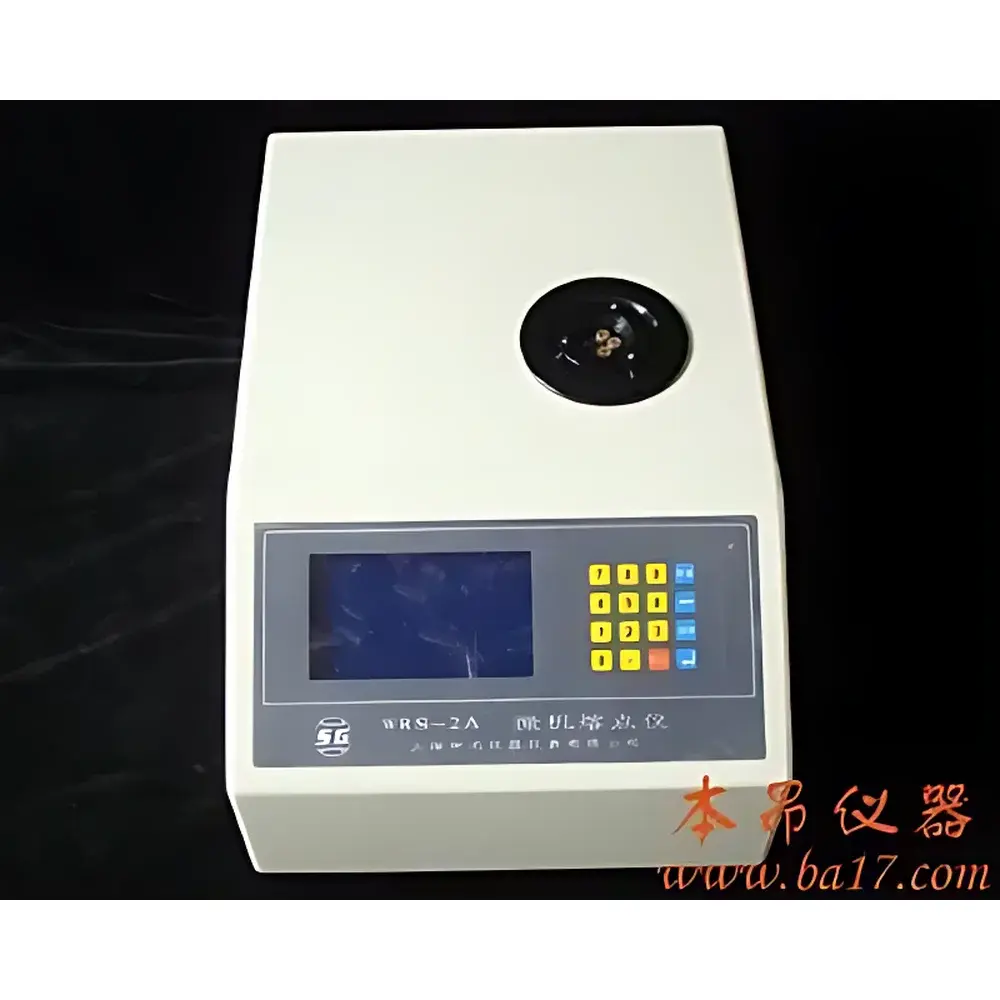
Shanghai Hengping WRS-2A Digital Melting Point Apparatus
| Origin | Shanghai, China |
|---|---|
| Manufacturer Type | Authorized Distributor |
| Origin Category | Domestic (PRC) |
| Model | WRS-2A |
| Price | USD 2,500 (FOB Shanghai) |
| Melting Point Range | Ambient to 300 °C |
| Temperature Resolution | 0.1 °C |
| Linear Heating Rates | 0.2, 0.5, 1.0, 1.5, 2.0, 3.0, 4.0, 5.0 °C/min (8 selectable rates) |
| Accuracy | ±0.5 °C below 200 °C |
| Sample Capacity | 3 simultaneous capillary samples |
| Data Output | RS232 serial interface |
| Net Weight | 11 kg |
| Dimensions | 398 × 280 × 170 mm |
| Display | Backlit LCD with real-time melting curve visualization |
| Input Method | Numeric keypad |
| Detection Principle | Photometric (transmittance-based) capillary melt detection |
Overview
The Shanghai Hengping WRS-2A Digital Melting Point Apparatus is a precision thermal analysis instrument engineered for the accurate and reproducible determination of melting point ranges in crystalline organic compounds. It operates on the photometric principle: as a solid sample in a standard 1-mm-diameter glass capillary undergoes phase transition, changes in light transmittance through the column are detected by a calibrated photodiode array. This optical signal—combined with real-time temperature feedback from a high-stability platinum resistance thermometer (PT100)—enables automatic identification of onset (initial softening), clear point (complete liquefaction), and intermediate melt stages. Designed for routine quality control and research-grade characterization, the WRS-2A delivers traceable thermal data compliant with pharmacopoeial methodologies including USP , EP 2.2.17, and JP 2.60. Its ambient-to-300 °C operating range accommodates the full spectrum of small-molecule pharmaceuticals, fine chemicals, dyes, fragrances, and polymer intermediates.
Key Features
- Triple-capillary sample holder enabling parallel analysis of three independent specimens per run—reducing inter-run variability and improving throughput in batch QC environments.
- Eight precisely calibrated linear heating rates (0.2–5.0 °C/min), each digitally stabilized via PID-controlled heating block, supporting method development per ICH Q5C and compendial requirements for rate-dependent melt behavior assessment.
- Backlit graphical LCD display rendering real-time temperature vs. transmittance curves, allowing visual verification of melt profile symmetry, eutectic shoulders, or decomposition artifacts prior to final reporting.
- Integrated numeric keypad for direct parameter entry—eliminating reliance on menu navigation and minimizing operator-induced input errors during high-volume testing.
- RS232 serial interface compliant with ANSI/TIA/EIA-232-F standards, facilitating bidirectional communication with LIMS platforms or validated laboratory PCs under FDA 21 CFR Part 11-compliant audit trail configurations.
- Rugged aluminum alloy chassis (11 kg mass) with thermally isolated optical path and forced-air cooling vents—ensuring long-term thermal stability and mechanical robustness in shared lab environments.
Sample Compatibility & Compliance
The WRS-2A accepts standard 100-mm-length, 1.0-mm-OD borosilicate capillaries filled to 3–5 mm height with dry, finely powdered, uniformly packed samples. It is validated for use with APIs (e.g., paracetamol, ibuprofen), excipients (mannitol, lactose monohydrate), agrochemical intermediates, and natural product isolates (caffeine, camphor). Instrument performance meets ISO 8677:2015 (Laboratory equipment — Melting point apparatus — Requirements and test methods) for accuracy, repeatability (RSD ≤ 0.3 °C within triplicate runs), and linearity. Calibration verification is supported using NIST-traceable reference standards (e.g., indium, tin, bismuth) across the full temperature span. The system supports GLP documentation workflows when paired with external electronic lab notebooks or validated spreadsheet templates.
Software & Data Management
While the WRS-2A operates as a standalone instrument with embedded firmware, its RS232 port enables integration with third-party data acquisition software (e.g., LabVIEW™, MATLAB® Serial Interface Toolboxes) or custom Python-based parsers for automated CSV export. Raw output includes timestamp, setpoint ramp rate, actual block temperature (0.1 °C resolution), photometric signal intensity (0–100% relative units), and auto-calculated onset/clear/mean values. All parameters are stored in non-volatile memory with power-loss recovery. For regulated environments, optional PC-based validation packages (IQ/OQ protocols, electronic signature modules) are available through authorized distributors—fully aligned with Annex 11 and ALCOA+ data integrity principles.
Applications
- Pharmaceutical QC laboratories verifying identity and purity of active pharmaceutical ingredients against pharmacopoeial monographs.
- R&D synthesis groups monitoring reaction progress and isolating pure crystalline fractions via melt-point correlation.
- Contract manufacturing organizations (CMOs) performing release testing under GMP Annex 19 and WHO TRS 1019 Annex 4 requirements.
- Academic chemistry departments teaching fundamental solid-state characterization techniques with hands-on, visually interpretable outputs.
- Food additive and cosmetic ingredient suppliers confirming batch-to-batch consistency of crystalline emulsifiers and UV filters.
FAQ
What capillary dimensions are required for optimal performance?
Standard 1.0 mm outer diameter × 0.1 mm wall thickness × 100 mm length capillaries are recommended. Fill height must be 3–5 mm with homogeneous, air-free packing.
Does the WRS-2A support non-linear or programmable temperature ramps?
No—it implements only fixed-rate linear heating profiles. Multi-step or isothermal hold functions require external controller integration via RS232.
Can the instrument be calibrated in-house without sending it to a service center?
Yes—users may perform two-point calibration using certified reference materials (e.g., pure urea and pure cinnamic acid) following the built-in calibration mode and manufacturer’s SOP-TP-002.
Is the photometric detection sensitive to sample color or opacity?
Transmittance-based detection requires translucent or lightly colored samples. Highly pigmented or opaque compounds (e.g., some metal complexes) may require alternative methods such as DSC or hot-stage microscopy.
What is the typical maintenance interval for the heating block and optical sensor?
No scheduled maintenance is required beyond quarterly cleaning of the capillary chamber and optical window with lint-free ethanol wipes. The PT100 sensor exhibits drift < 0.05 °C/year under normal use conditions.



