
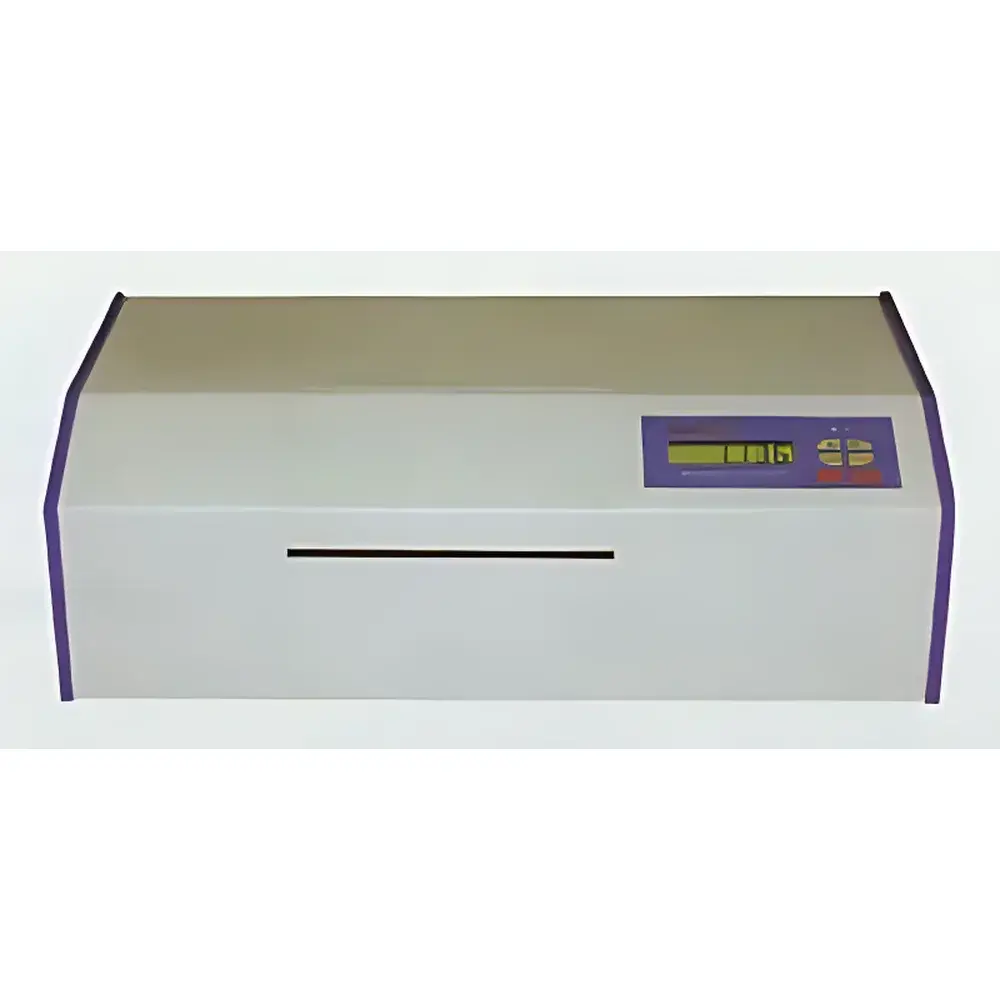
Shanghai INESA Physical Optics WZZ-3 Automatic Polarimeter
| Brand | INESA Physical Optics (YDWG) |
|---|---|
| Origin | Shanghai, China |
| Model | WZZ-3 |
| Product Type | Automatic Polarimeter |
| Temperature Control | Yes (thermostatically regulated sample chamber) |
| Digital Display | Backlit LCD |
| Light Source | Sodium D-line lamp (589.44 nm) |
| Optical Rotation Range | ±45° |
| Sugar Scale Range | ±120°Z |
| Minimum Resolution | 0.001° |
| Accuracy | ±(0.01° + 0.05% of reading) for optical rotation |
| Repeatability | ≤0.003° (optical rotation) |
| Minimum Sample Transmittance | 10% |
| Compliance Class | Grade 0.05 polarimeter per JJG 536–2015 (Chinese National Verification Regulation for Polarimeters) |
Overview
The Shanghai INESA Physical Optics WZZ-3 Automatic Polarimeter is a precision optical instrument engineered for quantitative measurement of optical rotation in optically active substances—primarily used in pharmaceutical quality control, fine chemical synthesis validation, food & beverage sugar content analysis, and academic research involving chiral molecules. Based on the fundamental principle of polarimetry—measuring the angular deviation of plane-polarized light as it passes through a chiral medium—the WZZ-3 employs a stable sodium D-line (589.44 nm) light source, a high-stability half-shade field analyzer, and a calibrated quartz calibration plate to ensure traceable angular measurement. Its design conforms to the metrological requirements specified in JJG 536–2015, classifying it as a Grade 0.05 polarimeter, indicating maximum permissible error limits appropriate for routine QC applications under GLP-aligned laboratory environments.
Key Features
- Automated measurement sequence with programmable averaging: supports up to six consecutive readings with automatic calculation of mean value and root-mean-square (RMS) deviation—enhancing statistical reliability without manual intervention.
- Thermostatically controlled sample compartment: enables temperature-stabilized measurements critical for reproducibility across viscosity-sensitive or thermally labile samples (e.g., sucrose solutions, amino acid derivatives).
- Backlit LCD display with dual-scale readout: simultaneously presents optical rotation (°) and sugar concentration (°Z) using standardized sucrose-equivalent conversion algorithms per ICUMSA and AOAC guidelines.
- High-resolution angular detection: 0.001° minimum display resolution, supported by precision stepper motor-driven analyzer rotation and photodiode-based null-detection circuitry.
- RS232 serial interface: facilitates bidirectional communication with external PCs for automated data logging, report generation, and integration into LIMS environments—compatible with standard terminal emulation protocols.
- Robust mechanical architecture: aluminum alloy optical bench, vibration-damped base, and sealed optical path minimize environmental drift and support long-term calibration stability.
Sample Compatibility & Compliance
The WZZ-3 accommodates standard 100 mm and 200 mm path-length sample tubes (with optional adapters for 50 mm), supporting liquid, solution-phase, and low-turbidity suspensions exhibiting ≥10% optical transmittance at 589 nm. It is routinely deployed in environments requiring adherence to pharmacopeial standards—including USP , EP 2.2.7, and ChP IV for assay of enantiomeric purity and specific optical rotation ([α]D). While not FDA 21 CFR Part 11–validated out-of-the-box, its RS232 output and deterministic measurement protocol allow integration into compliant workflows when paired with validated third-party data acquisition software featuring audit trail and electronic signature capabilities.
Software & Data Management
No proprietary software is bundled; however, the RS232 interface supports ASCII-based command-response communication using simple AT-style syntax (e.g., “READ?” returns “+12.345°”). Users may implement custom scripts (Python, LabVIEW, MATLAB) to acquire time-stamped readings, perform real-time statistical evaluation, and export CSV-formatted datasets. The instrument stores no internal history—data persistence relies entirely on host-system logging, aligning with ALCOA+ principles when properly configured within a documented electronic record system.
Applications
- Pharmaceutical QC: determination of specific rotation for APIs such as levodopa, ibuprofen, and chloramphenicol to verify enantiomeric identity and batch consistency.
- Sugar industry: rapid quantification of sucrose concentration in cane juice, molasses, and refined syrups per ICUMSA Method GS4/8-4.
- Academic research: kinetic monitoring of enzymatic hydrolysis (e.g., invertase activity via α-D-glucose/fructose ratio tracking) and chiral catalyst screening.
- Flavor & fragrance analysis: assessment of essential oil authenticity (e.g., limonene enantiomeric excess in citrus oils) and adulteration detection.
- Food regulatory compliance: verification of declared sugar content in beverages and dairy products against national labeling requirements.
FAQ
What is the wavelength of the light source?
The WZZ-3 uses a monochromatic sodium D-line lamp centered at 589.44 nm, meeting ISO 13795 and ASTM E1254 requirements for standard polarimetric illumination.
Does the instrument support temperature calibration verification?
Yes—the thermostatic chamber includes a calibrated Pt100 sensor with ±0.2 °C accuracy; users may validate temperature performance using NIST-traceable liquid-in-glass thermometers or digital probes.
Can the WZZ-3 measure samples below 10% transmittance?
No. Optical rotation measurement requires sufficient photon flux at the detector; samples with transmittance <10% at 589 nm yield unreliable null-point detection due to signal-to-noise degradation.
Is the sugar scale linearly proportional to concentration?
The °Z scale is empirically derived from sucrose solutions at 20 °C and is linear only within ±120°Z under defined conditions (100 mm tube, 20 °C); non-sucrose optically active compounds require individual calibration curves.
How often should the quartz calibration plate be verified?
Per JJG 536–2015, verification is recommended before each daily measurement session or after any mechanical shock; annual recalibration by an accredited metrology lab is advised for GMP-regulated use.



