
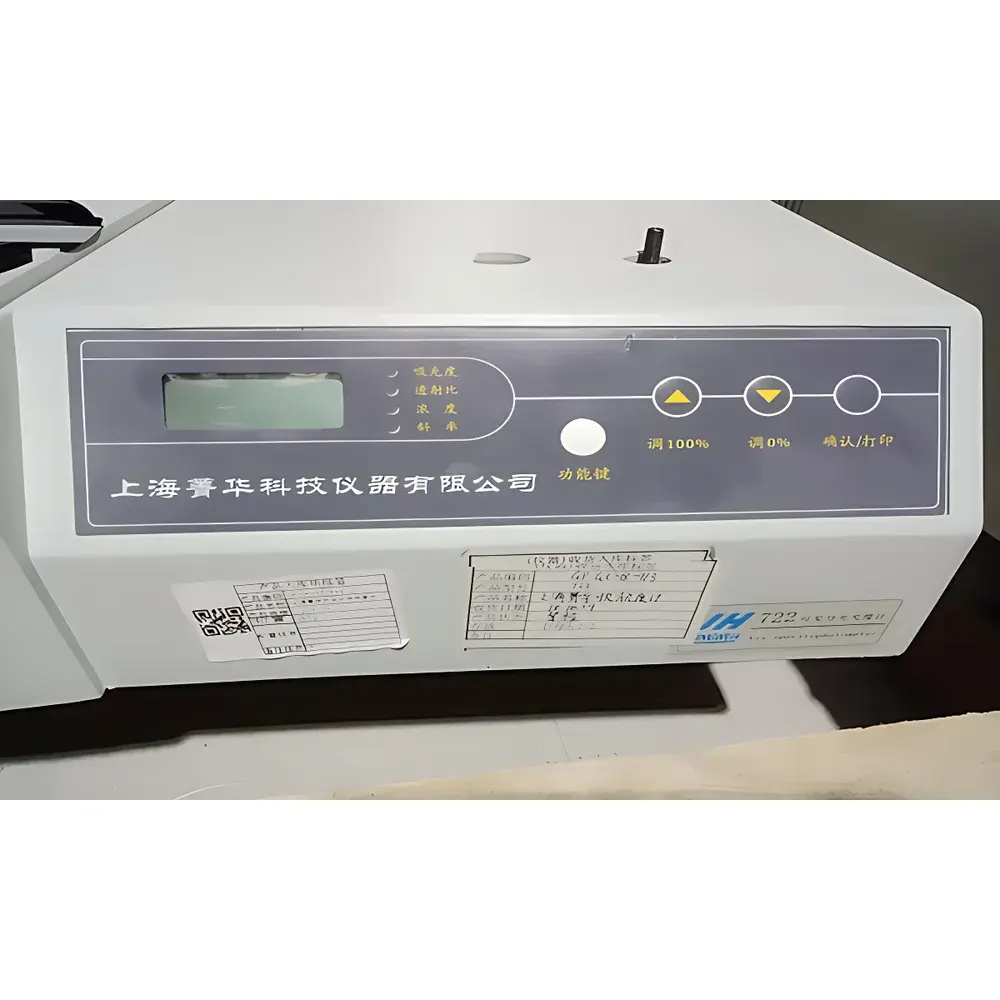
Shanghai Jinghua 722-1 Visible Spectrophotometer
| Origin | Shanghai |
|---|---|
| Manufacturer Type | Distributor |
| Origin Category | Domestic (China) |
| Model | 722-1 |
| Price | USD 70 (est.) |
| Optical Design | Single-beam |
| Detector | Photomultiplier Tube (PMT) |
| Wavelength Range | 330–1000 nm |
| Wavelength Selection | Manual |
| Spectral Bandwidth | 4 nm |
| Wavelength Accuracy | ±2 nm |
| Stray Light | ≤0.1% T |
| Wavelength Repeatability | 1 nm |
| Photometric Accuracy | ≤±0.5% T |
| Photometric Repeatability | ±0.2% T |
| Transmittance Range | 0–200% T |
| Absorbance Range | –0.301 to 3.000 A |
| Concentration Range | 0–99999 units |
| Baseline Stability | ±0.001 A/h |
| Output Interface | RS-232 |
| Optional Accessories | Thermal Printer, Dedicated PC Software |
Overview
The Shanghai Jinghua 722-1 Visible Spectrophotometer is a robust, entry-level single-beam optical instrument engineered for routine quantitative and qualitative analysis in the visible spectrum (330–1000 nm). It operates on the principle of Beer–Lambert law-based absorbance measurement, utilizing a Czerny–Turner (C-T) monochromator configuration with a high-efficiency 1200 lines/mm holographic grating. The system employs a precision-calibrated tungsten-halogen lamp as the broadband light source and a photomultiplier tube (PMT) detector to deliver high signal-to-noise ratio and excellent photometric linearity. Designed for laboratories requiring reliability without complexity, the 722-1 supports fundamental photometric modes—Transmittance (T), Absorbance (A), Concentration (C), and Factor (F)—and meets core performance benchmarks for educational labs, QC environments in food, pharmaceutical excipient, and industrial chemical settings where visible-range characterization suffices.
Key Features
- C-T monochromator architecture with 1200 L/mm holographic grating ensures consistent spectral resolution and minimal wavelength drift.
- High-stability tungsten-halogen lamp provides uniform intensity output across the entire 330–1000 nm range, optimized for reproducible baseline performance.
- Photomultiplier tube (PMT) detector delivers superior sensitivity and dynamic range compared to silicon photodiodes—critical for low-absorbance measurements and trace-level quantitation.
- Manual wavelength adjustment via calibrated vernier scale enables tactile control and intuitive operation; ideal for teaching laboratories and technician-led workflows.
- Wide sample compartment accommodates cuvettes up to 100 mm pathlength, supporting specialized applications including turbidity screening and highly diluted sample analysis.
- Optical system achieves ≤0.1% T stray light—meeting ISO 9001-aligned manufacturing tolerances for visible spectrophotometry—and supports reliable measurements near absorbance limits (up to 3.000 A).
Sample Compatibility & Compliance
The 722-1 accepts standard 10 mm square quartz or glass cuvettes (also compatible with 20–100 mm pathlength cells via optional holders). It supports liquid, solution-phase samples in transparent matrices and is routinely deployed for dye concentration calibration, enzyme kinetics (where visible cofactors such as NADH/NADPH are monitored), and colorimetric assays (e.g., phenol red, Bradford, or bicinchoninic acid methods). While not designed for regulatory-grade GMP environments, its photometric accuracy (≤±0.5% T) and stability (±0.001 A/h) align with ASTM E275 and ISO 6059 guidance for routine spectrophotometric verification. Instrument documentation and calibration records support GLP-compliant data handling when paired with validated software and audit-trail-enabled printers.
Software & Data Management
The 722-1 features an RS-232 serial interface for bidirectional communication with external PCs. Optional dedicated software enables real-time data acquisition, spectral scanning (via stepwise manual input), kinetic time-course plotting, and calibration curve generation (linear, polynomial, or multi-point). All exported datasets comply with ASCII-delimited formats (.csv, .txt) for compatibility with LIMS platforms and statistical packages (e.g., JMP, Minitab, Python pandas). When used with an optional thermal printer, hard-copy reports include timestamp, operator ID, wavelength setting, and measured T/A values—supporting basic traceability requirements under internal QA protocols.
Applications
- Educational laboratories: Teaching Beer–Lambert law fundamentals, calibration curve construction, and method validation principles.
- Quality control in paint, ink, textile, and cosmetic industries for color strength and batch consistency assessment.
- Environmental testing labs performing nitrate, phosphate, or iron(II) quantification via standard colorimetric methods.
- Pharmaceutical R&D for excipient purity checks and dissolution profile monitoring at visible wavelengths.
- Food & beverage labs measuring chlorophyll, carotenoid, or anthocyanin content in extracts and juices.
FAQ
Is the 722-1 compliant with FDA 21 CFR Part 11?
No—the instrument lacks electronic signature capability, audit trail functionality, and user access controls required for Part 11 compliance. It is intended for non-GxP environments or as a secondary verification tool.
Can it measure absorbance below 330 nm?
No—its optical design and tungsten lamp output limit effective operation to ≥330 nm. For UV-capable analysis (190–330 nm), a deuterium/tungsten dual-lamp system is required.
What is the maximum pathlength supported without modification?
The standard sample chamber accommodates 10 mm cuvettes; 100 mm pathlength cells require optional extended-height sample holders (sold separately).
Does it support automatic wavelength scanning?
No—wavelength selection is manual via front-panel dial. Scanning must be performed incrementally by user input.
Is PMT gain adjustable?
No—detector gain is factory-optimized for the specified spectral range and photometric range; no user-accessible HV or amplification controls are provided.



