
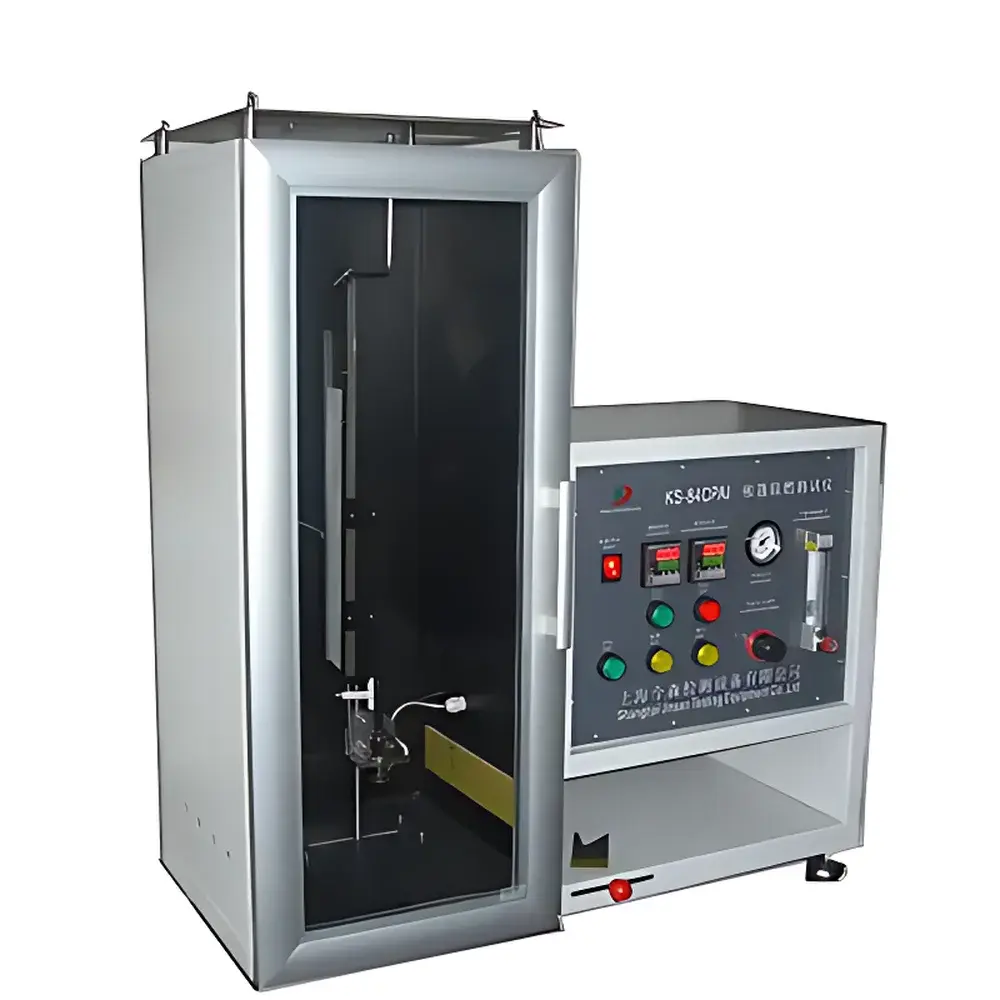
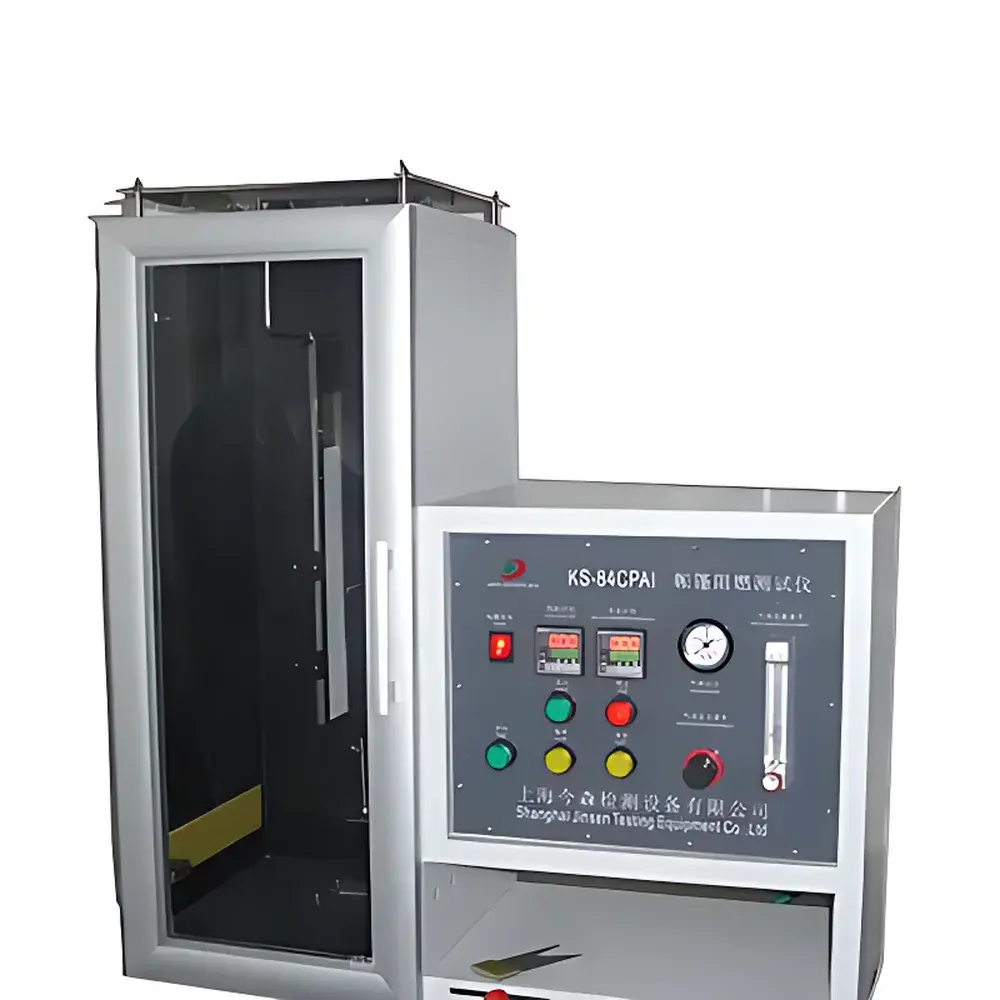
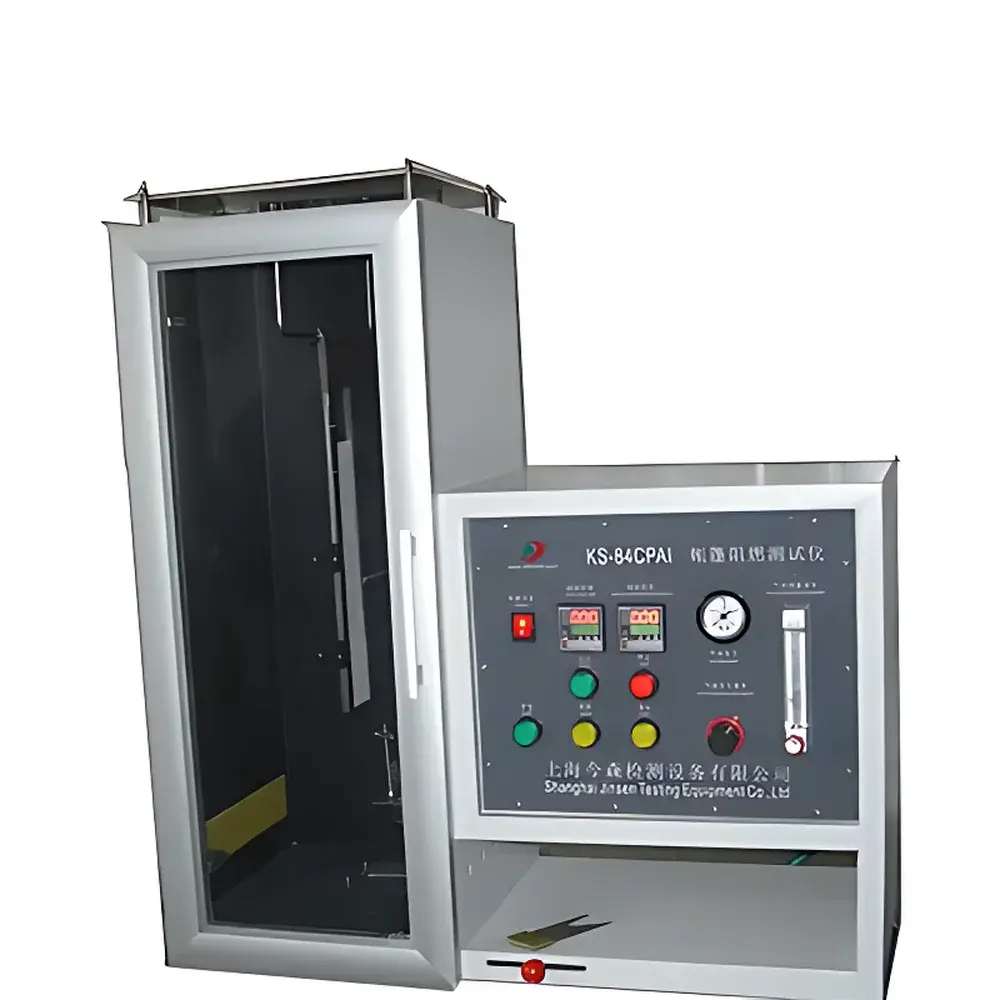
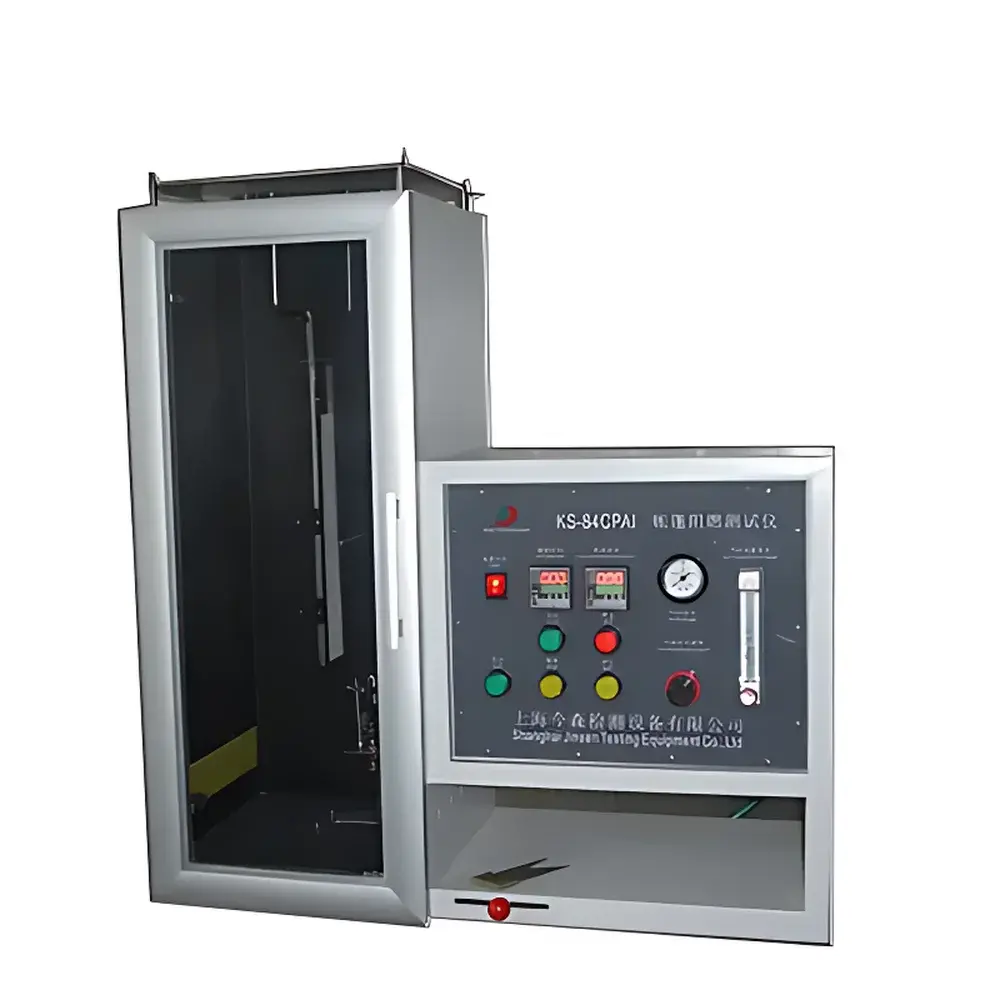
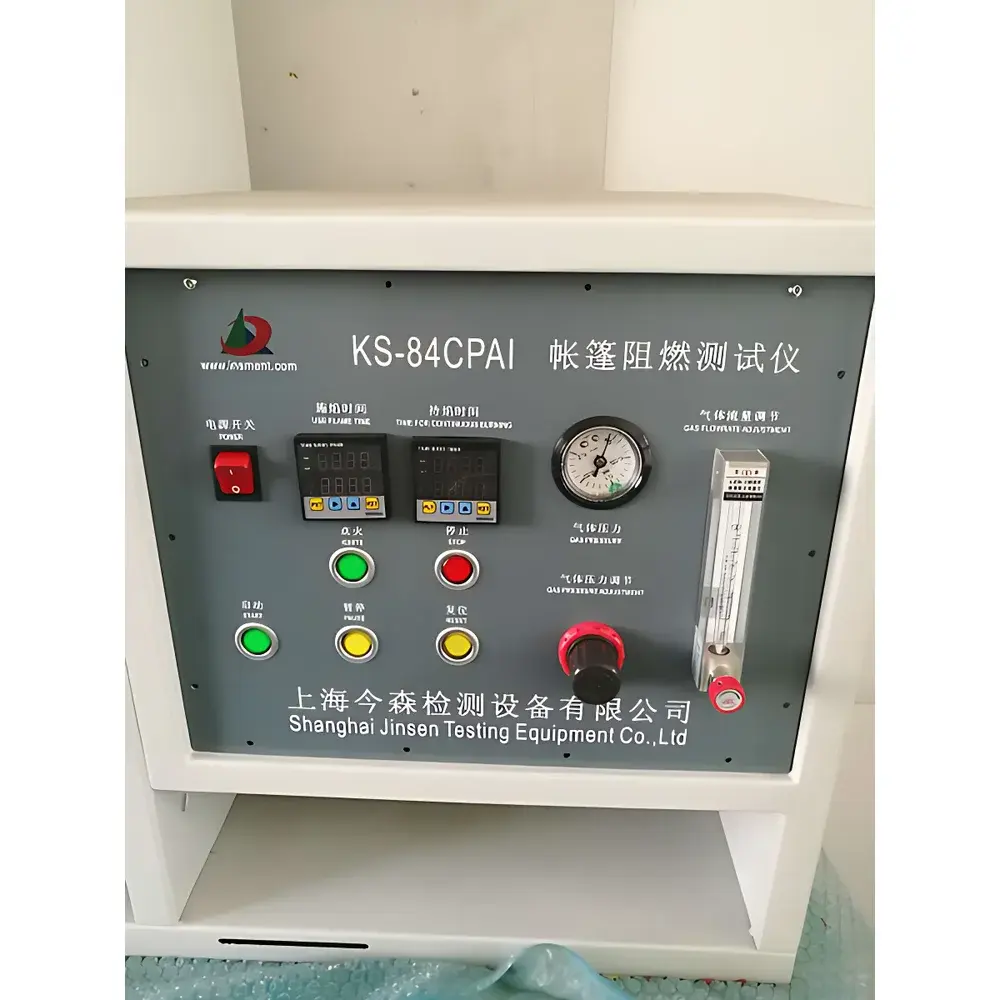
Shanghai Jinsen KS-84CPA CPAI-84 Vertical Flame Resistance Tester for Tent Fabrics
| Brand | Shanghai Jinsen / Insment |
|---|---|
| Origin | Shanghai, China |
| Model | KS-84CPA |
| Compliance Standard | CPAI-84 (1995 Edition) |
| Test Method | Vertical Flame Test |
| Sample Mounting | Stainless Steel Clip Fixture |
| Flame Source | Methane Gas Burner |
| Flame Height | 38 ± 2 mm (adjustable) |
| Ignition Duration | 12 s (pre-set, adjustable) |
| Afterflame Time Measurement Range | 1.0–999.9 s (digital display, manual hold function) |
| Specimen Dimensions | Bottom material: 230 × 230 mm (±3 mm), Wall & roof materials: 90 × 300 mm (±3 mm), four specimens per orientation |
| Burner Dimensions | 320 × 320 × 760 mm (W×D×H) |
| Gas Inlet Pressure | 2.5 ± 0.25 psi |
| Methane Purity | ≥97% |
| Observation Window | Transparent tempered glass |
| Air Ventilation | Integrated passive airflow ports |
| Control System | Electromechanical interface with manual flame adjustment valve |
| Reference Flame Gauge | 1.6 mm diameter pilot tube, positioned 3 mm from burner edge, flame length 3 mm |
| Specimen Holder Alignment | Centered vertical positioning via fixed clamping block |
Overview
The Shanghai Jinsen KS-84CPA CPAI-84 Vertical Flame Resistance Tester is a purpose-built combustion test apparatus engineered to evaluate the flame propagation behavior of tent fabrics and related outdoor textile assemblies in accordance with the CPAI-84 (1995) standard — a widely recognized specification developed by the Canvas Products Association International for recreational and commercial tenting materials. This instrument implements the vertical flame test method, wherein a conditioned specimen is mounted vertically in a controlled enclosure and exposed to a standardized methane-fueled flame for precisely 12 seconds. The test quantifies critical fire performance parameters: afterflame time (the duration of flaming combustion following flame removal), afterglow time (if applicable), and char length (the maximum extent of thermal degradation along the specimen’s length). These metrics collectively determine compliance with CPAI-84 pass/fail criteria, which mandate that afterflame time must not exceed 2 seconds, afterglow time must be ≤2 seconds, and char length must remain ≤254 mm (10 inches). The KS-84CPA’s rigid mechanical architecture ensures repeatable specimen alignment, consistent burner geometry, and stable thermal boundary conditions — essential for inter-laboratory reproducibility in third-party certification and internal quality assurance workflows.
Key Features
- Precision-engineered vertical flame test chamber (320 × 320 × 760 mm) constructed from non-combustible, heat-resistant materials with integrated passive ventilation ports to maintain stoichiometric air supply without forced draft interference.
- Calibrated methane burner assembly featuring a 5 mm ID stainless steel nozzle, fixed orifice, and adjustable inlet pressure regulator (2.5 ± 0.25 psi) enabling stable 38 ± 2 mm blue conical flame height — verified using an integrated 1.6 mm reference pilot tube positioned 3 mm from burner edge.
- Digital afterflame timer with 0.1 s resolution, manual hold functionality, and automatic start/stop triggering synchronized to burner motion, supporting ASTM E84 and ISO 6927 traceability protocols.
- Stainless steel specimen holder system with center-aligned clamping blocks ensuring perpendicular specimen orientation and consistent 20 mm flame-to-specimen distance — critical for eliminating positional variance per CPAI-84 Clause 6.2.
- Tempered transparent observation window facilitating real-time visual monitoring while maintaining operator safety and environmental isolation during test execution.
- Electromechanical control panel with intuitive flame adjustment valve, ignition switch, and specimen mounting indicators — designed for low-maintenance operation in QC laboratories and certification facilities.
Sample Compatibility & Compliance
The KS-84CPA accommodates standardized fabric specimens per CPAI-84 Section 5: four 90 × 300 mm (±3 mm) strips cut along warp and weft directions for wall and roof materials, plus four 230 × 230 mm (±3 mm) squares for floor components. All specimens undergo mandatory preconditioning at 21 ± 1 °C and 65 ± 5 % RH for minimum 4 hours prior to testing, as stipulated in CPAI-84 Annex A. The system supports both coated and uncoated synthetic textiles (e.g., polyester, nylon, polyethylene laminates) and hybrid composites commonly used in expedition-grade tents. While CPAI-84 remains the primary compliance benchmark, test data generated on this platform may inform supplementary assessments aligned with NFPA 701 (small-scale vertical test), CAN/ULC-S109, or ISO 6941 — provided specimen preparation and reporting follow respective standard annexes. The apparatus itself does not carry UL, CE, or UKCA marking; users are responsible for validating installation against local electrical codes (IEC 61000-6-3/4) and laboratory safety protocols (OSHA 1910.120, NFPA 56).
Software & Data Management
The KS-84CPA operates via dedicated electromechanical controls without embedded firmware or digital connectivity. All test parameters — ignition timing, flame duration, afterflame measurement, and char length — are recorded manually in laboratory notebooks or LIMS-integrated spreadsheets. To support GLP/GMP audit readiness, users are advised to document: specimen lot number, preconditioning log, operator ID, ambient temperature/humidity at time of test, methane cylinder batch ID, and raw timer readings. For laboratories requiring electronic records compliant with FDA 21 CFR Part 11, integration with external data acquisition systems (e.g., USB-connected stopwatches with timestamp export, calibrated digital calipers with CSV output) is feasible via standard analog interfaces. Calibration verification — including flame height confirmation using the built-in gauge and pressure gauge cross-checks — must be performed before each test series and logged per ISO/IEC 17025 Clause 7.7.
Applications
This tester serves laboratories engaged in textile flammability evaluation for outdoor recreation equipment manufacturers, independent testing service providers accredited to ISO/IEC 17025, and regulatory bodies performing surveillance sampling of imported camping gear. Typical use cases include pre-production validation of flame-retardant finishes (e.g., Pyrovatex®, Proban®), comparative assessment of halogen-free vs. brominated FR chemistries, durability evaluation after accelerated weathering (ISO 4892-3), and root-cause analysis of field-reported burn incidents. It is also employed in academic research investigating char-forming mechanisms in cellulosic-polyester blends and evaluating the impact of seam tape adhesion strength on flame barrier integrity under vertical orientation.
FAQ
Does the KS-84CPA comply with current CPAI-84 editions beyond 1995?
The KS-84CPA was designed explicitly for CPAI-84 (1995). Subsequent revisions (e.g., CPAI-84:2020) introduced updated specimen mounting fixtures and photometric flame verification — modifications not supported by this model’s mechanical configuration.
Can propane be substituted for methane?
No. CPAI-84 mandates methane (≥97% purity) to ensure consistent Btu content and flame thermodynamics. Propane alters flame temperature, velocity, and heat flux, invalidating compliance claims.
Is calibration certification included with purchase?
Factory calibration data for pressure regulators and flame gauges is provided; however, accredited third-party calibration certificates (e.g., NIST-traceable) must be obtained separately per user laboratory quality procedures.
What maintenance intervals are recommended?
Burner nozzles should be inspected weekly for carbon buildup; pressure regulators require quarterly verification against master gauges; observation windows must be cleaned with non-abrasive solvents after each test series to prevent soot accumulation.
Does the unit meet electrical safety standards for North American labs?
The 220 V / 0.5 kVA configuration complies with IEC 61010-1 for laboratory equipment but requires step-down transformer integration for 120 V nominal supply environments; grounding continuity must be validated prior to first operation.



