
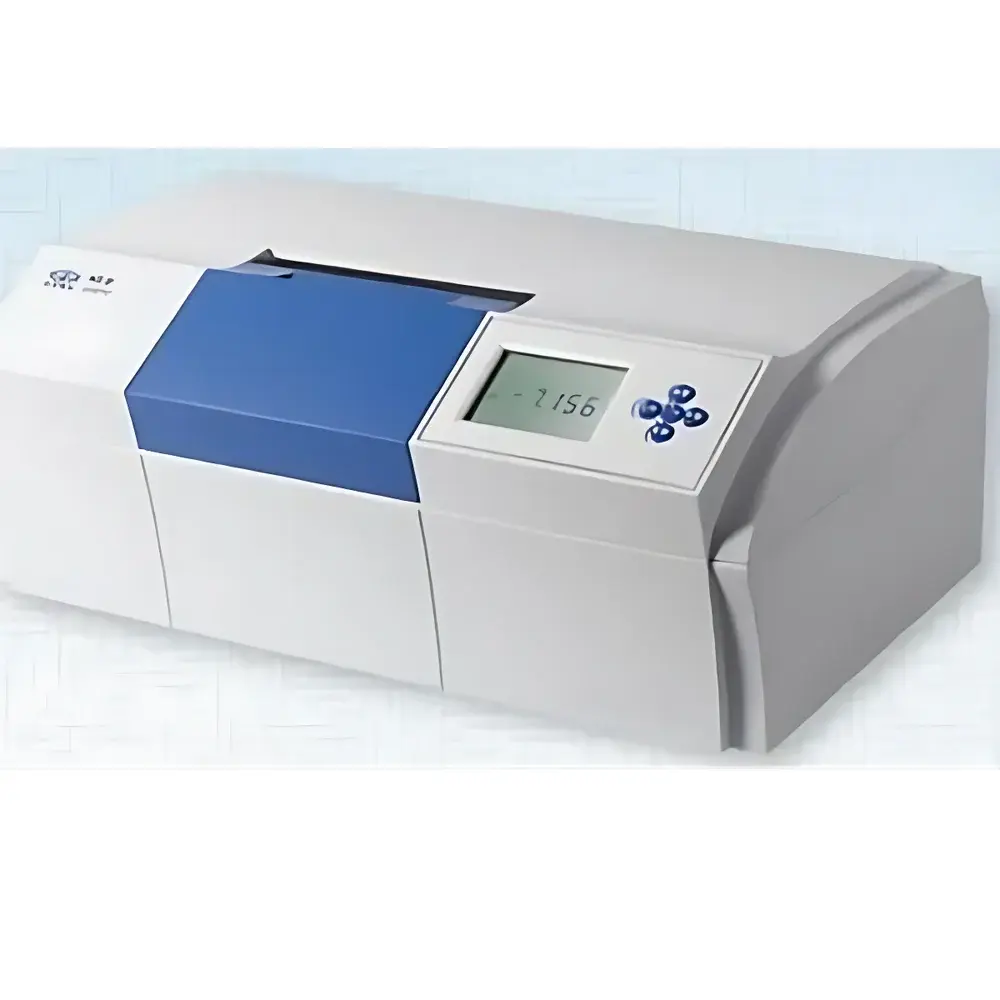
Shanghai Physical Optics WZZ-3 Digital Automatic Polarimeter
| Brand | YDWG (Shanghai Physical Optics) |
|---|---|
| Origin | Shanghai, China |
| Model | WZZ-3 |
| Type | Automatic Polarimeter |
| Display | 128×64 LCD |
| Temperature Control | None |
| Light Source | Sodium D-line equivalent (589.3 nm) |
| Measurement Range | ±45° |
| Resolution | 0.001° |
| Accuracy | ±(0.01 + 0.05% of reading)° (optical rotation), Grade 0.05 |
| Output Interface | RS232 |
| Data Functions | Auto-replicate measurement, mean & RMS calculation, specific rotation & sugar concentration conversion |
Overview
The Shanghai Physical Optics WZZ-3 Digital Automatic Polarimeter is a precision optical instrument engineered for the quantitative determination of optical rotation in optically active substances—primarily chiral compounds such as sugars, amino acids, pharmaceuticals, and natural products. Based on the fundamental principle of polarimetry—measuring the angular deviation of plane-polarized light as it passes through a chiral medium—the WZZ-3 employs a solid-state photodetector array and microprocessor-based control to deliver repeatable, operator-independent measurements. Designed for routine quality control and research applications in pharmaceutical, food, chemical, and academic laboratories, the instrument operates at the sodium D-line wavelength (589.3 nm), ensuring compatibility with established pharmacopoeial methods including USP , EP 2.2.7, and ChP IV. Its fixed-wavelength configuration and absence of temperature regulation position it as a cost-effective, entry-level platform for laboratories requiring compliance-grade data without advanced environmental control.
Key Features
- Digital automatic measurement with real-time angular readout to 0.001° resolution on a 128×64 dot-matrix LCD display
- Comprehensive calculation suite: direct output of optical rotation (α), specific rotation ([α]), and sucrose concentration (°Z) using built-in formulas per international conventions
- Statistical functionality: automatic replicate measurement (up to 3 cycles), computation of arithmetic mean and root-mean-square (RMS) deviation for improved data robustness
- RS232 serial interface compliant with standard PC communication protocols, enabling raw data export for external validation, audit trail generation, or integration into LIMS environments
- Robust mechanical design featuring a calibrated half-shade field compensator and precision-stabilized polarizer/analyzer optics optimized for long-term alignment stability
- Grade 0.05 accuracy certified per JJG 536–2015 (Chinese National Verification Regulation for Polarimeters), meeting minimum requirements for GLP-compliant documentation in non-GMP settings
Sample Compatibility & Compliance
The WZZ-3 accommodates standard 100 mm and 200 mm path-length sample cells (supplied separately), supporting both liquid solutions and clear, particle-free suspensions within typical solvent systems (e.g., water, ethanol, chloroform). It is routinely deployed for assay of dextrose, sucrose, lactose, and fructose in food and beverage QC; enantiomeric purity assessment of synthetic intermediates in fine chemical manufacturing; and identity verification of APIs per ICH Q5C guidelines. While lacking active temperature control, its thermal mass and ambient-stable optical train yield ≤0.02° drift over 30 minutes under ISO 17025-controlled lab conditions (20–25°C, <60% RH). The instrument satisfies basic metrological traceability requirements under ISO/IEC 17025:2017 when operated with NIST-traceable quartz calibration plates (e.g., ±5°, ±10°, ±30°).
Software & Data Management
No proprietary software is bundled; however, the RS232 interface supports ASCII-formatted output (e.g., “ROT=+12.345°rn”) compatible with generic terminal emulators (Tera Term, PuTTY), Excel via VBA macros, or validated laboratory informatics platforms. Users may implement manual audit trails by timestamping exported datasets and retaining original instrument printouts (when paired with optional serial-to-USB adapters and line printers). Though not 21 CFR Part 11 compliant out-of-the-box, the WZZ-3 can be embedded within broader GxP workflows where electronic records are generated externally and linked to instrument-generated hardcopy or CSV logs—consistent with FDA guidance on legacy instrumentation in hybrid environments.
Applications
- Pharmaceutical: Identity testing and assay of chiral actives (e.g., levofloxacin, ibuprofen, L-DOPA) per USP monographs
- Food & Beverage: Sucrose content quantification in syrups, juices, and confectionery per AOAC 951.02 and ICUMSA methods
- Academic Research: Teaching core concepts of molecular chirality, optical activity, and stereochemistry in undergraduate physical chemistry labs
- Chemical Manufacturing: In-process verification of asymmetric synthesis outcomes and batch release testing of enantiomerically enriched intermediates
- Essential Oil & Flavor Industry: Purity assessment of limonene, carvone, and other terpenoid constituents based on reference-specific rotation values
FAQ
Does the WZZ-3 support temperature-controlled measurements?
No. The instrument operates at ambient laboratory temperature only and does not include a thermostatic cell holder or Peltier module.
What calibration standards are recommended for routine verification?
NIST-traceable quartz rotatory dispersion plates (e.g., SRM 8500 series) or certified sucrose solutions prepared per USP general chapter .
Can the WZZ-3 measure samples with turbidity or high absorbance?
No. Optical rotation measurement requires transmission of polarized light; samples must be optically clear with absorbance <1.5 AU at 589 nm.
Is the RS232 output format documented and programmable?
Yes—ASCII protocol is fixed: [CR][LF]-terminated lines containing “ROT=±X.XXX°”, “CONC=Y.YYY°Z”, or “SPEC=[α]D²⁰=±Z.ZZZ” depending on selected mode.
How is measurement uncertainty calculated per the stated accuracy specification?
Total uncertainty = ±(0.01° + 0.05% of displayed reading), representing combined effects of linearity error, detector noise, and mechanical hysteresis under defined operating conditions.





