
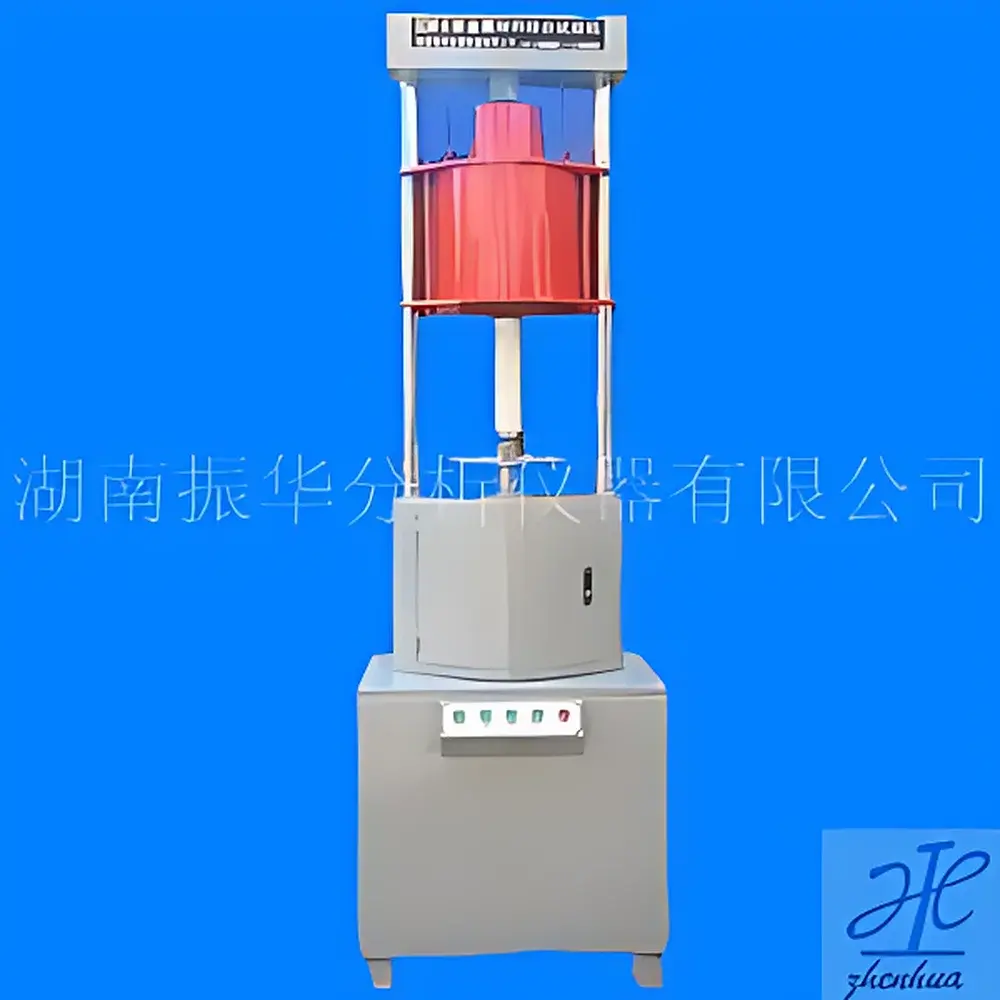
Shanghai Qianwei SQW-II-14 High-Temperature Comprehensive Physical Property Tester
| Origin | Hunan, China |
|---|---|
| Manufacturer Type | Authorized Distributor |
| Regional Origin | Domestic (PRC) |
| Model | SQW-II-14 |
| Price Range | USD 7,000 – 14,000 |
| Temperature Range | Ambient to 1350 °C (short-term up to 1400 °C) |
| Max Load Capacity | 0–28.29 MPa (0–2000 kgf) |
| Deformation Measurement Range | 0–5 mm (resolution: 0.01 mm) |
| Force Accuracy | ±1 % FS |
| Deformation Accuracy | ±1 % FS |
| Heating Rate | Programmable, two-segment linear ramp |
| Furnace Type | Silicon Carbide (SiC) tube furnace, bore Ø50 mm, power 2.5 kW |
| Loading Speed | 0.8–8 mm/min (manually adjustable) |
| Dimensions (main unit) | 720 × 500 × 1644 mm |
| Weight | 500 kg |
| Power Consumption | <3 kW |
| Ambient Operating Conditions | 0–40 °C, RH <85 %, 220 V ±10 %, 50 Hz, grounded supply, no strong magnetic fields/vibration/corrosive gases |
| Control System | PC-based real-time control with data acquisition, automated report generation, and SQL-compatible database storage |
| Mechanical Drive | Precision ball-screw loading mechanism |
| Sample Geometry | Ø30 × 50 mm truncated cone |
| Compliance | Designed for ASTM E228, ISO 7991, GB/T 4339, and DIN 51045 testing protocols |
| Software Features | GLP-compliant audit trail, user-level access control, experimental sequence scripting, export to CSV/PDF/Excel |
Overview
The Shanghai Qianwei SQW-II-14 High-Temperature Comprehensive Physical Property Tester is an integrated thermal-mechanical characterization system engineered for precise evaluation of inorganic non-metallic materials—including refractories, foundry molding sands, ceramics, and high-temperature alloys—under controlled elevated temperatures. It operates on the principle of simultaneous thermomechanical loading and dimensional monitoring, enabling concurrent measurement of thermal expansion, compressive strength, thermal deformation under constant load, residual strength after thermal cycling, and ambient mechanical integrity. The instrument employs a silicon carbide (SiC) tubular furnace capable of sustained operation from ambient to 1350 °C, with short-term excursions to 1400 °C, ensuring compatibility with standard high-temperature material qualification protocols. Its dual-function architecture—combining dilatometric, compressive, and creep-like deformation analysis within a single platform—eliminates cross-instrument calibration drift and improves inter-test reproducibility in research and quality assurance laboratories.
Key Features
- Modular, rigid frame construction with precision-ground base and vertical column assembly, minimizing thermal drift and mechanical hysteresis during long-duration tests.
- Ball-screw-driven loading mechanism with manual speed adjustment (0.8–8 mm/min), delivering stable force application and eliminating hydraulic or pneumatic complexity.
- Dual-channel high-resolution transducer system: calibrated load cell (0–28.29 MPa) and linear variable differential transformer (LVDT)-based displacement sensor (0–5 mm, 0.01 mm resolution), both traceable to national metrology standards.
- Programmable two-segment heating profile control via embedded PID algorithm, supporting isothermal holds, linear ramps, and custom thermal cycles—fully synchronized with mechanical loading events.
- PC-based control interface with real-time graphical display of temperature, load, displacement, and derived parameters (e.g., coefficient of thermal expansion, stress–strain curves, deformation rate).
- Comprehensive data management: timestamped raw data logging at ≥10 Hz, automated report generation per ASTM/ISO templates, and SQL-backed database for version-controlled archival and audit-ready retrieval.
- GLP-aligned software architecture featuring role-based user authentication, electronic signatures, change history tracking, and 21 CFR Part 11–compatible audit trails (configurable per client requirements).
Sample Compatibility & Compliance
The SQW-II-14 accommodates standard Ø30 × 50 mm truncated cone specimens—commonly used in foundry sand testing and refractory evaluation—as defined in GB/T 2684 and ISO 18184. Optional alumina fixtures (upper/lower test columns, spacers, thermal shields) ensure thermal stability and minimize parasitic conduction errors. The system complies with core international standards for high-temperature mechanical testing, including ASTM E228 (linear thermal expansion), ISO 7991 (refractory compression at elevated temperature), DIN 51045 (dilatometry of ceramic bodies), and GB/T 4339 (metallic and non-metallic material thermal expansion). Its design supports GMP-relevant validation documentation packages (IQ/OQ/PQ), and all electrical subsystems meet IEC 61000-6-3 (EMC) and IEC 61010-1 (safety) requirements.
Software & Data Management
The proprietary QW-TestSuite v3.x software provides full lifecycle test management—from method definition and hardware initialization to post-processing and regulatory reporting. Experimental sequences are scriptable via intuitive drag-and-drop workflow builder; each run generates a unique digital fingerprint containing operator ID, calibration status, environmental logs, and raw sensor streams. Data export supports CSV (for third-party statistical analysis), PDF (formatted reports with company header/footer), and Excel (pivot-ready tabular output). Database schema is normalized and compatible with common laboratory information management systems (LIMS); optional API integration enables automated data ingestion into enterprise QA platforms. All software updates are digitally signed and version-locked to maintain validation integrity.
Applications
- Foundry R&D: Quantifying hot strength, thermal deformation, and collapse temperature of green and baked molding sands under simulated casting conditions.
- Refractory Qualification: Measuring permanent linear change, hot modulus of rupture (HMOR), and creep resistance of alumina-silica, magnesia-carbon, and zirconia-based linings.
- Ceramic Processing: Evaluating sintering shrinkage kinetics, glass transition behavior, and thermal mismatch stresses in multilayer co-fired ceramics (LTCC/HTCC).
- Advanced Materials Development: Characterizing thermal expansion anisotropy in CMCs (ceramic matrix composites) and residual stress evolution in functionally graded materials.
- Quality Control Labs: Routine verification of batch-to-batch consistency for high-purity oxides, nitrides, and borides used in semiconductor and aerospace applications.
FAQ
What sample geometries are supported beyond the standard Ø30 × 50 mm truncated cone?
Custom fixtures for cylindrical (Ø25–Ø40 mm) and rectangular prism specimens (up to 10 × 10 × 50 mm) are available as optional accessories; contact technical support for dimensional constraints and thermal uniformity validation reports.
Is the furnace atmosphere controllable?
The base configuration operates in ambient air; inert gas purging (N₂, Ar) is supported via optional quartz tube extension and mass flow controller integration—enabling oxidation-sensitive testing per ASTM C1338.
Can the system perform dynamic mechanical analysis (DMA) at high temperature?
No—the SQW-II-14 is optimized for quasi-static and slow-rate thermomechanical loading; for oscillatory viscoelastic characterization, consider complementary high-temperature DMA instrumentation.
What calibration services are included with purchase?
Factory calibration includes NIST-traceable load and displacement verification at three points across full range, plus furnace temperature uniformity mapping at 1000 °C and 1300 °C; annual recalibration kits and certified service visits are available under extended support contracts.
How is thermal expansion coefficient calculated in software?
CTE is computed automatically using the standard linear regression method over user-defined temperature intervals (e.g., 100–800 °C), with options to exclude transient regions and apply baseline correction per ISO 11359-2 guidelines.



