
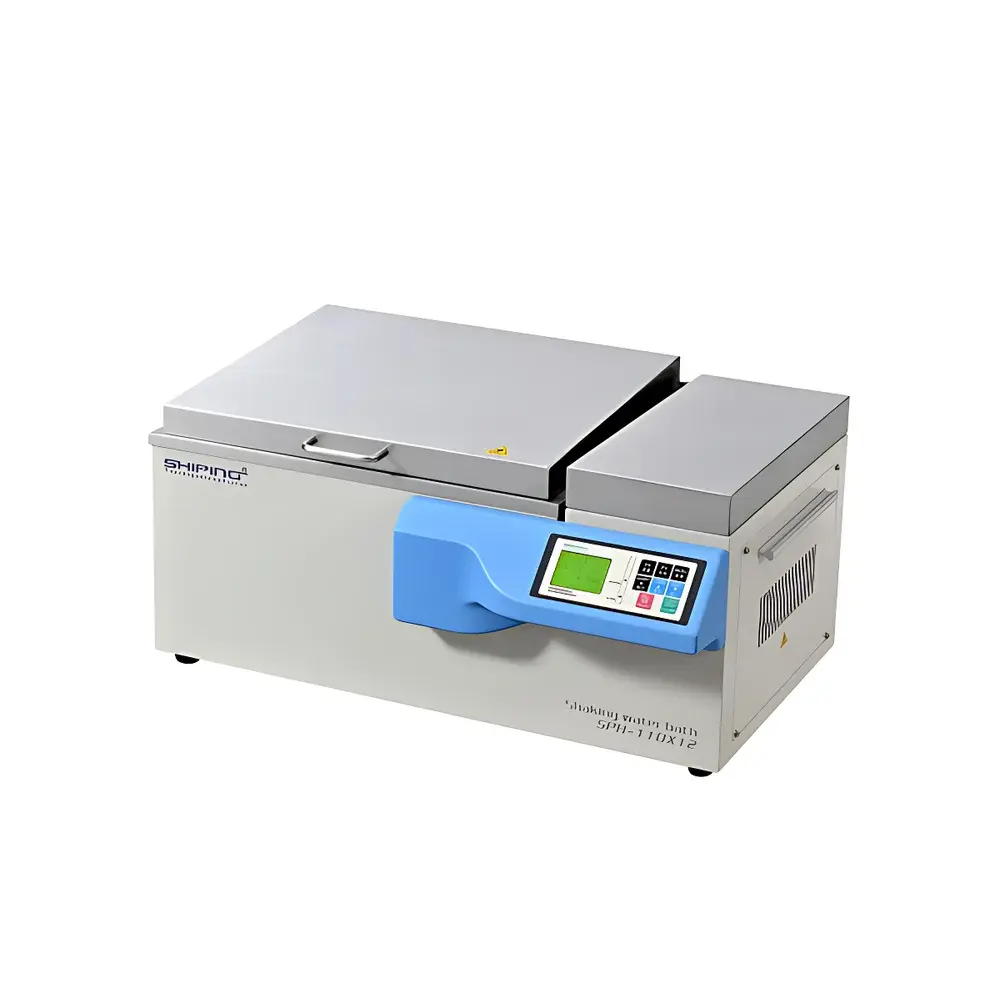
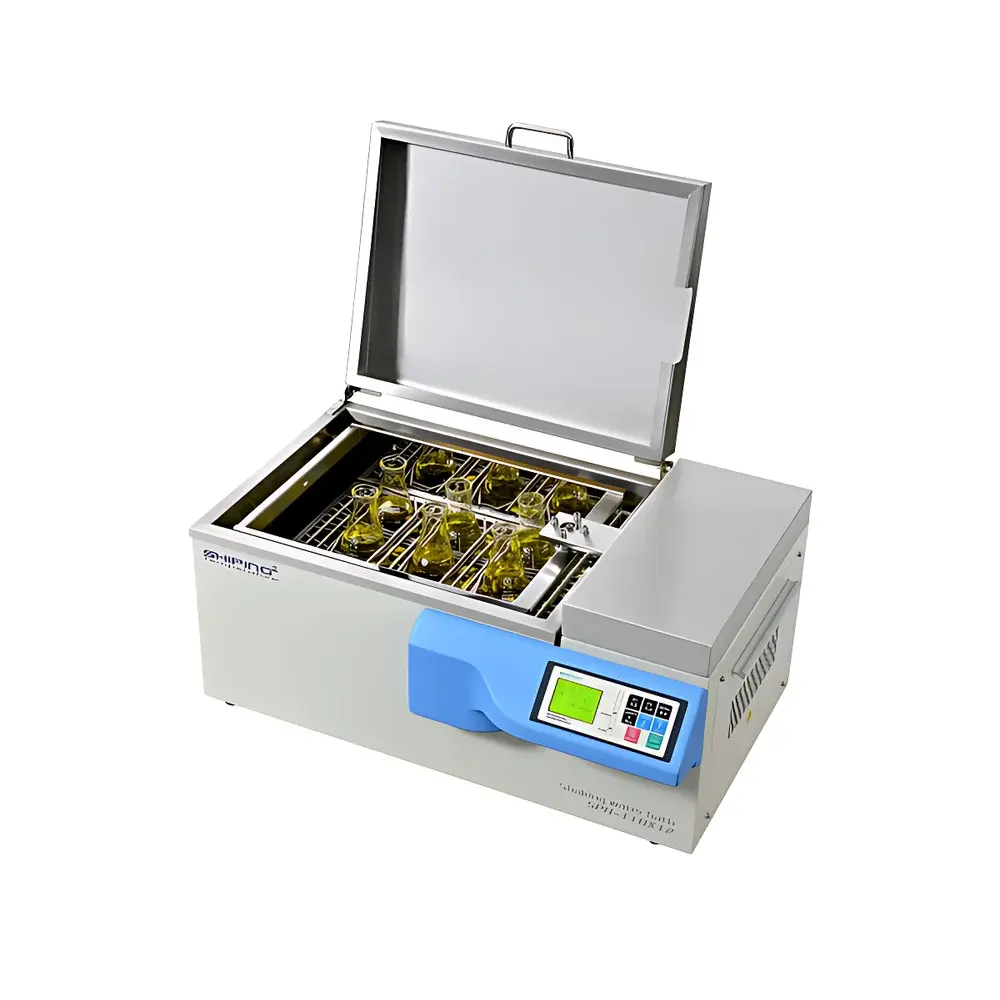
Shanghai Shiping SPH-110X12 Benchtop Reciprocating Water Bath Shaker
| Brand | Shanghai Shiping |
|---|---|
| Origin | Shanghai, China |
| Manufacturer Type | Direct Manufacturer |
| Instrument Type | Water Bath Incubator Shaker |
| Timer Range | 0–999.59 min |
| Oscillation Frequency | 20–200 rpm |
| Amplitude | Φ25 mm |
| Temperature Range | Ambient to 100 °C |
| Number of Shaking Platforms | 1 |
| Temperature Uniformity | ±0.2 °C |
| Temp. Control Accuracy | ±0.1 °C (at steady state) |
| Frequency Accuracy | ±1 rpm |
| Platform Size | 430 × 320 mm |
| Chamber Volume | 46 L |
| Max. Capacity | 12 × 250 mL or 11 × 500 mL or 6 × 1000 mL |
| Noise Level | <45 dB(A) |
| Power | 1900 W |
| Motor | 80 W Variable-Frequency Motor |
| Bearing | Imported NSK Double-Row Bearings |
| Construction Material | 316L Stainless Steel (Chamber & Platform) |
| Drive Mechanism | Single-Axis Parallel-Linkage Balanced Drive |
| Safety Features | Dual Over-Temp/Over-Speed Alarms, Independent Thermal Cut-Off, Leakage & Overcurrent Protection, Sensor Fault Detection |
Overview
The Shanghai Shiping SPH-110X12 Benchtop Reciprocating Water Bath Shaker is an engineered platform for precise temperature-controlled agitation of liquid samples in microbiological, biochemical, and pharmaceutical laboratories. It operates on the principle of reciprocating linear motion—driven by a single-axis parallel-linkage balanced mechanism—to deliver uniform, low-vibration oscillation across a wide frequency range (20–200 rpm) while maintaining stable thermal conditions from ambient to 100 °C. Unlike orbital shakers, this reciprocating design minimizes shear stress on sensitive biological suspensions, making it particularly suitable for bacterial culture expansion, enzyme kinetics studies, hybridization protocols, and tissue dissociation workflows where consistent mixing without excessive turbulence is critical. Its integrated water bath chamber ensures superior thermal homogeneity (±0.2 °C) and eliminates dry-heating artifacts common in air-jacketed systems.
Key Features
- High-stability single-axis drive system with parallel-linkage dynamic balancing—designed to eliminate mechanical friction, reduce energy consumption, and ensure silent operation (<45 dB[A]) over extended duty cycles.
- 316L stainless steel inner chamber and shaking platform—resistant to chlorides, acids, and alkalis; compliant with cleaning validation requirements under GMP and ISO 13485 frameworks.
- PID-based microprocessor control with LCD interface—enables intuitive parameter adjustment (temperature, speed, time), real-time monitoring, and eight-segment programmable ramping profiles.
- Dual-layer safety architecture: hardware-level independent over-temperature cut-off, dual-limit speed alarms, sensor fault diagnostics, and comprehensive electrical protection (leakage current, overvoltage, short-circuit).
- NSK-sourced double-row precision bearings rated for >100,000 hours of continuous operation—ensuring long-term mechanical reliability and minimal maintenance intervals.
- Configurable platform options: standard spring clamp or bottle holder configuration compatible with Erlenmeyer flasks (250–1000 mL), test tubes, and multi-well plates via optional adapters.
Sample Compatibility & Compliance
The SPH-110X12 accommodates standard laboratory glassware including borosilicate flasks (250 mL × 12, 500 mL × 11, or 1000 mL × 6) and supports aqueous, buffered, and mildly corrosive media. Its 316L stainless steel construction meets material compatibility requirements for USP , ASTM A240, and EN 10088-1 standards. The unit complies with IEC 61010-1:2010 for laboratory equipment safety and includes traceable calibration support for temperature and rotational speed—facilitating audit readiness for GLP, GMP, and FDA 21 CFR Part 11 environments when paired with validated software logs.
Software & Data Management
While the base model features standalone PID control, optional RS-485 or USB communication modules enable integration into centralized lab management systems. Firmware supports parameter encryption, user-level access control, automatic timestamped event logging (e.g., temperature excursions, alarm triggers, power interruptions), and recovery-on-resume functionality after grid failure. All operational parameters—including setpoints, actual readings, and alarm history—are retainable in non-volatile memory and exportable in CSV format for QA documentation and regulatory submissions.
Applications
This shaker serves core functions across academic research, clinical diagnostics, and industrial QC labs: microbial growth curve analysis under controlled thermal-agitation conditions; protein expression optimization in shake-flask bioreactors; DNA/RNA hybridization kinetics; immunoassay plate washing pre-incubation; dissolution testing per USP ; and environmental sample enrichment (e.g., coliform detection in water quality testing). Its stability at elevated temperatures (up to 100 °C) also supports applications such as wax bath preparation, agarose gel melting, and heat-mediated antigen retrieval in histopathology workflows.
FAQ
What is the maximum load capacity at 200 rpm?
At full speed (200 rpm), the recommended maximum total mass is 8 kg—including flask weight, medium volume, and clamping hardware—to maintain amplitude fidelity and thermal uniformity.
Can the unit be used for sterile applications?
Yes—the 316L chamber allows autoclaving of removable components and supports validated vapor-phase hydrogen peroxide (VHP) decontamination cycles when operated within specified humidity limits.
Is temperature calibration traceable to NIST standards?
Factory calibration uses NIST-traceable RTD probes; users may perform field verification using certified reference thermometers per ISO/IEC 17025 procedures.
Does the shaker support external temperature probes?
An optional PT100 input port is available for real-time monitoring of sample-specific temperature (e.g., inside a flask), decoupled from bath setpoint control.
What maintenance intervals are recommended?
Bearing inspection every 24 months; silicone seal replacement every 36 months; annual verification of thermal and speed accuracy using calibrated instrumentation.





