Shanghai Shiping SPH-322D Floor-Standing Orbital Shaker
| Brand | Shanghai Shiping |
|---|---|
| Origin | Shanghai, China |
| Manufacturer Type | Direct Manufacturer |
| Product Category | Domestic |
| Model | SPH-322D |
| Price Range | USD 2,800 – 7,000 |
| Instrument Type | Orbital Shaker |
| Timer Range | 0–999.59 h |
| Oscillation Speed | 30–300 rpm |
| Orbit Diameter | 50 mm |
| Temperature Control | Ambient Only |
| Platform Quantity | 1 |
| Power Consumption | 290 W |
| Voltage | AC 200–240 V, 50–60 Hz |
| Net Weight | 323 kg |
| Dimensions (W×D×H) | 1210 × 795 × 380 mm |
| Platform Size | 1108 × 740 mm |
| Max Load Capacity | 12 × 5000 mL or 40 × 1000 mL or 60 × 500 mL or 96 × 250 mL |
| Speed Accuracy | ±1 rpm |
| Noise Level | <45 dB(A) |
| Bearing | NSK Imported Double-Row Ball Bearings |
| Drive Mechanism | Single-Axis Parallel-Linkage Dynamic Balancing System |
| Structural Frame | Ductile Iron Core Components with Precision Machined Steel Shafts (AISI 1045, 220–250 HBW) |
Overview
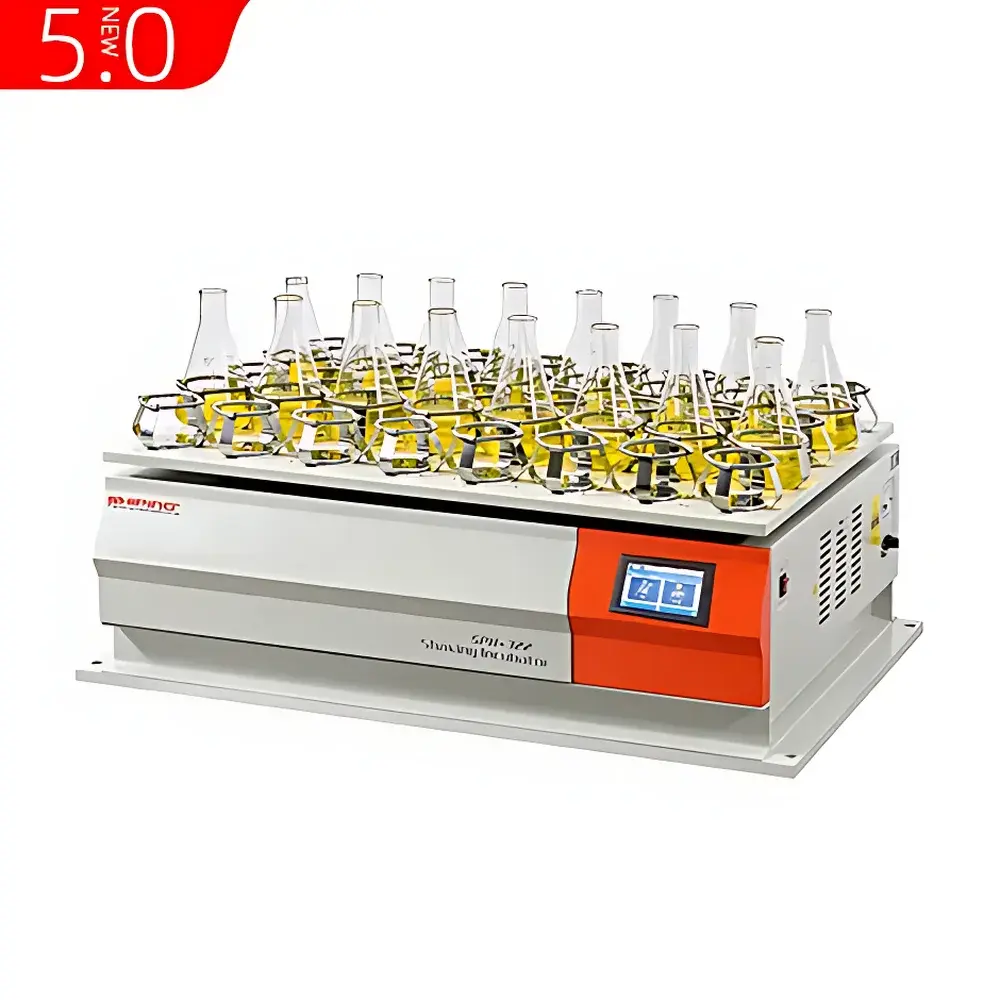
The Shanghai Shiping SPH-322D Floor-Standing Orbital Shaker is an engineered platform for consistent, low-shear, large-volume liquid mixing under ambient conditions. Designed around the orbital motion principle—where the platform rotates in a circular path at a defined diameter (50 mm)—this shaker delivers uniform agitation ideal for aerobic microbial growth, suspension cell culture, enzyme kinetics assays, and biochemical incubation protocols. Its robust floor-standing architecture eliminates benchtop space constraints while supporting high-capacity vessel configurations up to 96 × 250 mL flasks or 12 × 5 L bottles. The device operates without integrated heating or cooling; it is intended for use in temperature-controlled laboratory environments where ambient stability is maintained externally (e.g., climate-controlled rooms or cold rooms). All mechanical motion is governed by a single-axis parallel-linkage dynamic balancing system, minimizing harmonic vibration transmission and ensuring long-term operational fidelity.
Key Features
- Single-axis parallel-linkage drive mechanism: Eliminates mechanical friction through precision-engineered ductile iron linkages and dynamically balanced counterweights—enabling continuous operation with <45 dB(A) acoustic output and ±1 rpm speed accuracy.
- NSK double-row ball bearings: Factory-installed, pre-lubricated, and rated for ≥100,000 hours of nominal service life under full-load conditions.
- PID microprocessor control with LCD interface: Enables intuitive parameter adjustment—including speed, timer, and programmable multi-segment profiles—without specialized training.
- Triple-layer safety architecture: Includes independent overspeed audible/visual alarm, leakage current protection, overcurrent circuit interruption, and automatic restart after power recovery.
- Structural integrity: Core load-bearing components fabricated from ASTM A536 Grade 65-45-12 ductile iron; shafts machined from AISI 1045 steel (220–250 HBW hardness); platform frame reinforced with cold-rolled structural steel sections.
- Programmable operation modes: Supports repeat-cycle, stepwise, and 8-segment time-speed curve programming for complex kinetic experiments.
Sample Compatibility & Compliance
The SPH-322D accommodates standard microbiological and bioprocess vessels including Erlenmeyer flasks (100–5000 mL), Fernbach flasks, baffled bottles, and deep-well microplates (with optional clamping adapters). Its 1108 × 740 mm platform supports custom fixture mounting for non-standard containers. While the unit itself is not certified to ISO/IEC 17025 or FDA 21 CFR Part 11, its control firmware logs all runtime parameters (speed, elapsed time, alarms) with timestamped records suitable for GLP-compliant documentation when paired with external audit-trail software. It complies with IEC 61000-6-3 (EMC emission limits) and IEC 61000-6-2 (immunity standards), and meets CE marking requirements for machinery safety (2006/42/EC).
Software & Data Management
The embedded PID controller stores up to 10 user-defined protocols with persistent memory retention during power loss. All operational data—including start/stop timestamps, cumulative run time, and alarm event logs—are accessible via front-panel LCD navigation. No proprietary PC software is required; however, RS-232 or optional RS-485 interfaces enable integration with LabVantage, STARLIMS, or custom SCADA systems for centralized monitoring. Audit-ready data export requires third-party serial logging tools compliant with 21 CFR Part 11 electronic record controls (e.g., validated terminal emulators with digital signature support).
Applications
- Bacterial and yeast cultivation in shake-flask bioreactors for strain screening and media optimization.
- Suspension-based mammalian cell expansion prior to bioreactor inoculation.
- Enzyme activity assays requiring homogeneous substrate mixing without shear-induced denaturation.
- DNA hybridization and antigen-antibody binding kinetics in molecular diagnostics workflows.
- Environmental sample homogenization for wastewater microbiology or soil extract preparation.
- Pharmaceutical excipient blending validation studies under GMP-aligned environmental controls.
FAQ
Does the SPH-322D include temperature control?
No. This model operates at ambient temperature only. For thermostatic applications, integrate it within a climate-controlled room or pair with an external incubator chamber.
Can the shaker accommodate stacked platforms or multi-tier configurations?
No. The SPH-322D is configured with a single fixed platform. Multi-level agitation requires separate units or alternative stackable shaker models.
What maintenance intervals are recommended for the NSK bearings?
The sealed double-row bearings are lifetime-lubricated and require no routine greasing. Visual inspection every 12 months is advised for dust ingress or abnormal vibration signatures.
Is the unit compatible with 110 V / 60 Hz power supplies?
No. The SPH-322D accepts only 200–240 V AC, 50–60 Hz input. Use of a step-up transformer is not recommended due to sustained 290 W load and potential waveform distortion.
How is calibration verified for speed accuracy?
Speed calibration is performed at factory using traceable optical tachometry per ISO 2789. End users may verify in situ with a handheld laser tachometer referenced to NIST-traceable standards.
Related Products