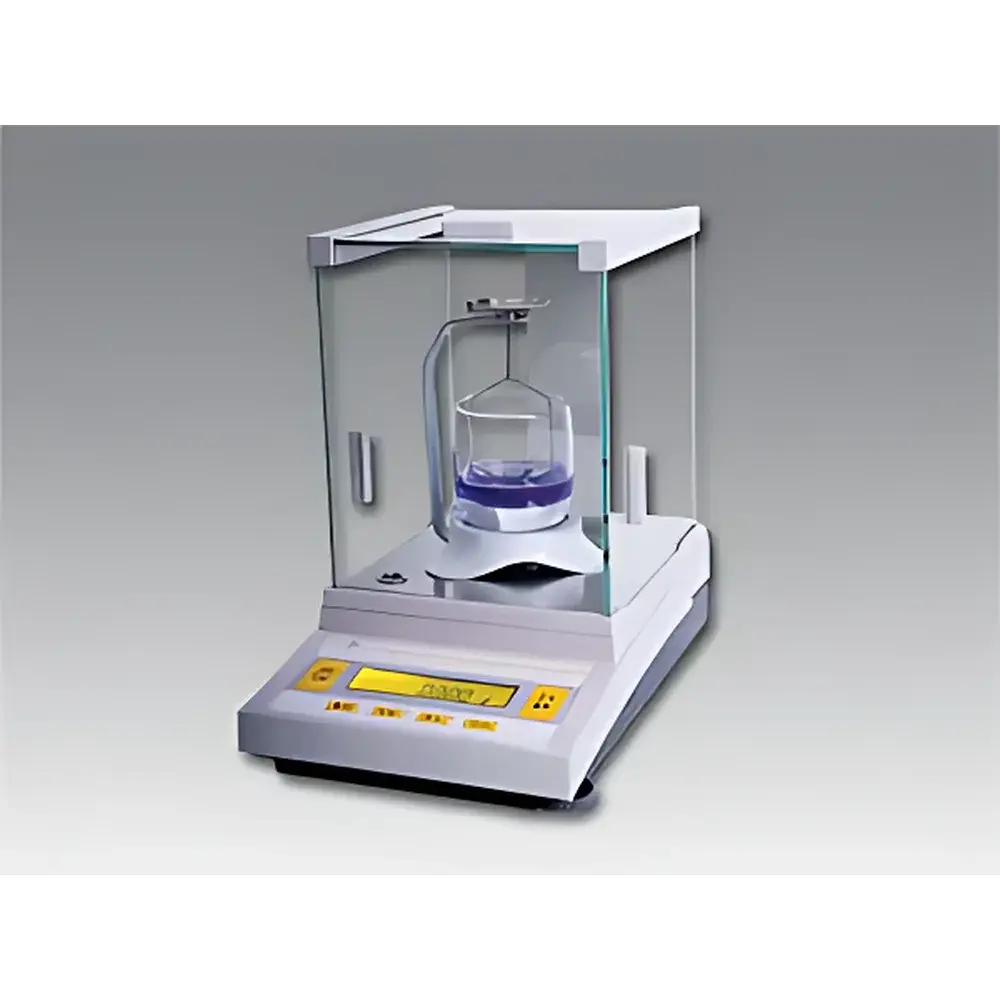
Shanghai SOPTOP JA5003J Electronic Density Balance
| Brand | SOPTOP |
|---|---|
| Origin | Shanghai, China |
| Model | JA5003J |
| Maximum Capacity | 500 g |
| Readability | 1 mg |
| Repeatability | ±1 mg |
| Calibration | External |
| Interface | RS232C |
| Minimum Sample Mass in Air | ≥0.25 g |
| Minimum Buoyant Force in Water | < −0.125 g |
| Density Measurement Resolution | 0.001 g/cm³ |
| Application Type | Solid & Liquid Density Determination via Archimedean Principle |
Overview
The Shanghai SOPTOP JA5003J Electronic Density Balance is a precision laboratory instrument engineered for rapid, non-destructive density determination of solid and liquid samples using the Archimedean principle. Unlike conventional analytical balances, the JA5003J integrates a dedicated density measurement module—comprising a high-stability suspension assembly, precision hook, and auxiliary sinker—to enable dual-mass acquisition: sample mass in air and apparent mass when fully immersed in a reference fluid (typically distilled water at 20 °C). The system calculates true density (ρ) automatically using the formula ρ = mair / [(mair − mwater) × ρfluid], where ρfluid is either pre-configured or user-defined. Designed for routine QC labs and R&D environments, it delivers traceable, reproducible results without requiring volumetric glassware or manual calculation—reducing operator error and throughput time significantly.
Key Features
- High-resolution weighing system with 1 mg readability and ±1 mg repeatability across the full 500 g capacity range
- Dedicated density measurement mode supporting both solid and liquid sample protocols per ISO 1183-1 and ASTM D792
- Preloaded standard liquid density library (e.g., water at 20 °C = 0.9982 g/cm³; ethanol = 0.789 g/cm³) with option to define custom reference fluids
- Integrated RS232C serial interface for direct data export to LIMS, Excel, or custom QA software—enabling automated record retention
- External calibration compatible with Class M1 or better weights; full calibration verification log accessible via front-panel menu
- Optimized suspension geometry minimizing air-current interference and thermal drift during immersion measurements
- Minimum detectable buoyant force of < −0.125 g ensures reliable measurement of low-density solids (e.g., foams, expanded polymers) down to ~0.25 g net mass in air
Sample Compatibility & Compliance
The JA5003J accommodates heterogeneous materials including granular plastics, rubber compounds, sintered metal powders, ceramic tiles, graphite electrodes, optical glass blanks, and viscous chemical solutions. Its open-platform design permits use with standard laboratory sinkers (stainless steel or PTFE-coated), temperature-controlled water baths (for thermal expansion correction), and anti-static enclosures where required. All density calculations comply with internationally recognized standards: ISO 1183-1 (plastics), ISO 2781 (rubber), ASTM D792 (density and specific gravity of plastics), and ASTM D1475 (density of liquid coatings). For regulated environments, the balance supports audit-ready operation—calibration events, date/time stamps, and operator IDs are retained in internal memory and exportable via RS232C for GLP/GMP documentation.
Software & Data Management
No proprietary software installation is required—the JA5003J operates as a plug-and-play device via RS232C. ASCII-formatted output includes timestamp, measurement mode (solid/liquid), mair, mwater, calculated density (g/cm³), and status flags (e.g., “CAL OK”, “UNDERLOAD”, “OVERLOAD”). Optional third-party integration packages support real-time plotting, statistical process control (SPC) charting, and automatic pass/fail flagging against user-defined specification limits. All data fields are human-readable and CSV-compatible, facilitating seamless import into ELN systems compliant with 21 CFR Part 11 requirements when paired with appropriate electronic signature controls.
Applications
- Quality assurance of injection-molded polymer parts in automotive and electronics supply chains
- Density grading of recycled PET flakes prior to extrusion
- Verification of sintered density in powder metallurgy components (e.g., tungsten carbide bushings)
- Batch consistency testing of silicone elastomers and thermoplastic vulcanizates (TPVs)
- Concentration monitoring of aqueous electrolyte solutions in battery material synthesis
- Porosity estimation of ceramic green bodies via theoretical vs. measured density comparison
- Raw material screening for graphite anode powders in lithium-ion battery R&D
FAQ
What is the minimum sample mass required for accurate density measurement?
For reliable results, the sample must weigh ≥0.25 g in air and generate a measurable buoyant force >0.125 g in water—ensuring signal-to-noise ratio meets metrological requirements.
Can the JA5003J measure the density of porous or irregularly shaped solids?
Yes—provided the sample is fully submersible and non-reactive with water or alternative immersion fluids (e.g., isopropanol for hygroscopic materials). Surface sealing with paraffin wax may be applied per ASTM D2766 if open porosity is present.
Is temperature compensation built into the density calculation?
The unit does not include integrated temperature sensing; however, users may input the actual fluid temperature manually to select the correct reference density value from NIST-traceable tables.
Does the balance support GLP-compliant audit trails?
Calibration history, date/time stamps, and operator codes are stored internally and exportable—enabling reconstruction of measurement provenance when used with validated external data capture systems.
What maintenance is required to sustain long-term accuracy?
Routine cleaning of the weighing pan and suspension hook, annual verification with certified test weights, and periodic inspection of the sinker’s surface integrity (to prevent air entrapment) are recommended per ISO/IEC 17025 guidance.