
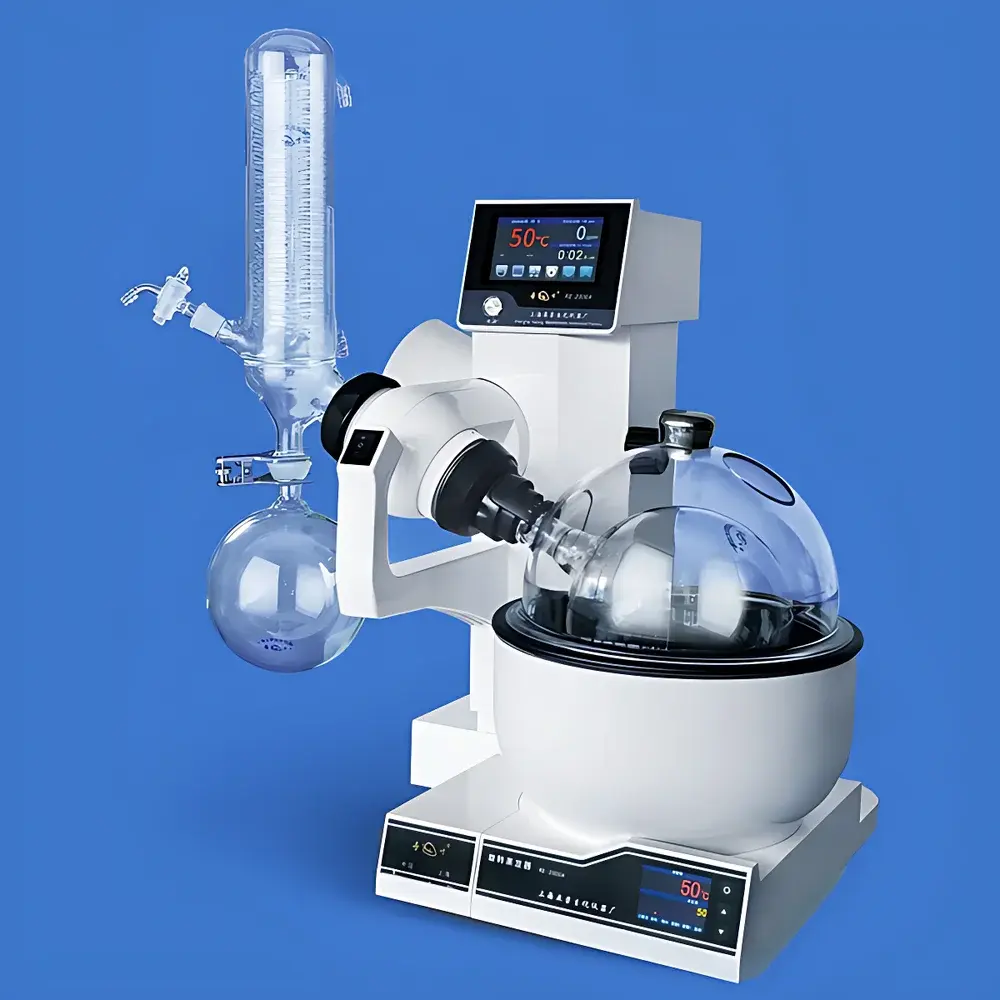
Shanghai Yarong RE-2000A Rotary Evaporator
| Brand | Shanghai Yarong |
|---|---|
| Model | RE-2000A |
| Evaporation Flask Capacity | 50–2000 mL |
| Rotational Speed Range | 0–200 rpm |
| Temperature Control Range | Ambient to 99 °C (PID-controlled, LED digital display) |
| Temperature Accuracy | ±1 °C |
| Condenser Cooling Surface Area | 0.15 m² |
| Condenser Type | Standardized 24/40 spherical joint with extended glass shaft (24 standard taper) |
| Sealing Mechanism | M42 quick-lock nut |
| Display | Dual-screen — main control panel + independent water bath temperature display |
| Interface | Touch-sensitive color LCD with time setting, real-time speed/temperature readout |
Overview
The Shanghai Yarong RE-2000A Rotary Evaporator is an engineered solution for efficient, reproducible solvent removal under reduced pressure in research and quality control laboratories. Based on the fundamental principle of rotary evaporation—simultaneous application of vacuum, controlled heating, and uniform sample rotation—the RE-2000A facilitates rapid concentration, purification, and recovery of heat-sensitive compounds across pharmaceutical, fine chemical, and academic applications. Its robust mechanical design integrates a precisely balanced rotating drive system, a PID-regulated thermostatic water bath, and a high-efficiency condenser assembly optimized for vapor capture across a broad volatility range. Unlike entry-level units relying on analog dials or single-point temperature feedback, the RE-2000A employs dual-sensor thermal monitoring (bath and vapor path proximity), enabling stable setpoint maintenance within ±1 °C across its full 0–99 °C operating range—a critical requirement for USP and ICH Q5C compliant processes involving thermolabile biologics or chiral intermediates.
Key Features
- Dual-screen digital interface: Independent touch-sensitive color LCDs for main process parameters (speed, time, bath temp) and real-time water bath temperature—reducing operator misreading and supporting GLP-compliant documentation.
- PID temperature regulation with LED digital display ensures consistent thermal input, minimizing thermal degradation during concentration of peptides, natural extracts, or polymer solutions.
- Rotational speed control from 0–200 rpm with stepless adjustment enables optimization for viscous samples (e.g., PEG-containing formulations) or low-boiling solvents (e.g., diethyl ether, ethyl acetate) without bumping or foaming.
- Standardized 24/40 spherical joint condenser with extended 24-taper glass shaft maximizes surface contact area and ensures leak-tight sealing under dynamic vacuum conditions (typically 10–100 mbar).
- M42 quick-lock nut mechanism provides rapid, tool-free flask attachment/detachment while maintaining vacuum integrity—critical for high-throughput workflows requiring frequent solvent switching or parallel batch processing.
- 0.15 m² effective cooling surface area supports condensation efficiency for solvents with moderate to high latent heat (e.g., methanol, acetone, dichloromethane) at typical lab vacuum levels (≤15 mbar).
Sample Compatibility & Compliance
The RE-2000A accommodates standard ground-glass evaporating flasks from 50 mL to 2000 mL, compatible with common laboratory glassware families (e.g., Kimble Chase, Wheaton). Its modular construction allows integration into ISO/IEC 17025-accredited QC environments when paired with calibrated vacuum controllers and traceable temperature probes. While the unit itself does not carry CE or UL certification as shipped, its electrical architecture (220 V / 50 Hz, Class I insulation) aligns with IEC 61010-1 safety requirements for laboratory equipment. For GMP-regulated operations, users may implement supplementary audit trails via external data loggers meeting FDA 21 CFR Part 11 criteria.
Software & Data Management
The RE-2000A operates as a standalone instrument with no embedded PC software or network connectivity. All operational parameters—including run duration, set temperatures, and rotational speed—are locally stored in non-volatile memory and displayed in real time. Time-setting functionality enables unattended operation for predefined cycles (e.g., overnight concentration of crude reaction mixtures), with automatic shutdown upon timer expiration. For laboratories requiring electronic record retention, third-party USB data loggers (e.g., Omega OM-DAQPRO-5300) can be interfaced via analog output ports (if equipped) or manual timestamped annotation aligned with batch records per ALCOA+ principles.
Applications
- Concentration of active pharmaceutical ingredients (APIs) and botanical extracts under mild thermal conditions to preserve stereochemistry and bioactivity.
- Solvent exchange in nanoparticle synthesis (e.g., PLGA micelle preparation) where residual chloroform or DMSO must be removed below decomposition thresholds.
- Removal of low-boiling reaction byproducts (e.g., THF, toluene) following Grignard or Suzuki couplings—enabling direct crystallization without intermediate lyophilization.
- Preparative-scale purification of fragrance compounds and essential oils via gentle vacuum distillation without thermal scorching.
- QC sample preparation for HPLC or GC analysis, including matrix simplification of environmental water extracts or food homogenates.
FAQ
What vacuum level is recommended for optimal performance with the RE-2000A?
For most organic solvents (bp < 100 °C at 760 torr), a vacuum of 10–25 mbar achieves efficient evaporation while minimizing bumping; use a calibrated vacuum gauge and cold trap for reproducibility.
Is the water bath temperature sensor calibrated to NIST-traceable standards?
The built-in sensor is factory-calibrated; users performing regulated work should verify accuracy annually using a certified reference thermometer per ASTM E74 or ISO/IEC 17025 procedures.
Can the RE-2000A be used with corrosive solvents such as concentrated HCl or brominated organics?
No—standard glass components are incompatible with strong acids, halogens, or oxidizers; consult Shanghai Yarong’s chemically resistant configuration options (e.g., PTFE-coated shaft, borosilicate 3.3 glass) prior to deployment.
Does the unit include a vacuum controller or require external vacuum source?
The RE-2000A has no integrated vacuum regulation; it requires connection to an external diaphragm pump (e.g., KNF N840.3FT.18) and optional vacuum controller for pressure ramping or endpoint detection.
What maintenance intervals are recommended for long-term reliability?
Inspect O-rings and ground-glass joints monthly; lubricate with silicone grease; clean condenser coils quarterly with ethanol; replace water bath fluid every 6 months to prevent scale buildup and thermal drift.



