
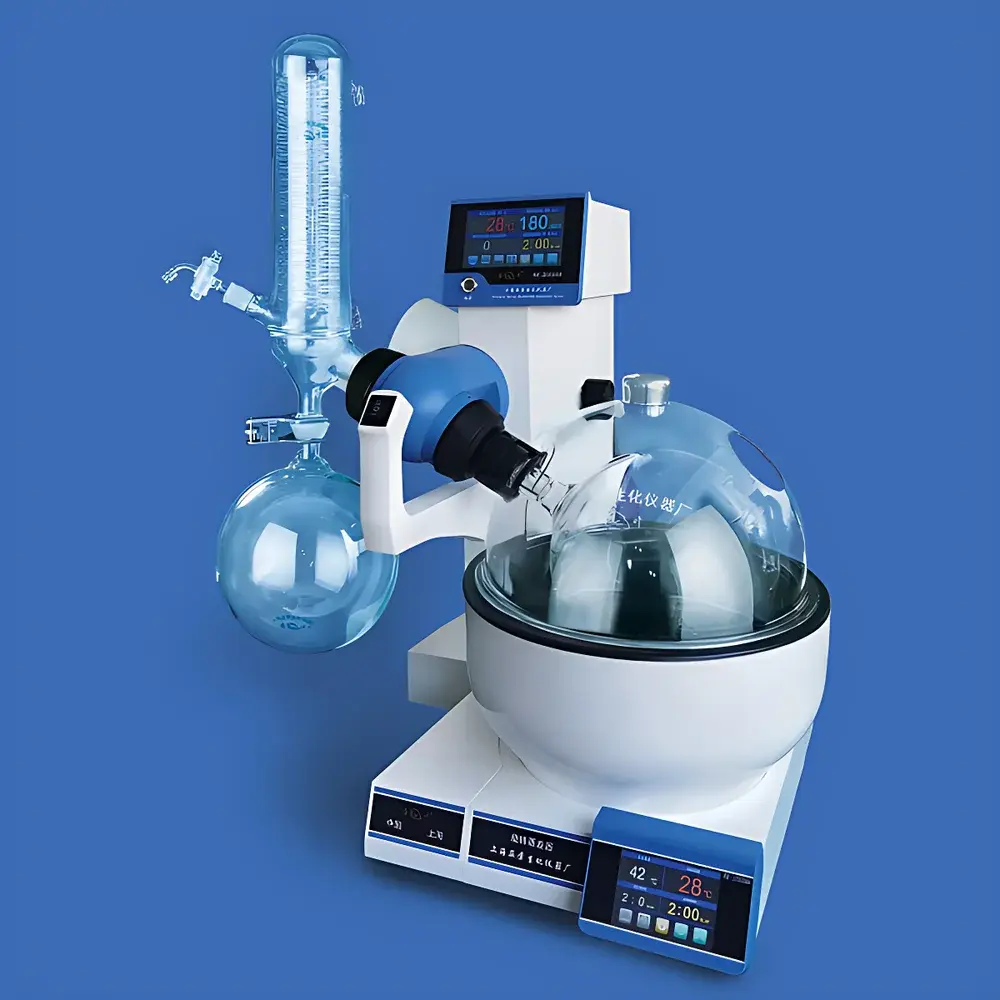
Shanghai Yarong RE-2000AA Rotary Evaporator
| Brand | Shanghai Yarong |
|---|---|
| Capacity | 50–2000 mL flask compatibility |
| Vacuum Range | –0.01 to –0.095 MPa (built-in vacuum controller, ±0.2–0.5% accuracy) |
| Rotation Speed | 0–200 rpm, reversible direction |
| Temperature Control | PID-controlled water bath, 20–99 °C (±1 °C accuracy) |
| Display | Dual-color LCD touchscreen with real-time digital readouts for temperature, speed, and timer |
| Condenser | Dual-flow vertical condenser, 0.15 m² cooling surface |
| Glassware Interface | Standard 24/40 taper joints, extended glass shaft, M42 locking nut |
Overview
The Shanghai Yarong RE-2000AA Rotary Evaporator is an engineered solution for efficient solvent removal, concentration, and purification under reduced pressure in research and quality control laboratories. Operating on the principle of rotary evaporation—where simultaneous rotation, heating, and vacuum application lower the boiling point of solvents—the RE-2000AA enables gentle, reproducible processing of thermally sensitive compounds. Its modular architecture integrates a precision PID-regulated water bath, a digitally controlled motorized drive system, and a built-in vacuum regulation module, eliminating the need for external vacuum pumps or controllers in many routine applications. Designed for compliance with standard laboratory workflows, the unit supports GLP-aligned documentation practices through time-stamped operational parameters and stable thermal/rotational profiles.
Key Features
- Reversible rotation drive (0–200 rpm) ensures uniform film formation across diverse viscosities and prevents bumping during volatile solvent removal.
- Integrated vacuum controller with adjustable setpoint (–0.01 to –0.095 MPa) and calibrated feedback loop (±0.2–0.5% accuracy), enabling precise pressure management without auxiliary instrumentation.
- Dual-color LCD touchscreen interface displays real-time values for bath temperature, rotational speed, and countdown timer—each independently configurable and retained across power cycles.
- PID-controlled water bath (20–99 °C, ±1 °C stability) with independent operation capability: the bath may be used as a standalone heating platform when evaporation is not required.
- Vertical dual-flow condenser (0.15 m² effective cooling area) optimized for high-efficiency reflux with minimal hold-up volume; constructed from borosilicate 3.3 glass with 24/40 standard taper joints and extended shaft geometry for secure, leak-free assembly.
- Mechanically robust frame with M42 locking nut system ensures long-term alignment stability and repeatable glassware mounting—critical for maintaining vacuum integrity during extended runs.
Sample Compatibility & Compliance
The RE-2000AA accommodates standard round-bottom flasks ranging from 50 mL to 2000 mL, supporting common organic solvents (e.g., ethanol, acetone, ethyl acetate, dichloromethane) and aqueous mixtures. Its design conforms to ISO 8573-1 (compressed air purity, where applicable for vacuum assist) and aligns with general safety requirements outlined in IEC 61010-1 for laboratory electrical equipment. While not certified to specific GMP Annex 11 or FDA 21 CFR Part 11 standards out-of-the-box, the device’s deterministic parameter logging (via screen timestamps and manual recordkeeping) supports audit-ready workflows in regulated environments when integrated into validated SOPs.
Software & Data Management
The RE-2000AA operates via embedded firmware with no external PC dependency. All operational parameters—including target temperature, rotation speed, vacuum setpoint, and timer duration—are stored in non-volatile memory and recalled at startup. Though it lacks Ethernet/USB data export, its dual-color display provides unambiguous visual confirmation of active settings and deviations, reducing transcription errors during batch documentation. For laboratories requiring electronic records, integration with LIMS or ELN systems can be achieved manually via timestamped operator logs or semi-automated capture using external camera-based monitoring aligned with ALCOA+ principles.
Applications
- Concentration of natural product extracts in phytochemistry and pharmacognosy labs.
- Solvent recovery and crude product isolation in fine chemical synthesis (e.g., API intermediate purification).
- Removal of low-boiling solvents prior to lyophilization or crystallization steps in biopharmaceutical process development.
- Preparative-scale dehydration of heat-labile polymers and dendrimers where precise thermal control mitigates degradation.
- Teaching applications in undergraduate organic chemistry laboratories—demonstrating Raoult’s law, vapor pressure depression, and mass transfer fundamentals under vacuum.
FAQ
Is the RE-2000AA compatible with corrosion-resistant cold traps for aggressive solvents like HCl or HF?
No—standard configuration uses a water-cooled dual-flow condenser. For halogenated or acidic vapors, users must install an inline dry ice/acetone cold trap upstream of the vacuum controller and verify material compatibility of all wetted parts.
Can the water bath temperature be calibrated traceably to NIST standards?
Yes—the bath sensor is accessible for field calibration using a certified RTD probe; calibration procedures are documented in the technical manual and support ISO/IEC 17025-compliant verification protocols.
Does the reversible rotation function support automated direction switching during a single run?
No—direction is manually selected prior to operation and remains fixed until changed by the user; it is not programmable or sequence-triggered.
What maintenance intervals are recommended for the vacuum controller and sealing components?
Inspect O-rings and ground-glass joints before each use; replace silicone grease every 6 months or after 200 operating hours. Vacuum controller calibration verification is advised annually or after 500 cumulative hours of operation.
Is the glassware set compliant with ASTM E2877-22 for volumetric accuracy in evaporation applications?
The flasks and condensers meet general laboratory glassware dimensional tolerances per ISO 3585 but are not individually certified to ASTM E2877-22; users requiring volumetric traceability must perform in-house gravimetric validation.



