
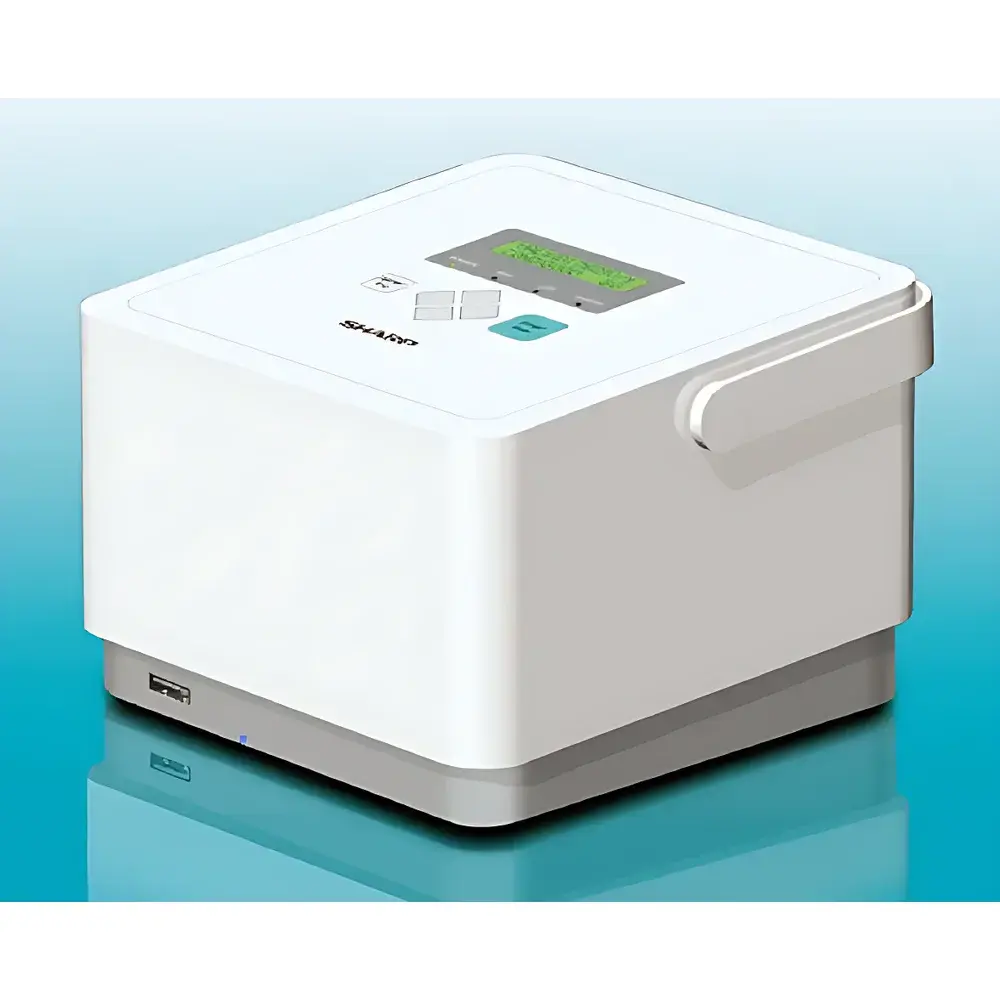
Sharp BM-300C Airborne Microbial Monitor
| Brand | Sharp |
|---|---|
| Origin | Japan |
| Manufacturer Type | Authorized Distributor |
| Product Origin | Imported |
| Model | BM-300C |
| Price | USD 21,000 (FOB Japan) |
Overview
The Sharp BM-300C Airborne Microbial Monitor is an advanced, real-time environmental monitoring instrument engineered for rapid, culture-independent quantification of viable and non-viable airborne microorganisms—including bacteria, yeasts, molds, and spores—in critical controlled environments. Unlike traditional plate-count or ATP-based methods, the BM-300C employs Sharp’s proprietary biofluorescence amplification technology: airborne particles are first size-classified via inertial separation to exclude non-biological particulates (>5 µm), followed by electrostatic capture of microbial cells onto a functionalized collection substrate. Upon contact, endogenous coenzymes (e.g., NAD(P)H, riboflavins) and enzymatic activity trigger a catalyzed fluorogenic reaction, generating measurable UV-excitable fluorescence signals proportional to total microbial load. This optical detection principle enables direct enumeration without incubation, culturing, or reagent addition—delivering statistically robust, repeatable results in as little as 10 minutes per sample cycle.
Key Features
- Ultra-Rapid Enumeration: Full-cycle measurement completed in ≤10 minutes—enabling near real-time decision-making in cleanroom qualification, aseptic process validation, and environmental monitoring (EM) programs.
- Culture-Independent Detection: Quantifies both cultivable and non-cultivable (VBNC), metabolically active and dormant, as well as heat- or chemically inactivated microorganisms—addressing key limitations of ISO 14698-1 and EU GMP Annex 1 microbiological risk assessment requirements.
- Integrated Electrostatic Capture: High-efficiency particle deposition (≥92% capture efficiency for 0.5–5.0 µm aerodynamic diameter) ensures representative sampling across diverse airflow conditions without reliance on impaction or filtration artifacts.
- Compact & Portable Design: Dimensions: 230 × 228 × 200 mm (W × D × H, including base and protrusions); weight: ~4.0 kg. Designed for flexible deployment in ISO Class 5–8 cleanrooms, isolators, laminar flow hoods, HVAC ducts, hospital isolation rooms, food processing lines, and R&D laboratories.
- Touchscreen-Driven Automation: Fully guided workflow with embedded calibration verification, self-diagnostics, and automatic background subtraction—requiring no microbiological training for routine operation.
Sample Compatibility & Compliance
The BM-300C is validated for continuous or discrete sampling of ambient air in non-sterile and classified environments per ISO 14644-1, ISO 14698-1, and USP . It complies with data integrity expectations under FDA 21 CFR Part 11 when integrated with compliant network infrastructure (audit trail enabled, electronic signature support). The system supports GLP/GMP-aligned environmental monitoring programs through configurable alarm thresholds, automated report generation (PDF/CSV), and time-stamped metadata logging (sampling duration, location ID, operator ID, ambient temperature/humidity if externally interfaced). No consumables beyond the disposable capture plates (shelf life: 12 months unopened, stored at 2–8 °C) are required.
Software & Data Management
The BM-300C operates with Sharp’s EM-Link™ Monitoring Suite—a secure, browser-based platform supporting centralized multi-instrument management. Key capabilities include: synchronized time-series visualization (microbial concentration vs. time, with 10-minute minimum interval resolution), cross-location comparative analytics, deviation alerting (email/SMS), and integration with existing MES/LIMS via RESTful API or OPC UA. All raw fluorescence intensity data, processed counts (CFU/m³ equivalent), and system logs are stored with immutable timestamps and user-access controls. Audit trails record all configuration changes, calibration events, and result exports—fully traceable for regulatory inspection (e.g., FDA pre-approval inspections, EMA Q5A audits).
Applications
- Pharmaceutical manufacturing: Aseptic fill line environmental surveillance, isolator performance verification, and HVAC system qualification.
- Biotechnology facilities: Cell therapy cleanroom monitoring, viral vector production suite control, and QC lab ambient air trending.
- FDA-regulated food & beverage plants: Pathogen risk mitigation in RTE product zones, packaging line validation, and post-sanitation verification.
- Hospital infection control: Operating room air quality assurance, ICU ventilation efficacy assessment, and outbreak investigation support.
- Research institutions: Microbial aerosol dynamics studies, HVAC filter efficiency testing, and antimicrobial surface efficacy evaluation.
FAQ
Does the BM-300C replace traditional settle plates or active air samplers?
No—it complements them. The BM-300C provides rapid, quantitative trend data; culture-based methods remain essential for organism identification and regulatory reporting where species-level data is mandated.
What is the detection limit and dynamic range?
The instrument reports microbial concentration in relative fluorescence units (RFU) calibrated to equivalent colony-forming units per cubic meter (CFU/m³); typical linear range spans 10²–10⁶ CFU/m³, verified per ISO 8573-7 Annex B protocols.
Can it distinguish between bacterial and fungal populations?
No. It measures total biofluorescent signal from metabolically active and structurally intact microorganisms; speciation requires downstream MALDI-TOF or sequencing.
Is routine calibration required?
Yes. Daily system verification using included reference standard plates is recommended; full calibration every 6 months by authorized Sharp service centers ensures metrological traceability to NIST-traceable biological standards.
How is data security ensured during cloud transmission?
All communications between the BM-300C and EM-Link™ servers use TLS 1.2+ encryption; data-at-rest is AES-256 encrypted; role-based access control (RBAC) enforces granular permissions per user group.




