
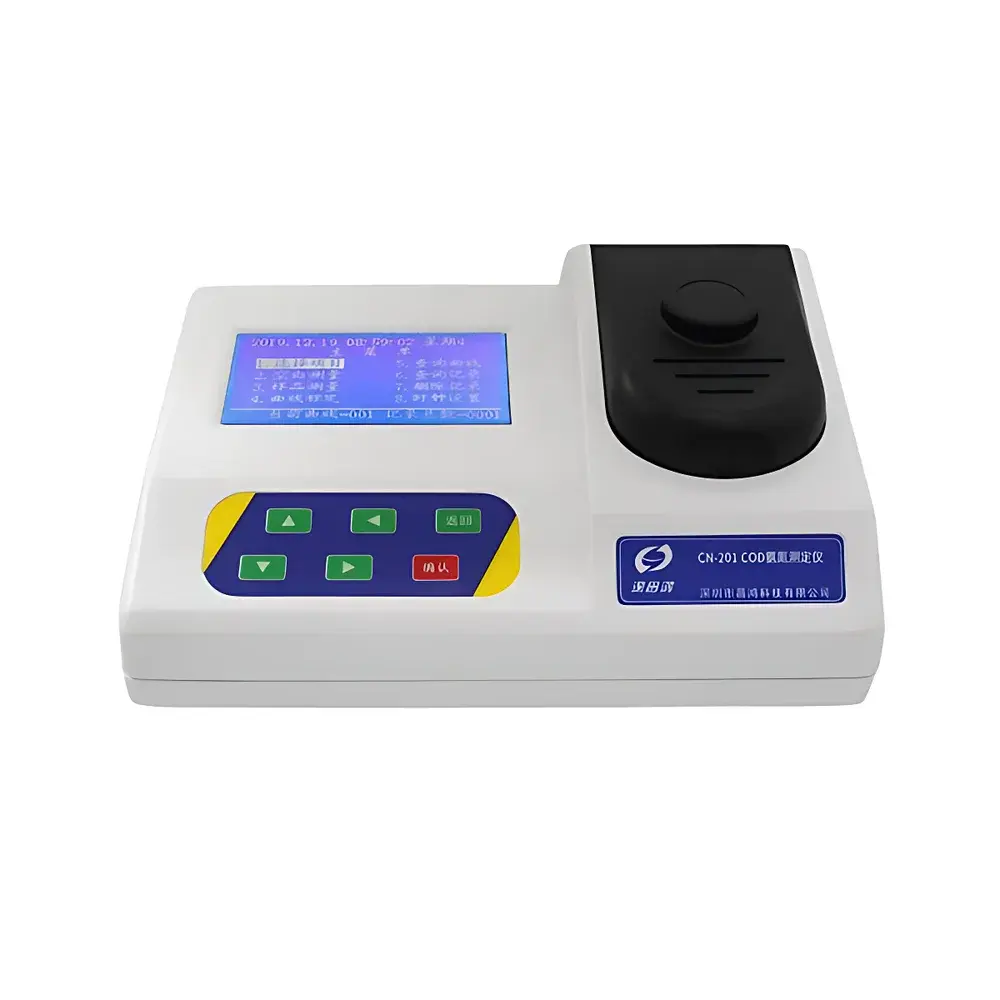
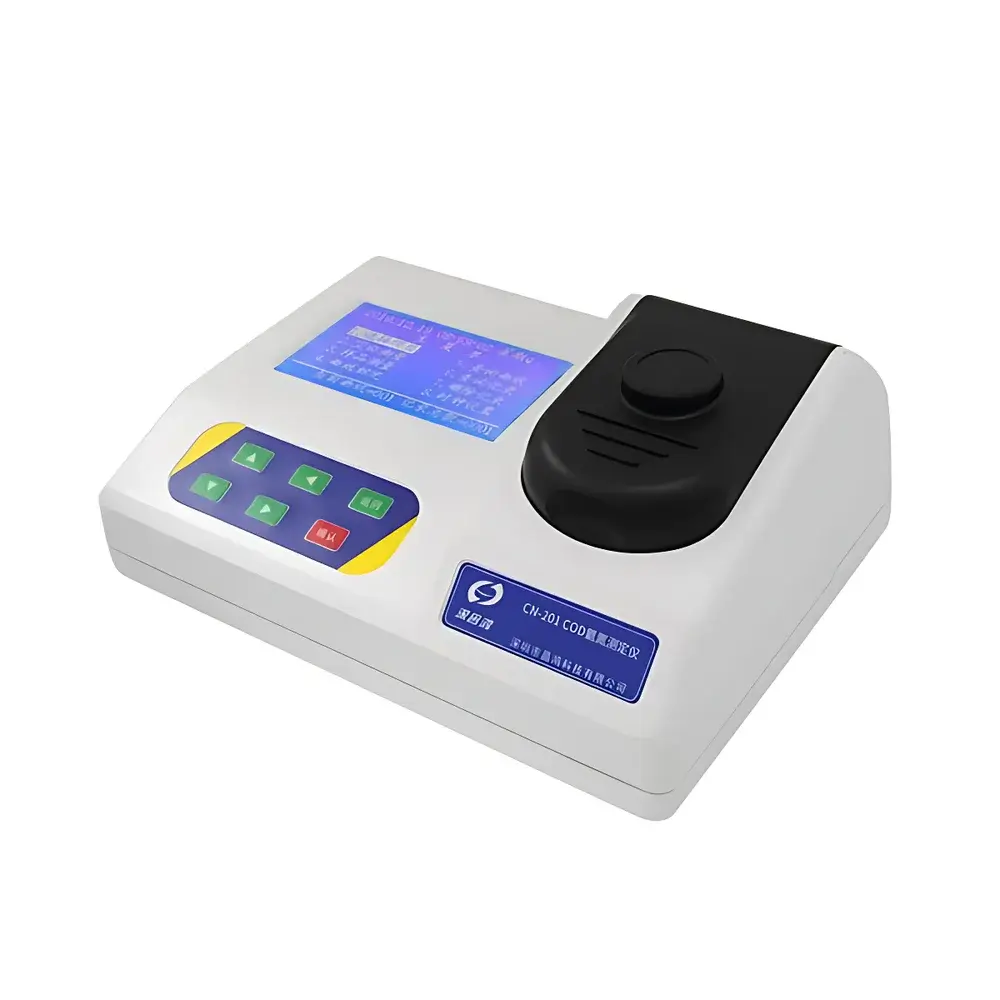
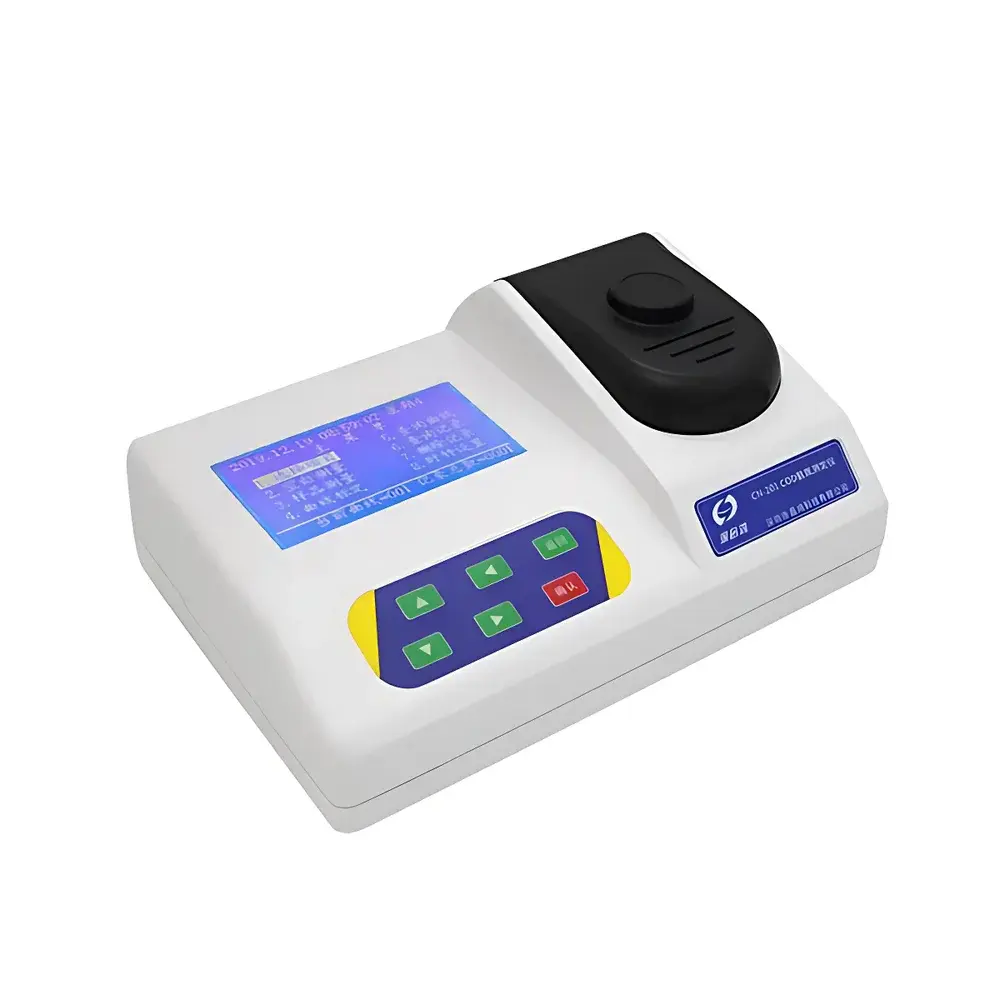
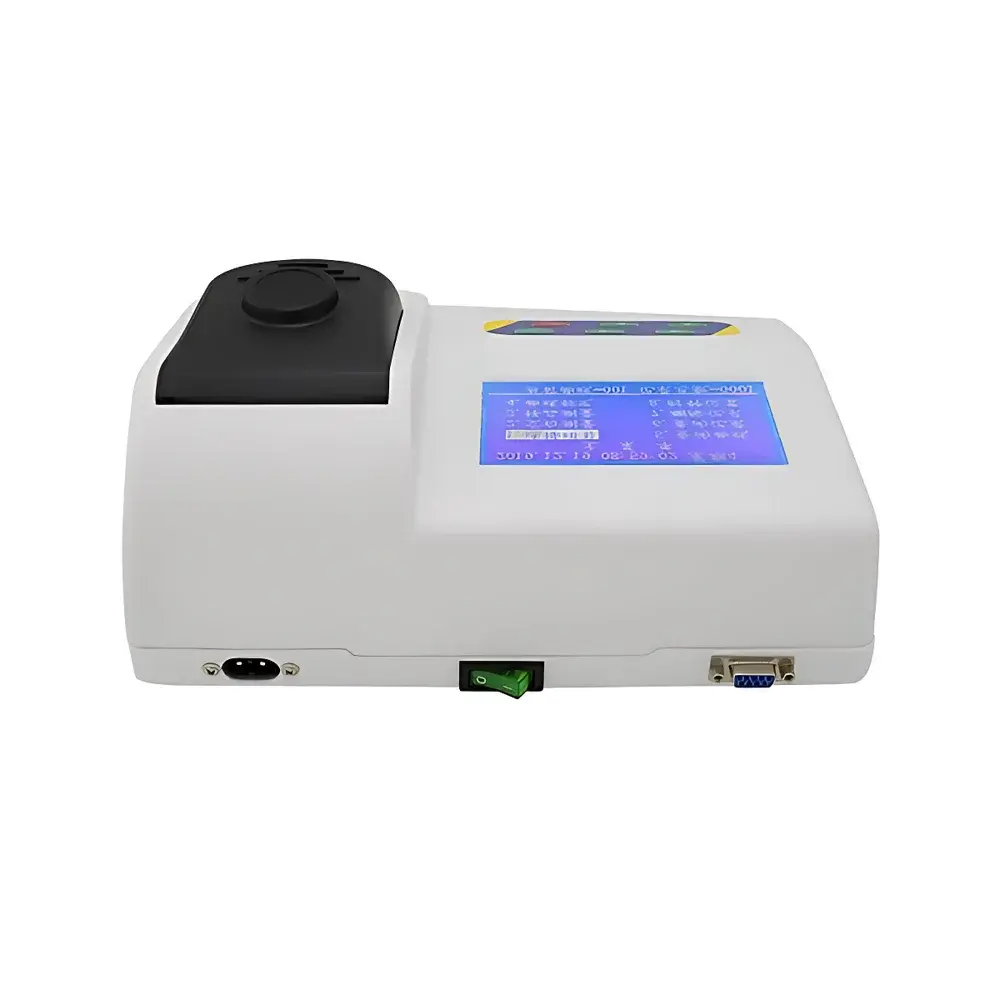
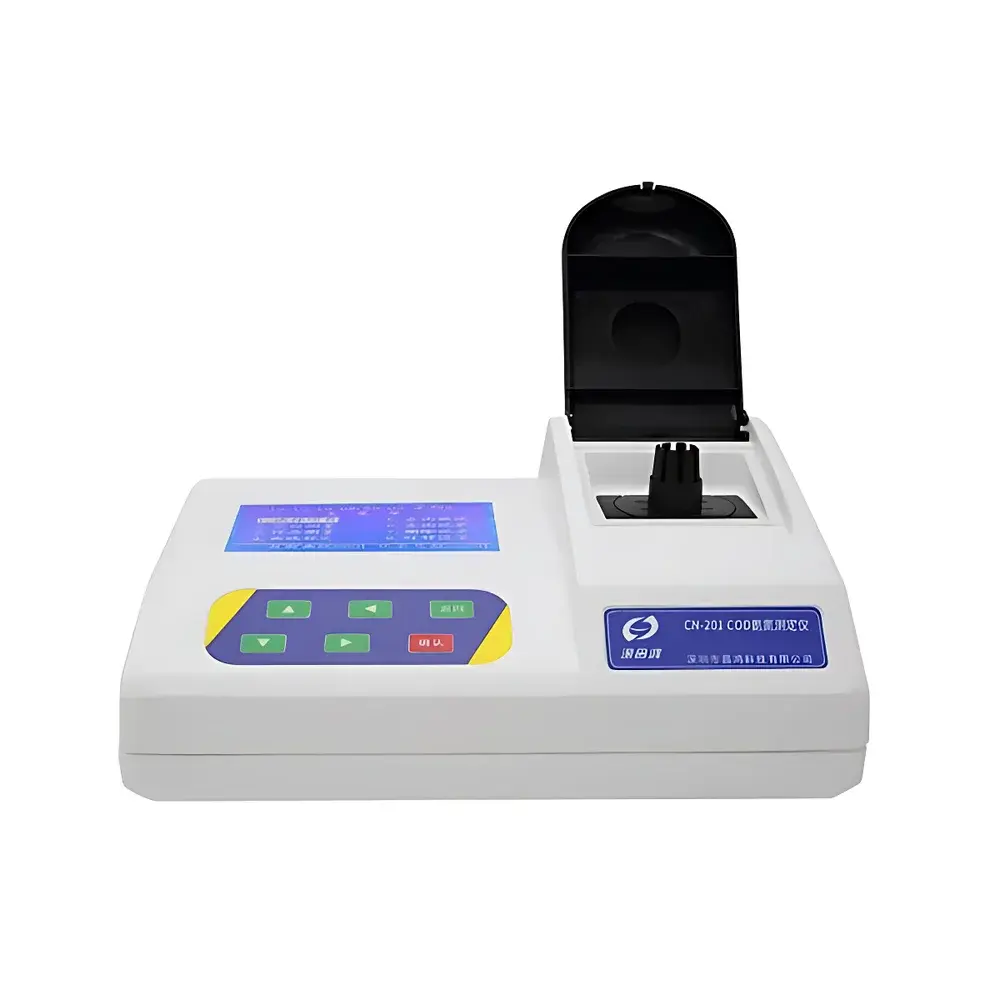
Shenchanghong CN-201 COD & Ammonia Nitrogen Analyzer
| Brand | Shenchanghong |
|---|---|
| Model | CN-201 |
| Origin | Guangdong, China |
| Manufacturer Type | Direct Manufacturer |
| Instrument Type | Laboratory Benchtop Analyzer |
| Measurement Principle | Colorimetric Method (Nesslerization for NH₃-N |
| COD Range | 5–2000 mg/L |
| NH₃-N Range | 0.02–25 mg/L |
| COD Accuracy | ≤ ±5% FS |
| NH₃-N Accuracy | ≤ ±3% FS |
| Repeatability | ≤ 3% |
| Chloride Interference Tolerance | ≤ 2000 mg/L Cl⁻ |
| Optical Wavelengths | 610 nm (COD), 420 nm (Low-range COD & NH₃-N) |
| Optical Drift | < 0.002 A in 20 min |
| Temperature Control Range | Ambient to 180 °C |
| COD Digestion Temp | 165 °C |
| Temperature Accuracy | ±0.5 °C |
| Digestion Time | 15 min (COD), Adjustable 1–9999 min |
| Batch Capacity | 16 samples |
| Dimensions (Analyzer) | 240 × 205 × 170 mm |
| Dimensions (Digestor DIS-16B) | 355 × 260 × 135 mm |
| Weight (Analyzer) | 3 kg |
| Weight (Digestor) | 5.5 kg |
| Power Consumption | < 500 W |
| Operating Environment | 5–40 °C, RH ≤ 85%, AC 220 V ±10%, 50 Hz |
Overview
The Shenchanghong CN-201 COD & Ammonia Nitrogen Analyzer is a dual-parameter benchtop laboratory instrument engineered for precise, trace-level quantification of chemical oxygen demand (COD) and ammonia nitrogen (NH₃-N) in aqueous environmental samples. It implements standardized colorimetric methodologies: dichromate-based oxidation at 165 °C for COD determination (ISO 6060, APHA 5220 C), and Nesslerization at controlled alkaline pH for ammonia nitrogen (ISO 7150-1, APHA 4500-NH₃ B). The system decouples digestion and photometric measurement—eliminating thermal crosstalk between the heating module and optical path—to ensure long-term baseline stability and metrological integrity. Designed for compliance with routine water quality monitoring protocols, the CN-201 supports regulatory reporting under national environmental standards (e.g., China’s HJ 828–2017 for COD; HJ 535–2009 for NH₃-N) and serves as a validated platform for method verification in GLP-aligned laboratories.
Key Features
- Optically isolated architecture: Independent analyzer and DIS-16B digestion unit prevent heat-induced drift in absorbance readings.
- Cold-light, narrow-band interference optical system with dual-wavelength capability (610 nm for standard COD, 420 nm for low-range COD and NH₃-N), ensuring high spectral selectivity and minimal matrix interference.
- 3.5-inch full-color touch screen on the DIS-16B digester (320 × 240 resolution) with bilingual UI (English/Chinese), real-time temperature profiling, and programmable ramp-hold profiles.
- Integrated safety controls: Dual thermal protection (automatic cutoff at 200 °C), audible digestion-end alert, and post-digestion auto-shutdown.
- Calibration robustness: Multi-point non-linear calibration with zero-error interpolation at user-defined setpoints—compensating for inherent thermistor nonlinearity in conventional digesters.
- Data retention: Stores up to 20 preloaded calibration curves and 199 measurement records with non-volatile memory; retains all data during power interruption.
- Durable construction: Mainframe housing molded from ABS polymer with enhanced resistance to acid vapors, organic solvents, and humid laboratory environments.
Sample Compatibility & Compliance
The CN-201 accepts standard 16-mm borosilicate glass digestion tubes (included), compatible with both open-reflux and sealed-tube digestion protocols. It accommodates raw and pretreated samples from surface water, wastewater effluents, industrial discharges, and potable water sources—with chloride tolerance up to 2000 mg/L Cl⁻ (via mercury sulfate masking per Standard Methods 5220 D). The instrument meets mechanical and electrical safety requirements per IEC 61010-1:2010 and supports traceability in regulated environments through audit-ready operation logs. While not inherently 21 CFR Part 11 compliant, its deterministic calibration workflow, fixed wavelength selection, and immutable result storage align with ALCOA+ principles for data integrity in environmental QA/QC labs.
Software & Data Management
No external PC software is required for basic operation; all configuration, calibration, and reporting occur via the embedded interface. The analyzer supports manual curve entry or factory-default polynomial fits for both parameters. Measured values are displayed in real time with %RSD calculation for replicate runs. Export is limited to on-device review and print-ready reports (via optional serial-to-printer adapter); for LIMS integration, users may manually transcribe results using the alphanumeric LCD display (240 × 128 pixels, Chinese/English font). Firmware updates are performed via USB flash drive, with version history and checksum verification built into the bootloader.
Applications
- Regulatory compliance testing for municipal wastewater treatment plants (WWTPs) and industrial discharge monitoring per local environmental protection bureau mandates.
- Academic research in limnology, biogeochemistry, and environmental engineering where parallel COD/NH₃-N trends inform nutrient loading assessments.
- Quality control in drinking water utilities performing source water screening and distribution system integrity checks.
- Method validation studies comparing rapid digestion protocols against classical reflux methods (e.g., ASTM D1252–05).
- Educational laboratories requiring robust, service-resistant instrumentation for undergraduate analytical chemistry and environmental science curricula.
FAQ
What digestion method does the CN-201 use for COD analysis?
It employs closed-tube dichromate oxidation at 165 °C for 15 minutes, conforming to HJ 828–2017 and ISO 6060.
Can the instrument measure both COD and NH₃-N simultaneously?
No—measurements are sequential. Users must select the target parameter before digestion and analysis; optical filters are manually switched between 610 nm and 420 nm wavelengths.
Is the CN-201 suitable for field use?
It is designed exclusively for laboratory environments: AC-powered, non-battery-operated, and requires stable ambient conditions (5–40 °C, no direct sunlight or vibration).
How is calibration verified across the measurement range?
Using certified reference materials (CRMs) traceable to NIM (China National Institute of Metrology); multi-point calibration eliminates systematic offset at critical thresholds (e.g., 5 mg/L and 2000 mg/L COD).
Does the system support GLP-compliant audit trails?
It maintains chronological logs of calibration events and measurement timestamps but lacks electronic signature, user-role access control, or automated report generation required for full GLP/GMP compliance.
Related Products







