
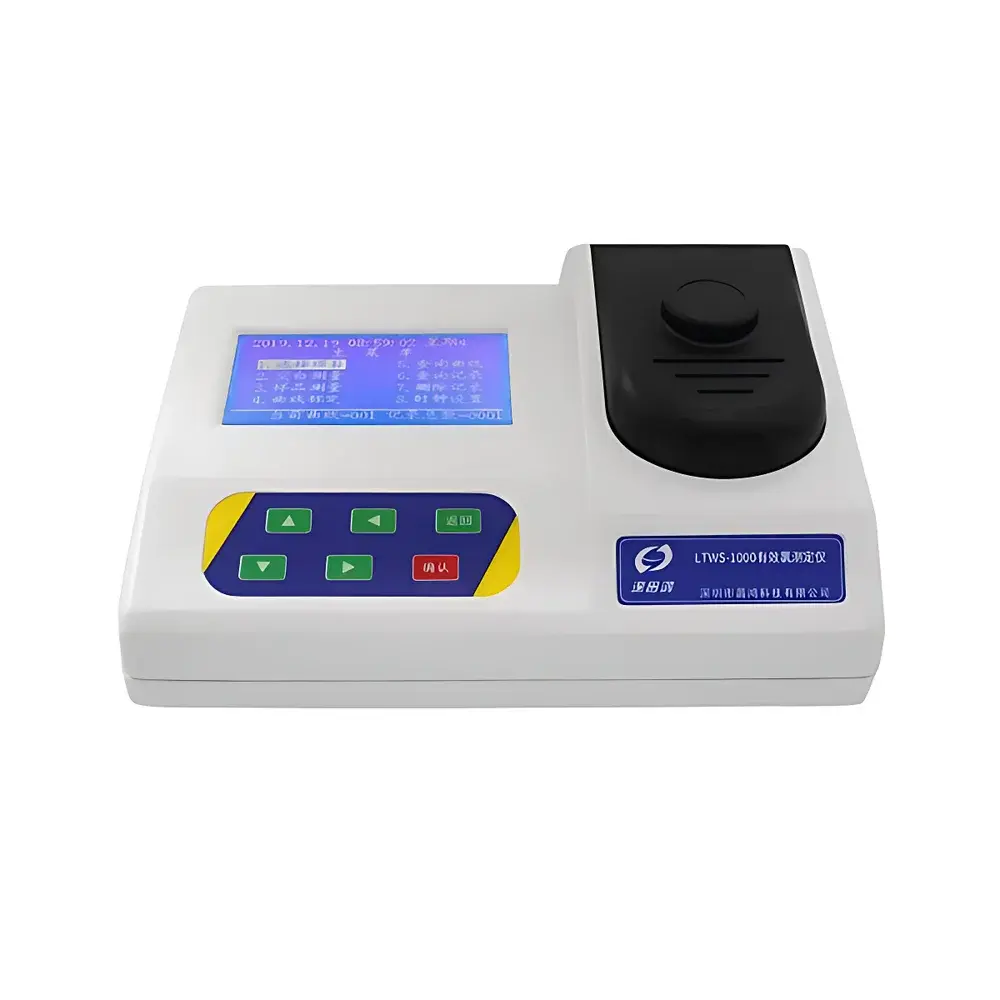
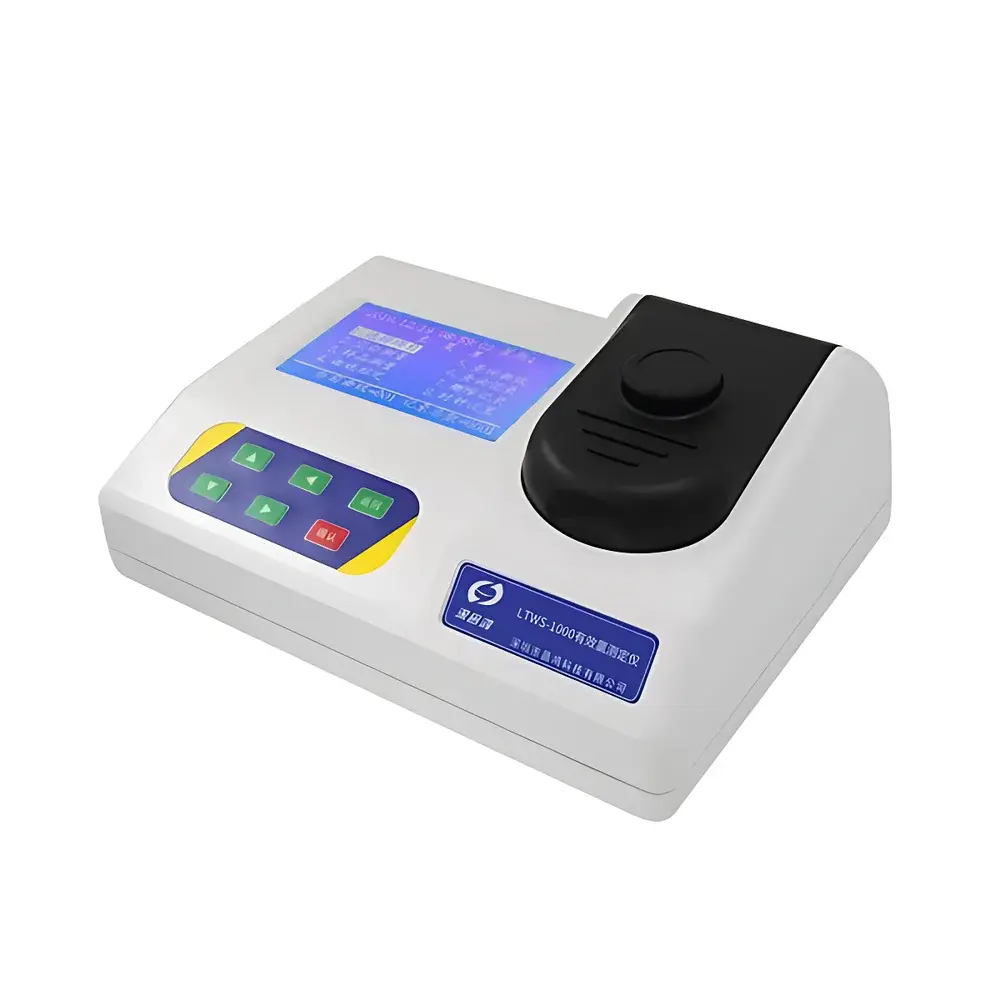
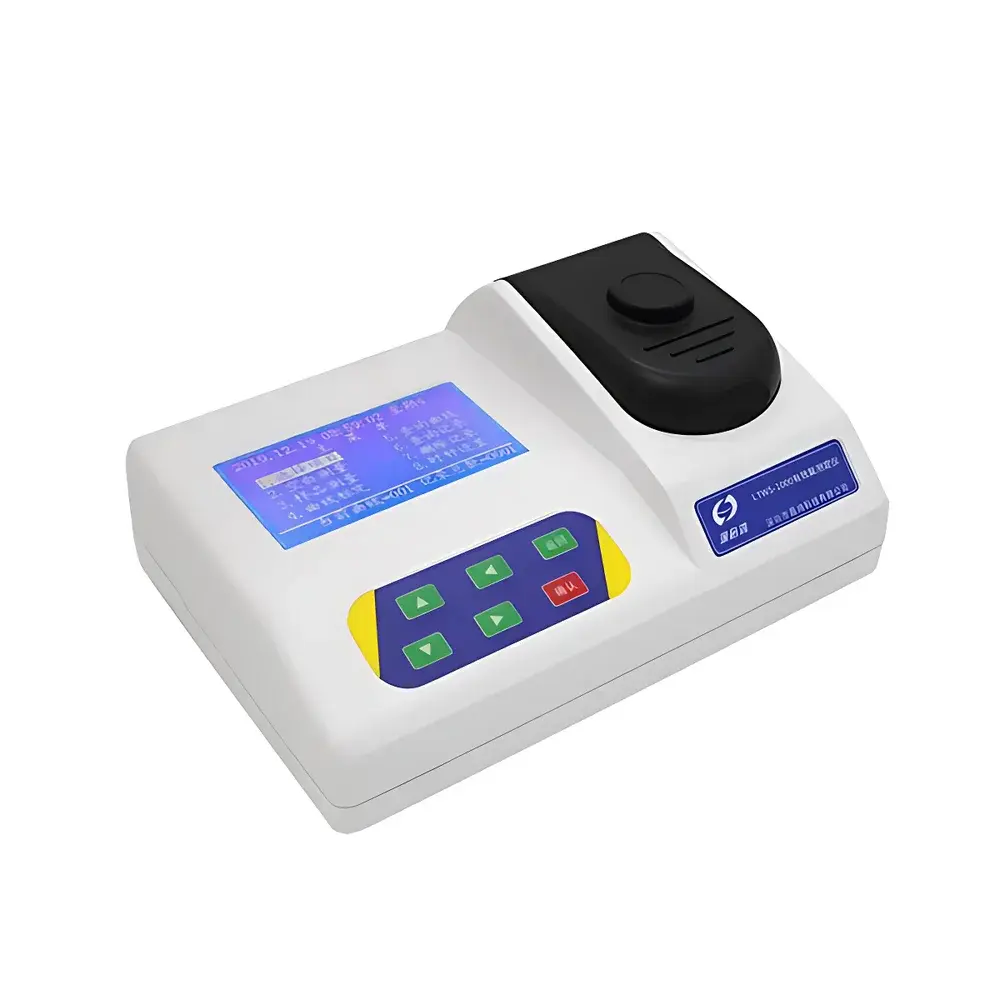
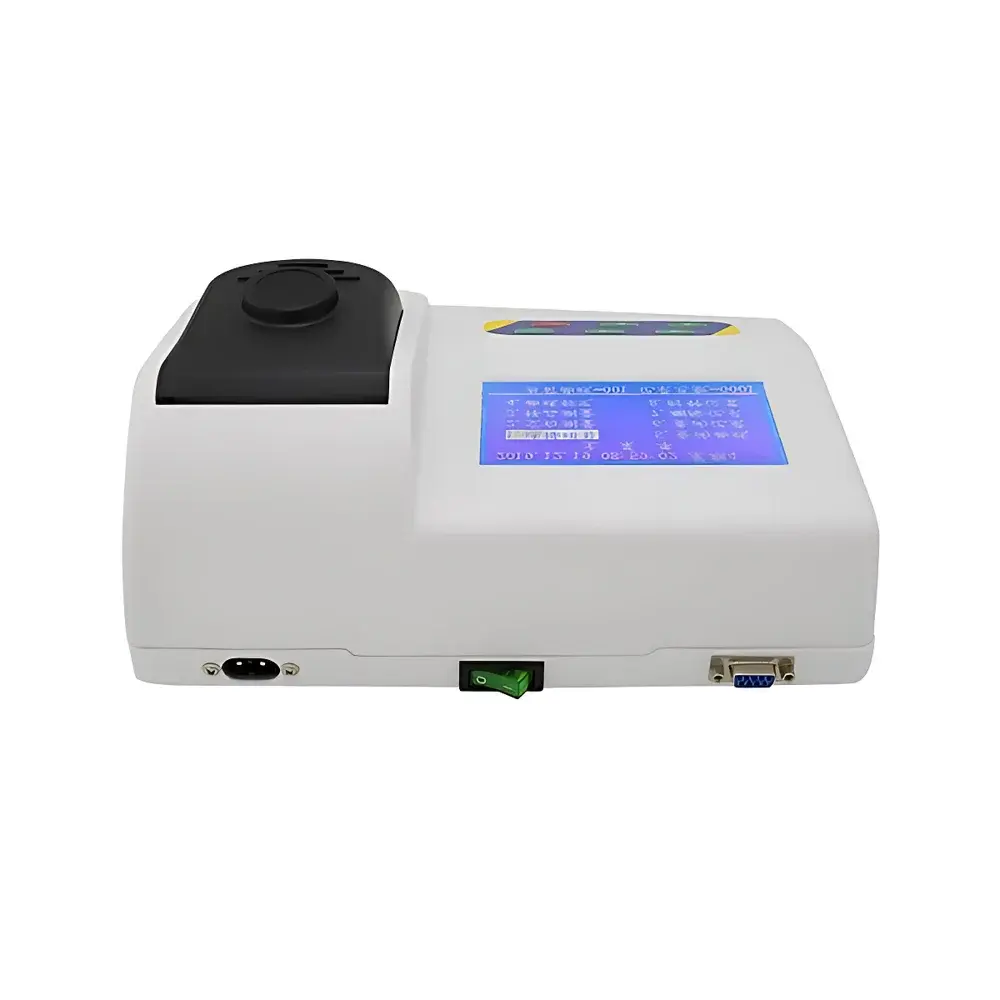
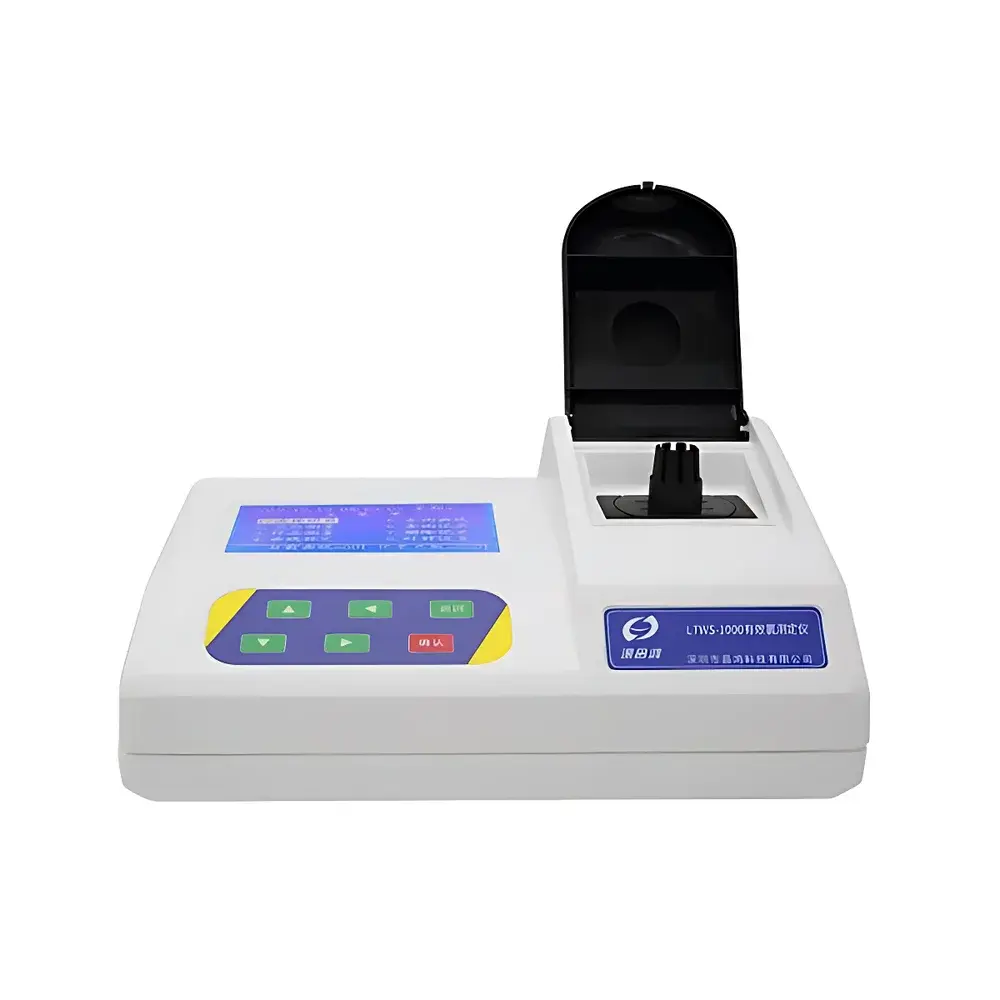
Shenchanghong LTWS-1000 Residual Chlorine and Chlorine Dioxide Analyzer
| Brand | Shenchanghong |
|---|---|
| Origin | Guangdong, China |
| Manufacturer Type | Direct Manufacturer |
| Instrument Type | Benchtop Laboratory Analyzer |
| Model | LTWS-1000 |
| Measurement Principle | Colorimetric Method (DPD-based) with Fixed-Wavelength Photometry |
| Measured Parameters | Free Chlorine, Total Chlorine, Chlorine Dioxide (ClO₂), and Optional Bromine |
| Range | 0.00–100.00 mg/L as Cl₂ |
| Accuracy | ≤ ±5% of Full Scale (F.S.) |
| Repeatability | ≤ 3% RSD |
| Resolution | 0.01 mg/L |
| Detection Limit | ≤ ±3% F.S. |
| Optical Stability | Absorbance drift < 0.002 A within 20 min |
| Dimensions | 266 × 200 × 130 mm |
| Weight | 1.0 kg |
| Operating Temperature | 5–40 °C |
| Relative Humidity | ≤85% RH (non-condensing) |
| Power Supply | 4 × AA alkaline batteries (no AC adapter included) |
| IP Rating | IP65 |
| Data Storage | 199 measurement records with timestamp (YYYY-MM-DD hh:mm:ss), plus 20 programmable calibration curves |
| Display | Backlit LCD, 128 × 64 pixels |
| Housing Material | Molded ABS with chemical-resistant finish |
Overview
The Shenchanghong LTWS-1000 Residual Chlorine and Chlorine Dioxide Analyzer is a portable, benchtop-grade photometric instrument engineered for precise, field-deployable quantification of free chlorine, total chlorine, chlorine dioxide (ClO₂), and optionally bromine in aqueous samples. It operates on the standardized N,N-diethyl-p-phenylenediamine (DPD) colorimetric method—fully compliant with ISO 7393-2:2018, APHA Standard Methods 4500-Cl G, and EPA Method 334.0—where oxidants react with DPD reagent to form a stable pink-colored complex proportional to concentration. The analyzer employs a cold LED light source and narrow-band optical interference filters centered at 515 nm, eliminating thermal drift and minimizing spectral interference from turbidity or colored matrices. Its fixed-wavelength photometric architecture ensures high reproducibility across variable ambient conditions without requiring wavelength scanning or internal reference cuvettes.
Key Features
- Robust IP65-rated molded ABS housing—resistant to water ingress, dust, and common laboratory/field chemicals including chlorine gas and sodium hypochlorite solutions.
- Ultra-low-power 16-bit microcontroller architecture enabling >200 hours of continuous operation on four AA alkaline batteries—ideal for remote sampling sites without grid access.
- Backlit monochrome LCD display (128 × 64 pixels) with intuitive menu navigation and real-time graphical feedback during calibration and measurement cycles.
- Integrated data logging with non-volatile memory: stores up to 199 timestamped results (including absorbance, transmittance, and concentration) and 20 user-defined calibration curves—including slope/intercept parameters and date-stamped validation records.
- Optical system stability verified per ISO 8655-7: absorbance drift remains below 0.002 A over 20 minutes under ambient temperature fluctuations (5–40 °C), ensuring reliability during extended monitoring sessions.
- Automatic power-off and data retention circuitry provides full protection against accidental battery depletion—no loss of stored calibrations or measurement history.
Sample Compatibility & Compliance
The LTWS-1000 is validated for use with potable water, wastewater effluents, swimming pool recirculation systems, cooling tower make-up water, and process streams in food & beverage production. It accommodates standard 10-mm square glass or quartz cuvettes (included: three matched 10-mL reaction tubes with screw caps). All DPD-based assays conform to ISO/IEC 17025:2017 requirements for testing laboratories, and the instrument supports audit-ready documentation when paired with external lab information management systems (LIMS). While not FDA 21 CFR Part 11–certified out-of-the-box, its timestamped data logs and immutable storage structure meet GLP traceability prerequisites for routine QC/QA applications in regulated environments.
Software & Data Management
No proprietary PC software is bundled; however, measurement records are exportable via manual transcription or optional USB-to-serial adapter (not supplied). Each stored entry includes full metrological metadata: date/time stamp (year-month-day hour:minute:second), measured absorbance (A), transmittance (%T), calculated concentration (mg/L), and associated calibration curve ID. Internal memory retains all entries through battery replacement—no volatile RAM dependency. For integration into enterprise-level QA workflows, users may map exported CSV-formatted logs into validated LIMS platforms supporting ASTM E1384 or ISO/IEC 17025-compliant data integrity protocols.
Applications
- Drinking water distribution network monitoring—verifying residual disinfectant levels at entry points, reservoirs, and endpoint taps per WHO Guidelines for Drinking-water Quality (4th ed., 2017).
- Swimming pool and spa facility compliance—routine verification against national standards such as EN 15288-1 and NSF/ANSI 50.
- Pharmaceutical water systems—supporting USP purified water and WFI hold-time studies where chlorine residuals must remain below 0.1 mg/L prior to point-of-use filtration.
- Wastewater disinfection validation—quantifying post-chlorination residuals before discharge to receiving waters under local environmental permits.
- Food processing line sanitation verification—ensuring rinse water chlorine concentrations meet HACCP prerequisite programs and SQF Code Edition 9.0 Section 9.5.2.
FAQ
What DPD reagents are compatible with the LTWS-1000?
The instrument is optimized for commercially available DPD No. 1 (for free chlorine), DPD No. 3 (for total chlorine), and DPD No. 4 (for chlorine dioxide) tablet or powder formulations meeting ISO 7393-2 specifications. Reagent lot traceability and expiration dates must be recorded per GLP.
Can the LTWS-1000 measure combined chlorine independently?
No—it calculates combined chlorine indirectly as the difference between total and free chlorine values, consistent with APHA 4500-Cl G methodology. It does not perform direct monochloramine-specific assays.
Is calibration verification required before each use?
Per ISO/IEC 17025 Clause 7.7.1, calibration verification using a mid-range standard (e.g., 2.00 mg/L Cl₂) is recommended at the start and end of each analytical session, especially after temperature shifts exceeding 5 °C.
Does the instrument support multi-point calibration?
Yes—up to 20 user-defined calibration curves may be stored, each supporting linear regression (y = mx + b) with up to five concentration–absorbance pairs. Curve selection is manual and context-specific.
How is optical pathlength controlled during measurement?
The LTWS-1000 uses fixed 10-mm pathlength reaction tubes with precision-ground optical windows. Cuvette alignment is mechanically constrained within the instrument’s sample compartment to ensure repeatable beam positioning and eliminate operator-induced variability.
Related Products







