
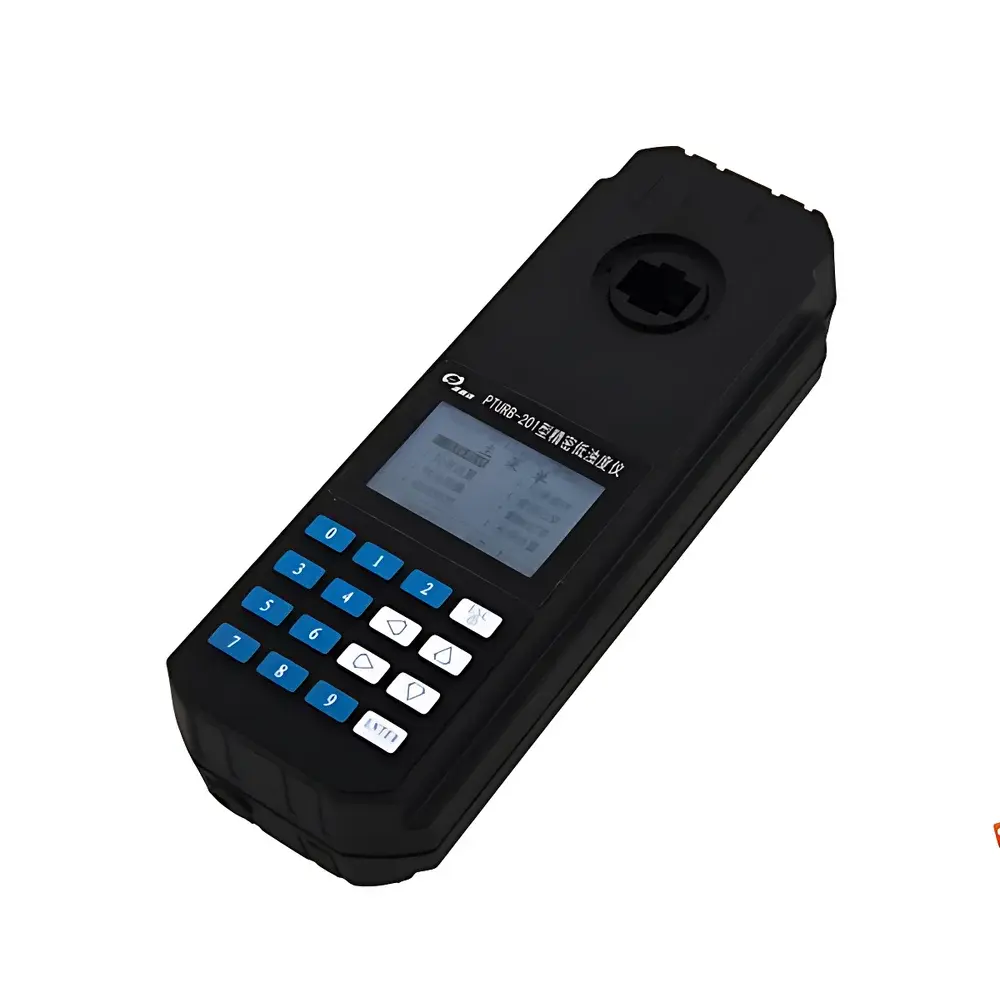
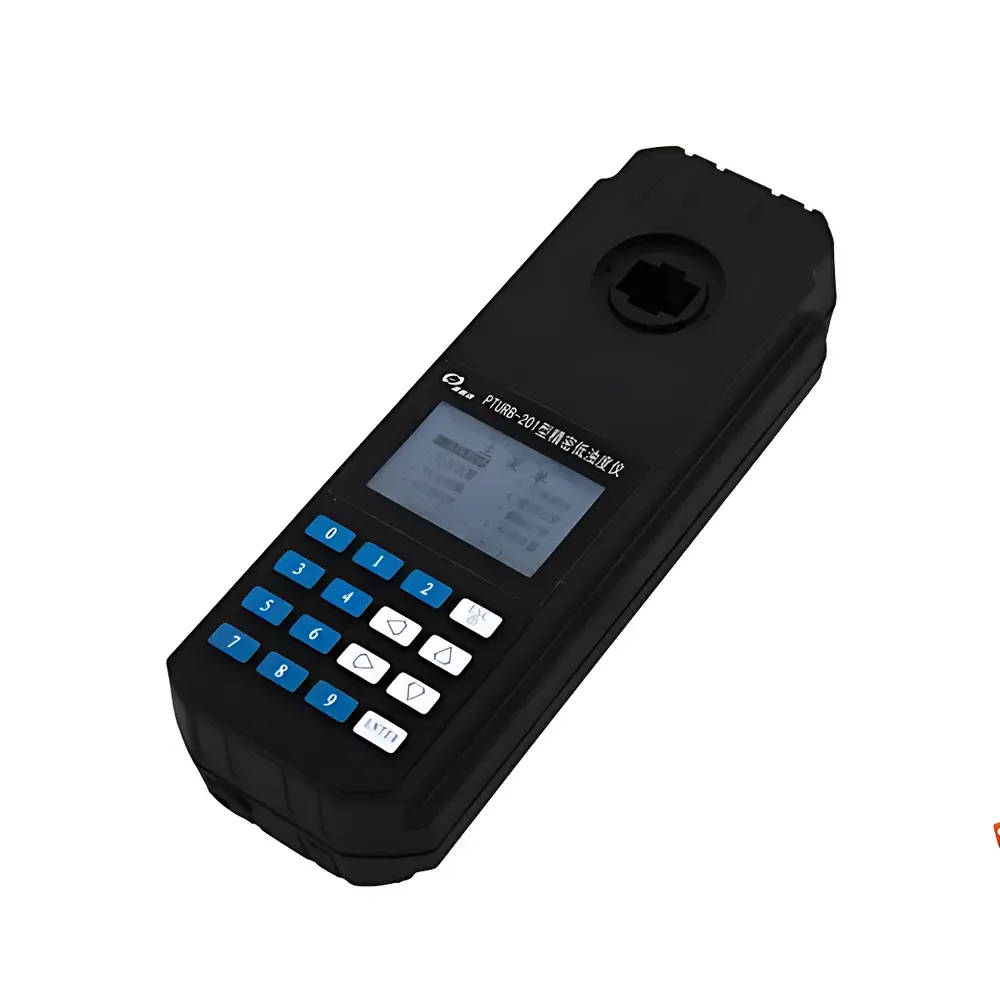
Shenchanghong PTURB-202A Portable Precision Turbidimeter
| Brand | Shenchanghong |
|---|---|
| Origin | Guangdong, China |
| Manufacturer Type | Direct Manufacturer |
| Region Classification | Domestic (China) |
| Model | PTURB-202A |
| Product Type | Portable |
| Measurement Range | 0–1000 NTU |
| Resolution | 0.1 NTU |
| Operating Temperature | 5–40 °C |
| Accuracy | ≤ ±1 % FS |
| Repeatability | ≤ ±1 % FS |
| Drift | < 0.1 NTU/h |
| Minimum Detectable Resolution | 0.01 NTU |
| Power Supply | Rechargeable Lithium Battery |
| Weight | 1 kg |
| Dimensions | 80 mm × 230 mm × 55 mm |
| IP Rating | IP65 |
| Display | Backlit LCD (Chinese interface) |
| Data Storage | 20 calibration curves + 199 measurement records |
| Interface | USB port |
| Environmental Protection | ABS molded housing with corrosion-, water-, and dust-resistant design |
Overview
The Shenchanghong PTURB-202A Portable Precision Turbidimeter is an ISO 7027-compliant optical instrument engineered for field-deployable, high-reliability turbidity measurement in compliance-critical environments. It operates on the principle of nephelometric detection—measuring the intensity of light scattered at 90° by suspended particles in aqueous samples using a stable 850 nm near-infrared LED source. This cold-light, narrow-band interference optical architecture minimizes thermal drift and eliminates spectral interference from sample coloration, ensuring robust performance across diverse matrix types including potable water, pharmaceutical process water, beverage formulations, and biopharmaceutical rinse solutions. Designed to meet the operational demands of mobile quality control teams, the PTURB-202A delivers laboratory-grade repeatability (≤ ±1 % FS) and low temporal drift (< 0.1 NTU/h) without requiring temperature-controlled benchtop conditions.
Key Features
- ISO 7027-compliant 90° nephelometric detection with 850 nm LED light source—ensures traceable, standardized turbidity reporting aligned with global regulatory expectations.
- IP65-rated ABS polymer housing—provides ingress protection against dust, water jets, and chemical splashes during field use in wastewater treatment plants, bottling lines, or cleanroom support zones.
- Rechargeable lithium-ion battery system—enables continuous operation for up to six months in standby mode and ≥12 hours of active measurement per full charge, eliminating dependency on external power sources.
- High-stability optical path with precision-machined 5 cm pathlength cuvettes—minimizes alignment sensitivity and supports consistent inter-laboratory reproducibility.
- Onboard data management—stores up to 20 user-defined calibration curves and 199 timestamped measurement records with automatic data retention during power loss.
- USB interface compliant with USB 2.0 standards—facilitates secure data export to Windows-based PCs using included acquisition software; supports CSV export for integration into LIMS or ELN platforms.
Sample Compatibility & Compliance
The PTURB-202A is validated for use with clear to moderately turbid aqueous matrices—including purified water (PW), water for injection (WFI) pre-filtration checks, municipal drinking water, soft drink syrups, beer wort, and sterile saline rinsates. Its optical design inherently compensates for minor chromatic interference, making it suitable for lightly colored samples where traditional white-light turbidimeters may overestimate turbidity. The instrument meets essential requirements of ASTM D6508 (Standard Practice for Determination of Turbidity in Water Using a Nephelometer), USP (Turbidity Measurements), and EU Pharmacopoeia 2.2.1. While not 21 CFR Part 11–validated out-of-the-box, its audit-trail-capable firmware architecture allows configuration for GLP/GMP environments when paired with controlled software deployment protocols and documented calibration procedures.
Software & Data Management
The bundled PC software provides raw data visualization, calibration curve generation (linear, quadratic, or multi-point non-linear), and batch report generation with customizable headers and metadata fields (operator ID, location tag, sampling time). All exported datasets include embedded instrument serial number, firmware version, and measurement timestamp—supporting traceability in regulated workflows. Data integrity is reinforced via built-in checksum validation and optional password-protected user access levels (administrator/operator modes). Firmware updates are delivered via signed binary packages to prevent unauthorized modification—a foundational requirement for audit readiness in pharmaceutical and clinical laboratory settings.
Applications
- Real-time monitoring of filter integrity in pharmaceutical water systems (e.g., post-carbon filtration, pre-UV validation).
- Routine QC testing of bottled water, carbonated beverages, and fruit juice concentrates prior to filling.
- Field verification of coagulation/flocculation efficiency in municipal water treatment facilities.
- Validation of sterilizing-grade membrane performance in bioprocessing buffer preparation suites.
- Environmental health surveillance—rapid turbidity screening in outbreak response scenarios by public health laboratories.
FAQ
Is the PTURB-202A compliant with ISO 7027?
Yes—the instrument uses a fixed 850 nm LED source and 90° scatter geometry meeting all optical and metrological criteria defined in ISO 7027:2016.
Can it be used for USP turbidity testing?
It satisfies the instrumental requirements for Method I (nephelometry); however, users must validate method suitability per USP general chapter guidelines, including verification of linearity, LOD/LOQ, and matrix interference for each application.
Does the device support calibration with Formazin or AMCO AEPA standards?
Yes—calibration can be performed using either primary Formazin standards (NTU scale) or secondary AMCO AEPA reference suspensions (FNU scale), with selectable unit display (NTU/FNU) in firmware.
What is the recommended recalibration interval?
Shenchanghong recommends quarterly verification using certified reference standards under routine use; more frequent checks are advised after mechanical shock, extended storage, or exposure to extreme ambient humidity.
Is the USB data export compatible with LIMS integration?
Raw CSV exports contain structured columns (timestamp, sample ID, NTU value, calibration ID, operator code) and are routinely ingested by major LIMS vendors via automated file watchers or API-based adapters.





