
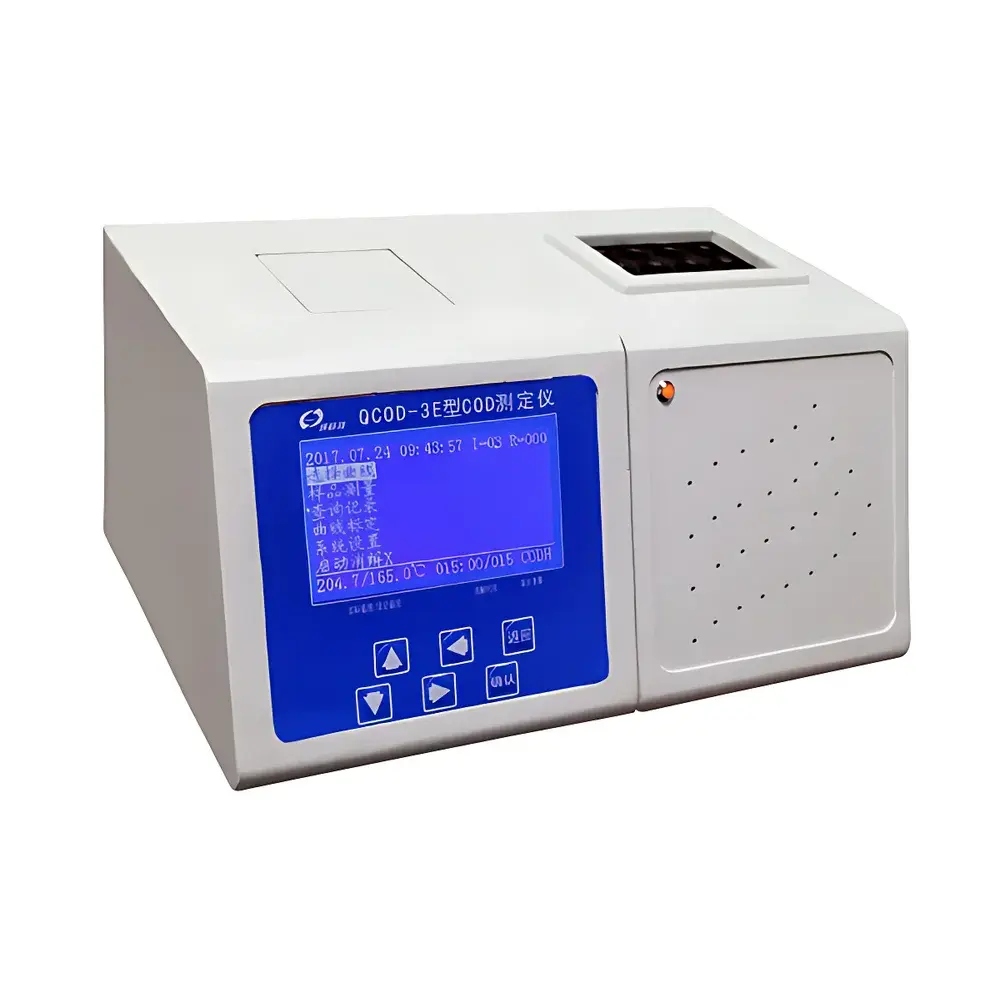
Shenchanghong QCOD-3E Chemical Oxygen Demand (COD) Analyzer
| Brand | Shenchanghong |
|---|---|
| Origin | Guangdong, China |
| Manufacturer Type | Direct Manufacturer |
| Regional Classification | Domestic (China) |
| Model | QCOD-3E |
| Instrument Type | Benchtop Laboratory Analyzer |
| Measurement Principle | Rapid Digestion Method (Closed-Tube Catalytic Digestion) |
| Wavelength | 610 nm |
| Measurement Range | 5–2000 mg/L (dilution enabled for higher concentrations) |
| Accuracy | ≤ ±5 % |
| Repeatability | ≤ 3 % |
| Detection Limit | 0.1 mg/L |
| Digestion Time | 10 min |
| Total Assay Time | 15 min |
| Batch Capacity | 20 samples per run |
| Chloride Interference Tolerance | ≤ 2000 mg/L Cl⁻ |
| Digestion Temperature | 165 °C (adjustable from ambient to 180 °C) |
| Temperature Control Accuracy | ±0.5 °C |
| Temperature & Time Programmability | PID-controlled, 1–999 min adjustable |
| Optical Stability | Absorbance drift < 0.002 A within 20 min |
| Dimensions (Analyzer) | 240 × 205 × 170 mm |
| Dimensions (Digestion Unit) | 240 × 107 × 170 mm |
| Weight (Analyzer) | 3 kg |
| Weight (Digestion Unit) | 4 kg |
| Power Consumption | < 500 W |
| Operating Environment | 5–40 °C, RH ≤ 85 %, AC 220 V ± 10 %, 50 Hz ± 0.5 Hz, low-vibration, low-EMI, no direct sunlight |
Overview
The Shenchanghong QCOD-3E Chemical Oxygen Demand (COD) Analyzer is a benchtop laboratory instrument engineered for rapid, reliable, and standardized determination of chemical oxygen demand in water and wastewater samples. It implements the closed-tube catalytic digestion method—aligned with standard protocols such as ISO 6060 and APHA Standard Method 5220 D—followed by photometric quantification at 610 nm. The system comprises two physically separated modules: a dedicated thermal digestion unit and an independent spectrophotometric analyzer. This modular architecture eliminates thermal cross-talk and ensures long-term optical stability during repeated measurements. The analyzer employs a cold LED light source coupled with narrow-band interference filters to deliver consistent spectral output, minimizing wavelength drift and enhancing measurement reproducibility. Data acquisition and calculation are handled by an embedded microprocessor that automatically applies pre-calibrated curves, compensates for background absorbance, and reports results directly in mg/L COD without manual interpolation.
Key Features
- Modular design: Independent digestion and measurement units prevent heat-induced optical instability and support parallel workflow optimization.
- High-precision temperature control: PID-regulated heating with ±0.5 °C accuracy across a programmable range (ambient to 180 °C), enabling compliance with multiple digestion protocols beyond standard COD (e.g., total phosphorus, heavy metal extraction).
- Narrow-band photometry: Cold LED source and 610 nm interference filter ensure minimal spectral deviation and high signal-to-noise ratio, critical for low-concentration detection down to 0.1 mg/L.
- Integrated data handling: Onboard memory stores up to 10 user-defined calibration curves and 500 result records with timestamping; all data retained during power loss.
- Optimized assay efficiency: Full digestion–measurement cycle completed in ≤15 minutes, including 10-minute digestion and immediate post-digestion colorimetry—no tube transfer or reagent addition required after digestion.
- Robust mechanical design: Compact footprint (240 × 205 × 170 mm for analyzer), lightweight construction (3 kg), and low power draw (<500 W) suit shared lab environments and mobile testing stations.
Sample Compatibility & Compliance
The QCOD-3E is validated for use with surface water, groundwater, domestic and industrial wastewater, effluent streams, and treated discharge samples. Its chloride tolerance of up to 2000 mg/L Cl⁻ allows direct analysis of moderately saline matrices without pretreatment—reducing analytical bias associated with masking agents or dilution errors. All digestion vials are made of borosilicate glass with PTFE-lined screw caps, ensuring resistance to strong oxidants (e.g., potassium dichromate in sulfuric acid medium) and minimizing leaching artifacts. The instrument supports traceable calibration via NIST-traceable potassium hydrogen phthalate (KHP) standards and conforms to core elements of ISO/IEC 17025:2017 for testing laboratories, including documented uncertainty estimation, routine verification of linearity and blank response, and periodic optical validation using neutral density filters.
Software & Data Management
While the QCOD-3E operates autonomously via its built-in LCD interface (Chinese-language menu), it supports optional RS232 or USB serial export for integration into LIMS or centralized QA/QC databases. Exported files follow ASCII-delimited format (.csv), containing sample ID, measurement time, COD value (mg/L), calibration curve ID, and digest temperature/time settings. Audit trail functionality is implemented at firmware level: all parameter changes, calibration events, and result overwrites are timestamped and non-erasable. For regulated environments—including those governed by EPA 40 CFR Part 136 or EU Directive 2000/60/EC—the device can be configured to generate electronic logs compliant with ALCOA+ principles (Attributable, Legible, Contemporaneous, Original, Accurate, Complete, Consistent, Enduring, Available) when paired with validated third-party data capture software.
Applications
- Environmental monitoring agencies performing routine compliance testing against national discharge limits (e.g., China’s GB 8978-1996, US EPA NPDES requirements).
- Wastewater treatment plants conducting influent/effluent QC, process optimization, and sludge activity assessment.
- Academic and research laboratories studying organic load dynamics in bioreactors, constructed wetlands, or microbial fuel cells.
- Industrial facilities (food processing, pharmaceuticals, textiles) fulfilling internal environmental management system (EMS) obligations under ISO 14001.
- Third-party testing labs requiring GLP-aligned instrumentation with verifiable performance metrics and minimal operator dependency.
FAQ
Does the QCOD-3E comply with international COD measurement standards?
Yes—it implements the closed-reflux, dichromate-based digestion method specified in ISO 6060 and APHA 5220 D, with optical detection aligned to ASTM D1253 practices for absorbance-based quantification.
Can the instrument measure samples with high chloride content?
It tolerates chloride concentrations up to 2000 mg/L without correction or masking; for higher levels, dilution or alternative methods (e.g., mercury-free digestion) are recommended.
Is calibration traceable to national standards?
Calibration is performed using potassium hydrogen phthalate (KHP) certified reference material traceable to NIST SRM 1967 or equivalent national metrology institutes.
What maintenance is required for long-term reliability?
Routine cleaning of the cuvette chamber and optical path with lint-free wipes and isopropanol; annual verification of digestion temperature uniformity and photometer baseline stability using factory-provided check standards.
Can the digestion module be used independently for other tests?
Yes—the PID-controlled heater accepts custom vial formats and supports temperature/time profiles for total phosphorus, total nitrogen (persulfate oxidation), and heavy metal digestion per ISO 11969, ISO 11969-2, and EPA Method 3050B.
Related Products







