
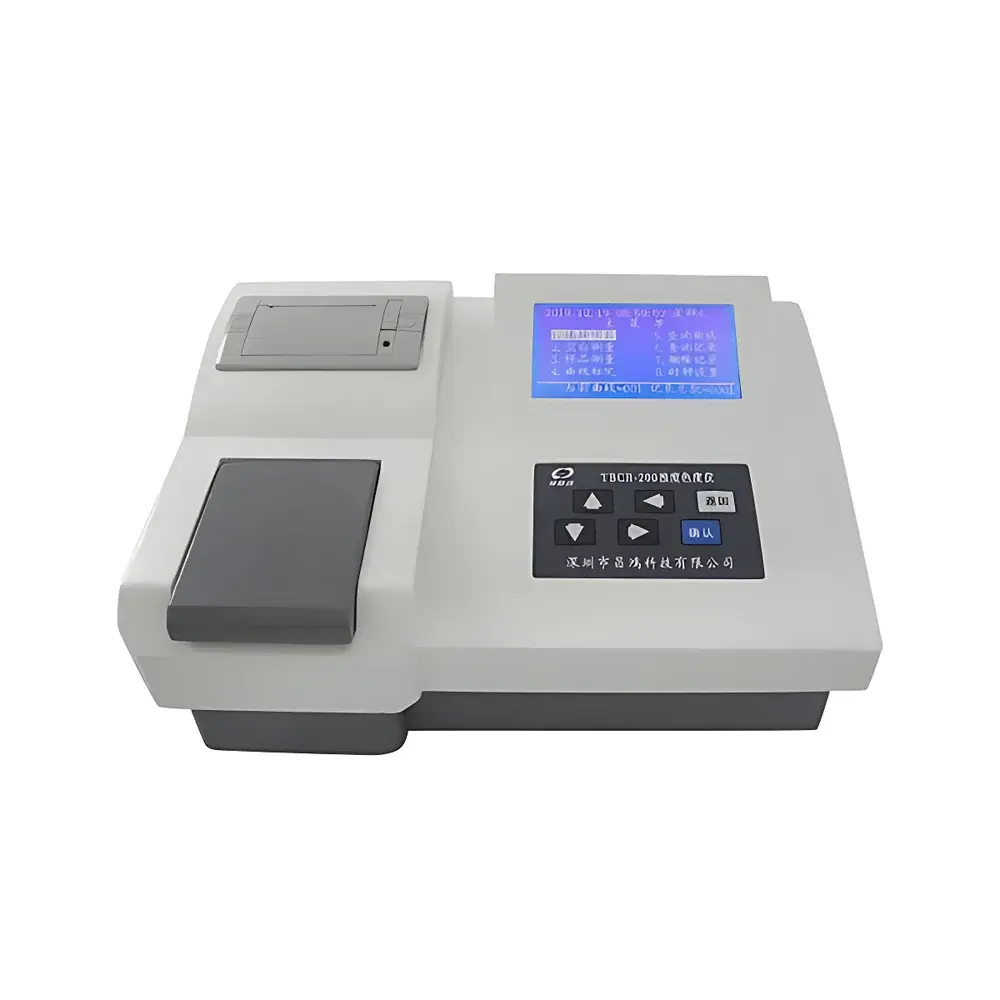
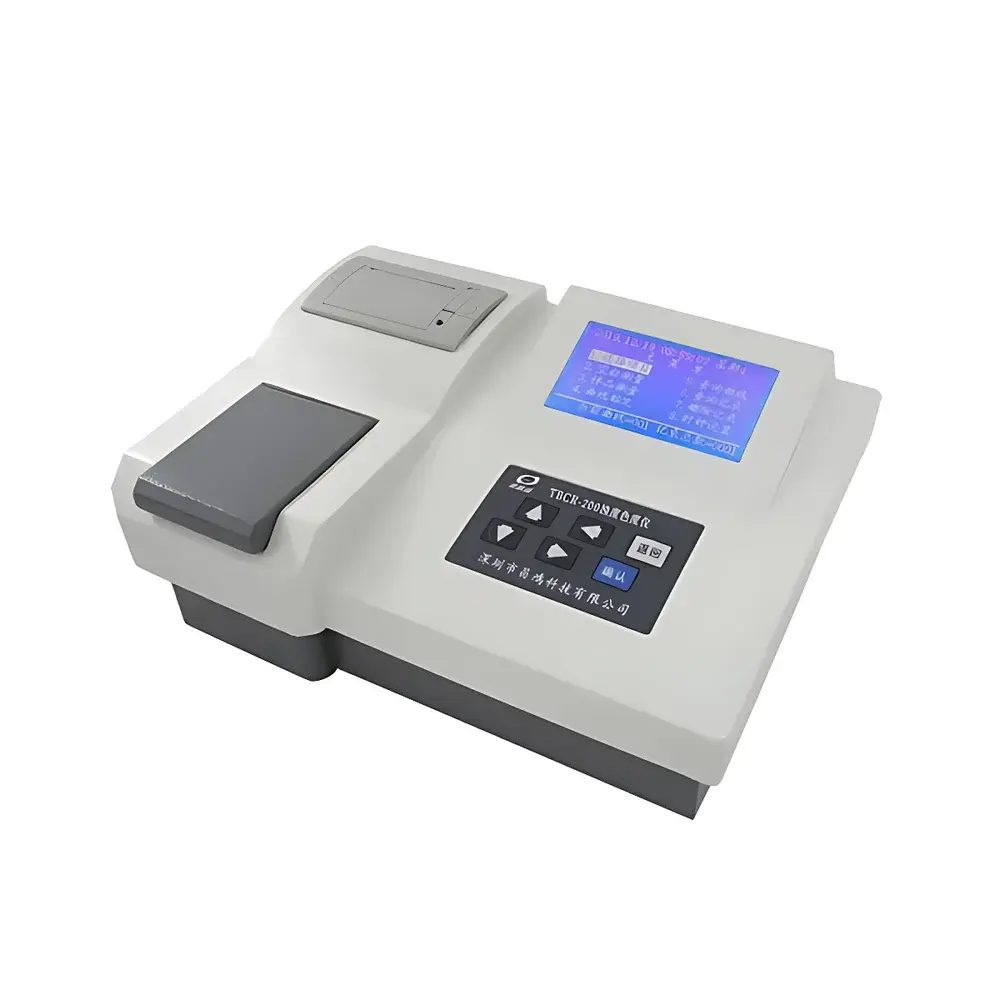
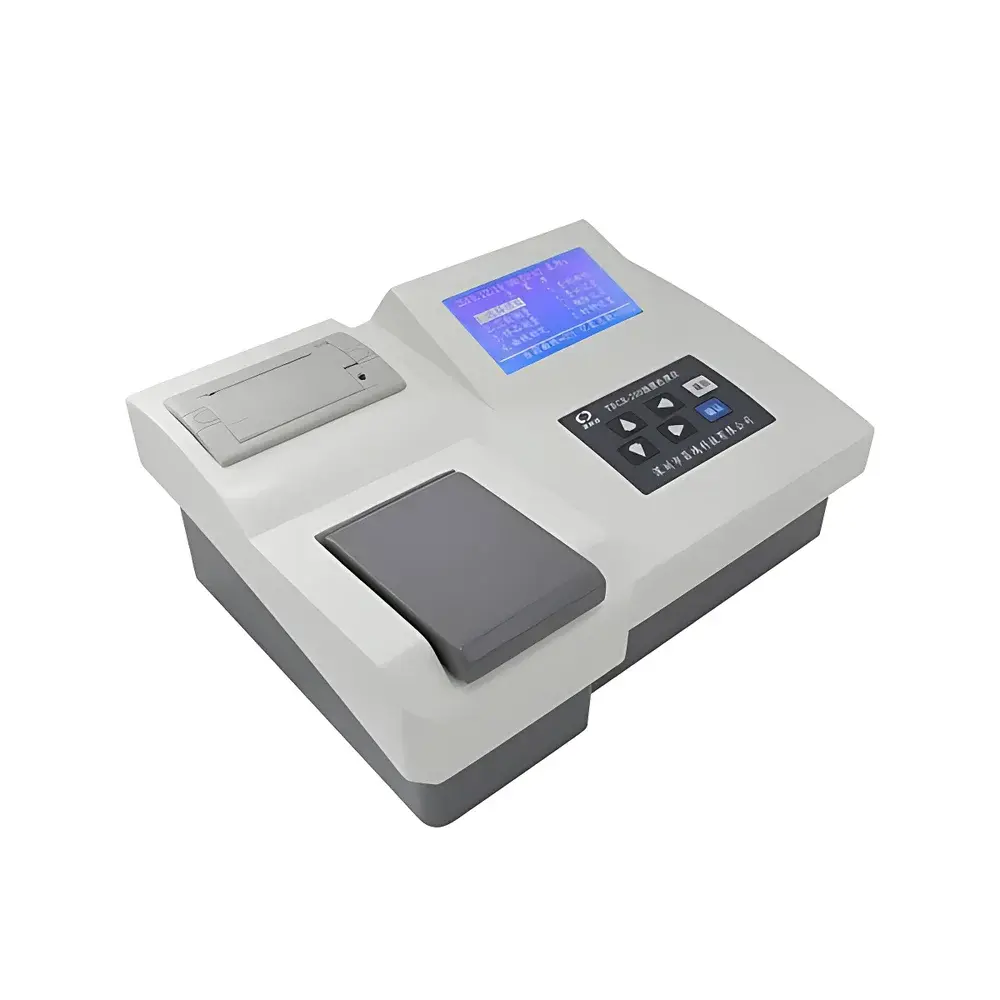
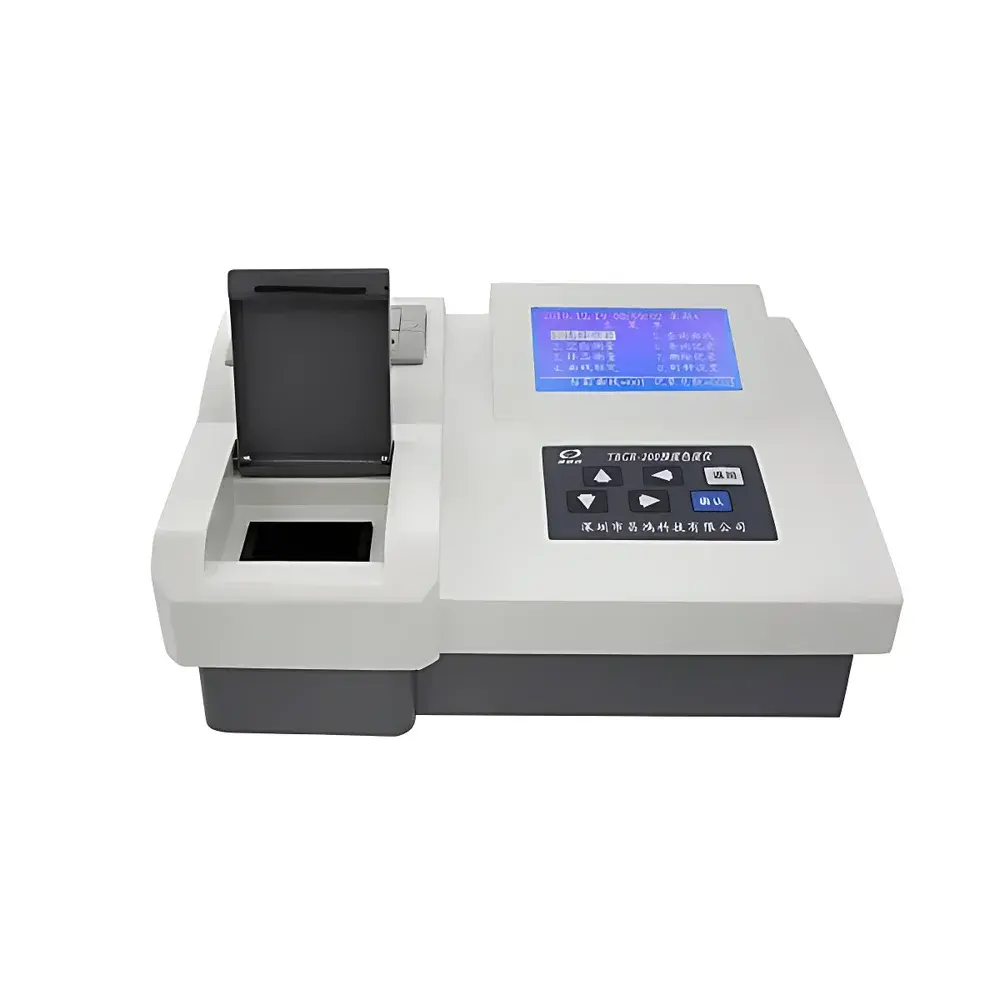
Shenchanghong TBCR-200 Benchtop Turbidity and Color Analyzer
| Brand | Shenchanghong |
|---|---|
| Origin | Guangdong, China |
| Manufacturer Type | Direct Manufacturer |
| Origin Category | Domestic (China) |
| Model | TBCR-200 |
| Form Factor | Benchtop / Laboratory |
| Turbidity Range | 0–1000 NTU |
| Color Range | 0–500 CPU |
| Turbidity Resolution | 0.01 NTU |
| Turbidity Accuracy | ±2% FS |
| Color Accuracy | ±3% FS |
| Repeatability | ≤±2% FS |
| Drift | <0.1 NTU/h |
| Operating Temperature | 5–40 °C |
| Relative Humidity | ≤70% RH |
| Power Supply | AC (220±10%) V, 50 Hz |
| Dimensions | 340 × 250 × 130 mm |
| Weight | 4 kg |
| Light Source | Imported high-intensity LED (100,000 h lifetime) with narrow-band optical filtering |
| Display | Backlit LCD with Chinese menu interface |
| Data Storage | 10 calibration curves + 500 measurement records (non-volatile memory) |
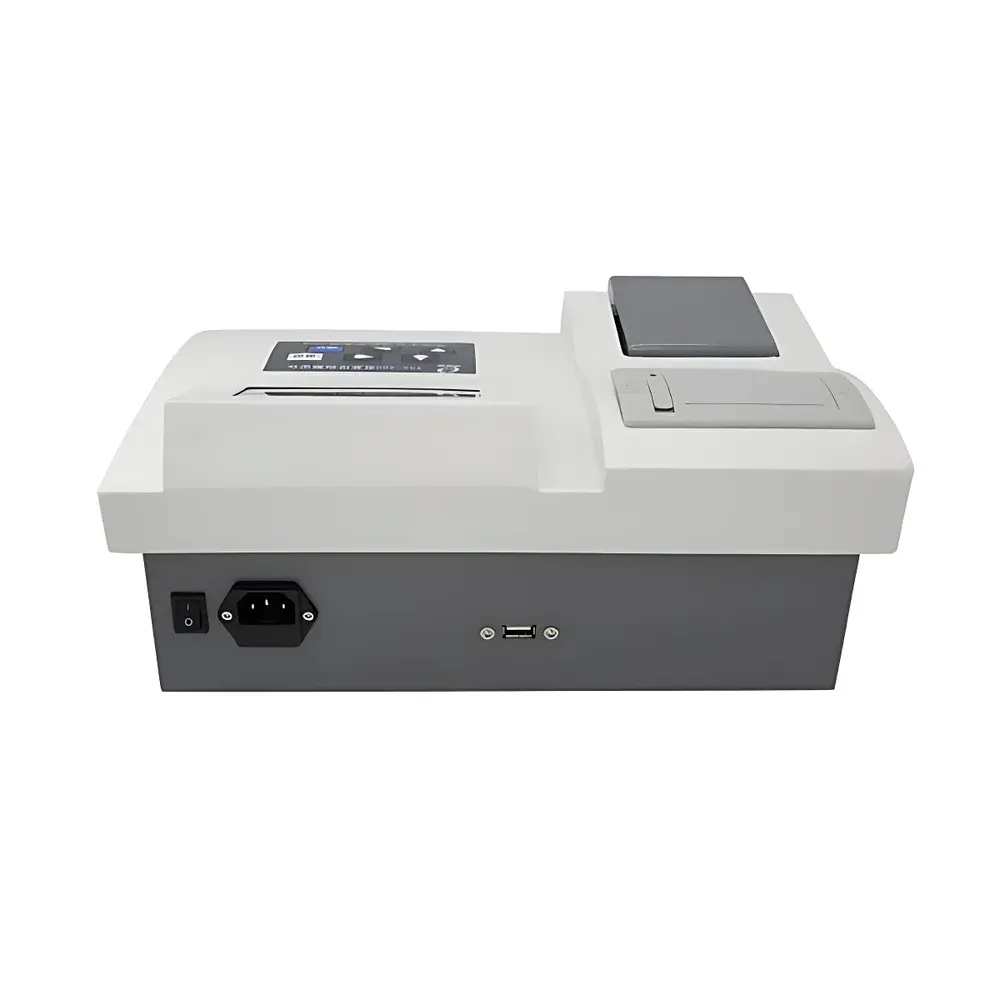
| Connectivity | USB port for data export |
| Optional | Thermal printer support |
| Housing Material | Molded ABS with corrosion resistance |
| Microcontroller | Low-power 16-bit MCU architecture |
Overview
The Shenchanghong TBCR-200 Benchtop Turbidity and Color Analyzer is an integrated optical measurement instrument engineered for simultaneous quantitative assessment of turbidity (in Nephelometric Turbidity Units, NTU) and true color (in Platinum-Cobalt Units, CPU) in aqueous samples. It operates on the principle of nephelometric detection for turbidity—measuring scattered light intensity at a 90° angle relative to the incident beam—and spectrophotometric comparison against standardized platinum-cobalt solutions for color quantification. Designed specifically for routine water quality analysis in municipal drinking water facilities, environmental monitoring laboratories, and industrial process control environments, the TBCR-200 complies with foundational optical measurement conventions aligned with ISO 7027 (turbidity) and APHA Standard Methods 2120B (color). Its dual-parameter capability eliminates the need for separate instruments, reducing cross-calibration errors and operational overhead while maintaining traceable, reproducible results under controlled laboratory conditions.
Key Features
- Stable optical architecture featuring an imported high-brightness LED light source rated for 100,000 hours of operation, coupled with precision narrow-band interference filters to minimize spectral drift and ambient light interference.
- High-resolution detection system with 0.01 NTU resolution across the full 0–1000 NTU range and ±2% full-scale accuracy for turbidity; color measurement achieves ±3% FS accuracy within 0–500 CPU.
- Robust mechanical design: injection-molded ABS housing provides chemical resistance against common reagents and cleaning agents used in water testing workflows.
- Embedded 16-bit low-power microcontroller ensures deterministic response timing, thermal stability during extended operation, and efficient power management—critical for labs operating multiple instruments on shared circuits.
- Backlit monochrome LCD with intuitive Chinese-language menu navigation supports rapid method selection, calibration execution, and real-time result display without external software dependency.
- Non-volatile memory retains up to 10 user-defined calibration curves and 500 individual measurement records—including date/time stamps—even after power loss.
Sample Compatibility & Compliance
The TBCR-200 is validated for use with clarified, filtered, or raw water matrices including potable water, surface water, groundwater, and treated effluent. Sample cells are compatible with standard 25-mm round glass cuvettes (not included), ensuring interchangeability with legacy photometric workflows. While not certified to ISO/IEC 17025 as a standalone accredited system, the instrument’s performance specifications meet the minimum technical requirements referenced in ASTM D1889, EPA Method 180.1, and China’s HJ 1075-2019 standard for turbidity measurement. For GLP/GMP-regulated environments, users may implement procedural controls—including daily verification with NIST-traceable formazin standards and documented instrument logbooks—to satisfy internal audit requirements.
Software & Data Management
Data acquisition and export are managed locally via the onboard interface. Measurement results can be transferred externally through the integrated USB 2.0 port using standard mass-storage mode—no proprietary drivers required. Exported files follow CSV format with columns for sample ID, date/time stamp, turbidity (NTU), color (CPU), operator ID (if entered), and calibration status flag. Though no dedicated PC software is bundled, the structured output enables seamless ingestion into LIMS platforms, Excel-based QA/QC dashboards, or statistical process control (SPC) tools. Optional thermal printer connectivity supports immediate hardcopy generation for field reports or chain-of-custody documentation—particularly valuable during regulatory inspections where contemporaneous record retention is mandated.
Applications
- Routine compliance monitoring of finished drinking water per national regulatory limits (e.g., China’s GB 5749-2022: turbidity ≤1 NTU at point-of-entry).
- Performance evaluation of coagulation-flocculation-sedimentation units in water treatment plants by tracking turbidity reduction efficiency across process stages.
- Baseline characterization of source waters prior to disinfection, where elevated turbidity may shield microbial contaminants from UV or chlorine exposure.
- Color profiling of wastewater influents and effluents to identify organic loading trends or industrial discharge anomalies.
- Educational laboratories requiring a cost-effective, maintenance-light platform for teaching fundamental principles of optical absorption, scattering theory, and water quality parameter interrelationships.
FAQ
Is the TBCR-200 compliant with US EPA or ISO turbidity standards?
The instrument adheres to the optical geometry and detection methodology specified in ISO 7027 (nephelometry at 90°) and aligns with the performance thresholds outlined in EPA Method 180.1; however, it does not carry formal third-party certification from EPA or ISO/CNCA bodies.
Can the device measure samples with suspended solids above 1000 NTU?
No—samples exceeding 1000 NTU must be diluted with particle-free deionized water and measured within the linear range, followed by proportional correction. Undiluted high-turbidity measurements risk detector saturation and nonlinearity.
Does the unit support multi-point calibration for both turbidity and color?
Yes—users may store up to 10 independent calibration curves, each configurable for either turbidity (using formazin or StablCal standards) or color (using Pt-Co stock solutions), with manual slope/intercept entry or auto-fit options.
What is the recommended verification frequency for routine use?
Daily verification with a mid-range certified standard (e.g., 20 NTU formazin) is advised; full recalibration is required after lamp replacement, major firmware updates, or if drift exceeds 0.1 NTU/h during warm-up stabilization.
Is USB data export compatible with Windows, macOS, and Linux systems?
Yes—the USB interface operates in standard CDC ACM (Communication Device Class) mode, appearing as a removable drive on all major desktop OS platforms without driver installation.





