
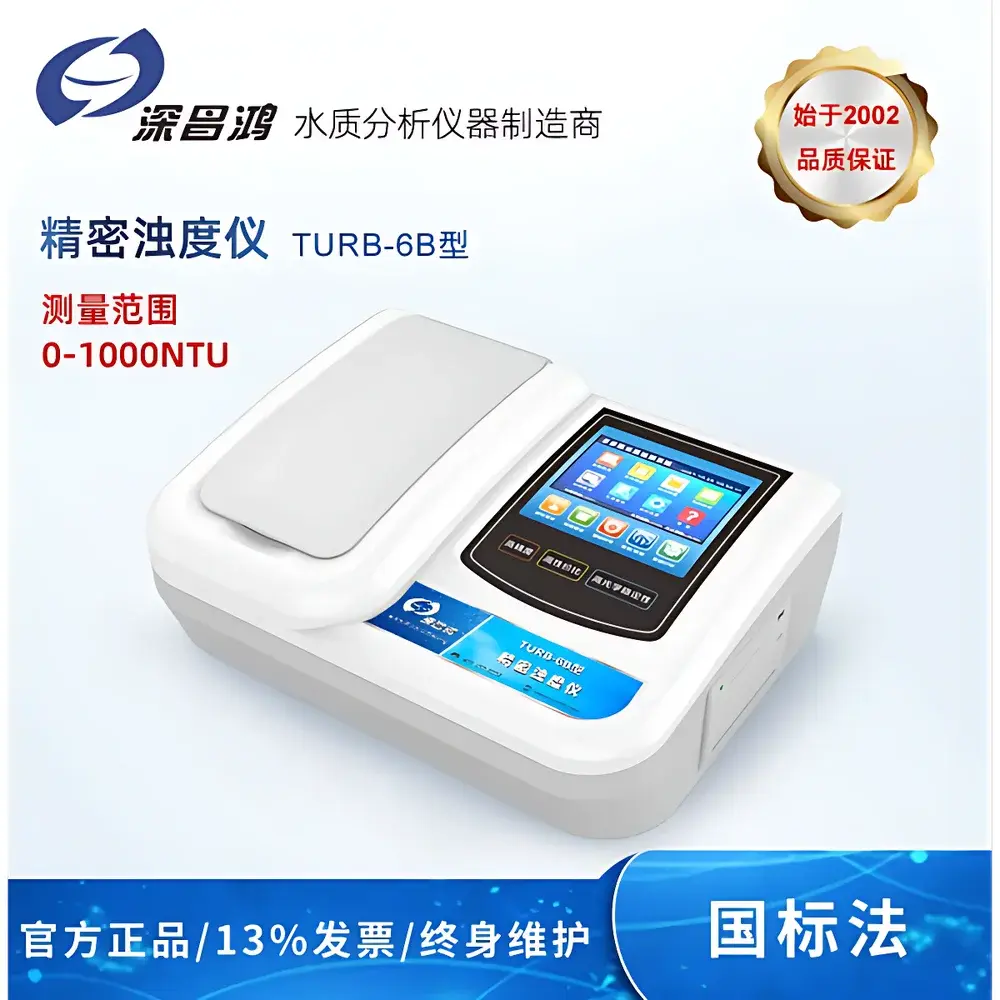
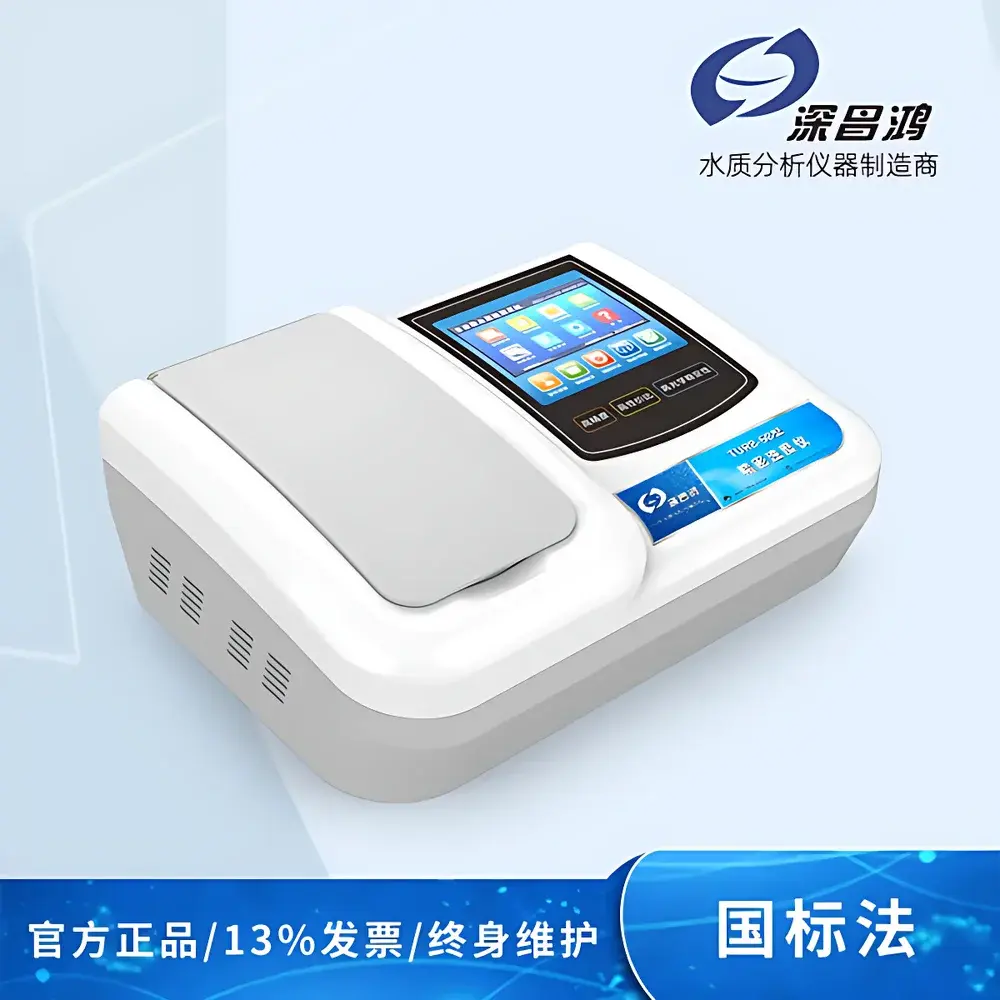
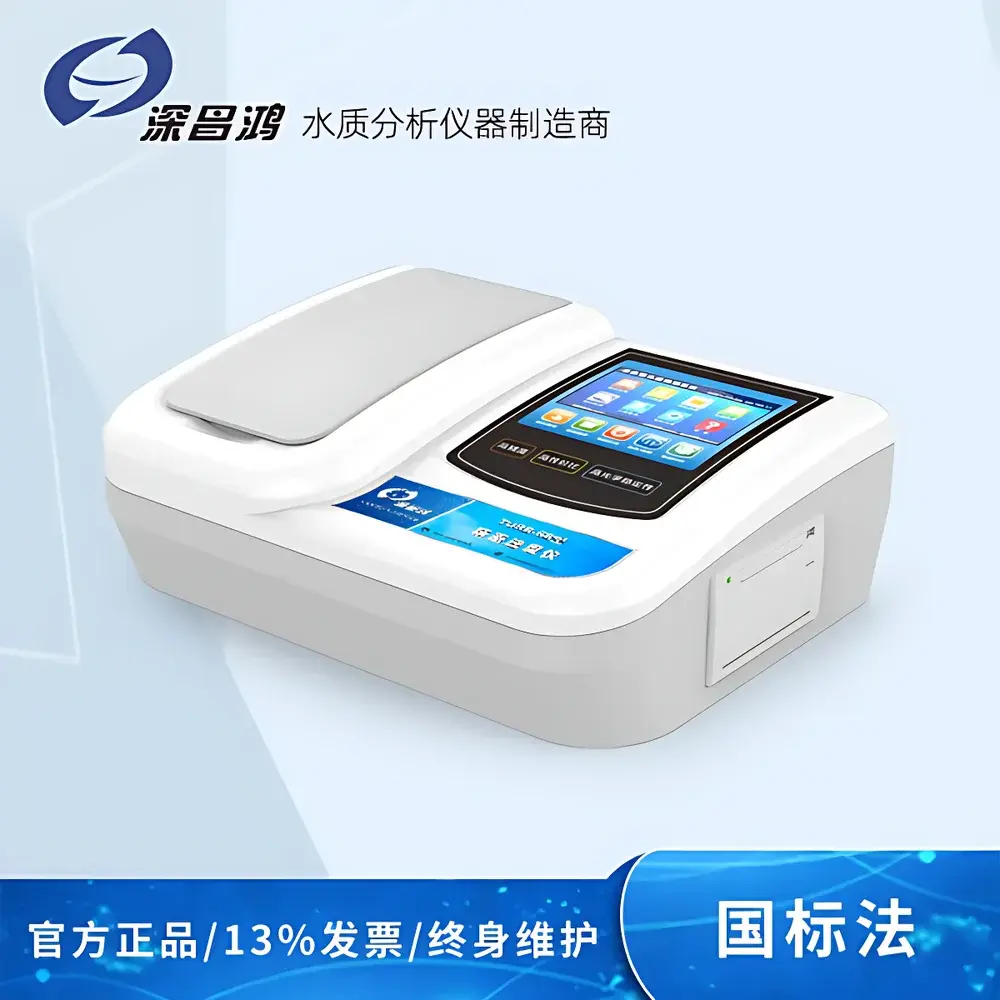
Shenchanghong TURB-6B Precision Turbidimeter
| Brand | Shenchanghong |
|---|---|
| Origin | Guangdong, China |
| Manufacturer Type | Direct Manufacturer |
| Origin Category | Domestic (China) |
| Model | TURB-6B |
| Form Factor | Benchtop / Laboratory |
| Measurement Range | 0–1000 NTU |
| Resolution | 0.01 NTU |
| Operating Temperature | 5–40 °C |
| Accuracy | ≤ ±1% FS |
| Repeatability | ≤ ±2% FS |
| Optical Drift | <0.002 A over 20 min |
| Display | Color Touchscreen with English & Chinese UI |
| Dimensions | 400 × 300 × 140 mm |
| Weight | 2.6 kg |
| Power Consumption | <100 W |
| Power Supply | AC 220 V ±10%, 50 Hz ±0.5 Hz |
| Humidity Limit | ≤85% RH non-condensing |
| Data Storage | 3500 calibration curves + 100,000 measurement records (non-volatile) |
| Connectivity | USB port for PC data export |
| Compliance | Designed per ISO 7027:2016 principles (nephelometric detection at 860 nm), supports GLP-compliant audit trails via timestamped calibration logs and operator ID tagging |
Overview
The Shenchanghong TURB-6B Precision Turbidimeter is a benchtop nephelometric instrument engineered for accurate, repeatable turbidity quantification in laboratory and field-deployable quality control environments. It operates on the principle of 90° light scattering (nephelometry) at an 860 nm near-infrared LED source—aligned with ISO 7027:2016 requirements for standardized turbidity measurement. This optical configuration minimizes interference from sample coloration and absorbance, ensuring high fidelity across diverse aqueous matrices including potable water, wastewater effluents, aquaculture recirculation systems, and industrial process streams. The instrument employs a cold-light, narrow-band interference optical path with thermally stabilized detection electronics, delivering long-term photometric stability (<0.002 A drift over 20 minutes). Its fixed-wavelength design eliminates spectral variability associated with broadband sources, supporting method consistency required under regulatory frameworks such as EPA Method 180.1 and ASTM D6508.
Key Features
- Nephelometric detection at 860 nm compliant with ISO 7027:2016 and US EPA guidance
- High-resolution color touchscreen interface with dual-language (English/Chinese) support for international lab personnel
- Integrated self-calibration routine enabling real-time correction of optical drift during extended operation
- One-touch restore function to recover factory default settings and calibration curves without firmware reset
- Non-volatile memory storing up to 3,500 user-defined calibration curves and 100,000 timestamped measurements—including operator ID, calibration date/time, standard reference values, and corresponding absorbance readings
- USB 2.0 interface for secure data export to LIMS or spreadsheet-based QA/QC reporting
- Low-power consumption (<100 W) and compact footprint (400 × 300 × 140 mm) optimized for shared analytical workspaces
- Robust mechanical housing rated for continuous use in ambient lab conditions (5–40 °C, ≤85% RH)
Sample Compatibility & Compliance
The TURB-6B accepts standard 25 mm round glass cuvettes (included) and is validated for use with formazin-based primary standards (e.g., 0.1, 10, 100, and 400 NTU traceable references). It maintains linearity and repeatability across its full 0–1000 NTU range, meeting ISO 7027 accuracy specifications (≤±1% FS) and repeatability criteria (≤±2% FS). Calibration traceability is supported through documented operator-assigned IDs and time-stamped log entries—enabling compliance with GLP and internal QA documentation protocols. While not FDA 21 CFR Part 11 certified out-of-the-box, its audit-ready data structure (with immutable timestamps and user identifiers) provides foundational infrastructure for laboratories implementing electronic record controls under GMP or ISO/IEC 17025 accreditation.
Software & Data Management
Data acquisition and management are handled via embedded firmware with no external software dependency. All calibrations and measurements generate structured metadata: date/time stamp, operator code, standard concentration, measured NTU, and raw detector signal (absorbance units). Exported CSV files via USB retain full contextual integrity for integration into validated laboratory information management systems (LIMS). The onboard database supports curve interrogation—allowing full reconstruction of calibration history, including individual standard point verification. No proprietary drivers or cloud dependencies are required; raw data files are human-readable and compatible with common statistical analysis platforms (e.g., Excel, JMP, Python pandas).
Applications
- Drinking water treatment: verification of coagulation/flocculation efficiency and final filter performance
- Municipal and industrial wastewater monitoring: compliance reporting per local discharge permits
- Aquaculture and hydroponics: real-time assessment of suspended solids impacting dissolved oxygen and pathogen risk
- Pharmaceutical water systems: routine testing of purified water (PW) and water-for-injection (WFI) distribution loops
- Environmental field labs: portable verification of turbidity trends in surface water bodies and stormwater runoff
- Educational laboratories: hands-on instruction in optical metrology, calibration theory, and environmental analytical methods
FAQ
What wavelength does the TURB-6B use for turbidity measurement?
It utilizes a stable 860 nm near-infrared LED source, conforming to ISO 7027:2016 for reduced color interference.
Can calibration curves be exported or backed up externally?
Yes—via USB interface, users can export full calibration histories and measurement datasets in standard CSV format.
Is the instrument suitable for GLP-regulated environments?
Its timestamped, operator-tagged calibration logs and non-volatile storage meet foundational GLP data integrity requirements; validation documentation must be site-specific.
Does the TURB-6B support automatic range switching?
No—it requires manual range selection within the 0–1000 NTU span; however, auto-zero and self-calibration functions minimize setup time between samples.
What cuvette type is required?
Standard 25 mm round glass cuvettes (10 mm path length), supplied with the instrument; quartz cuvettes are not required due to the 860 nm operating wavelength.



