
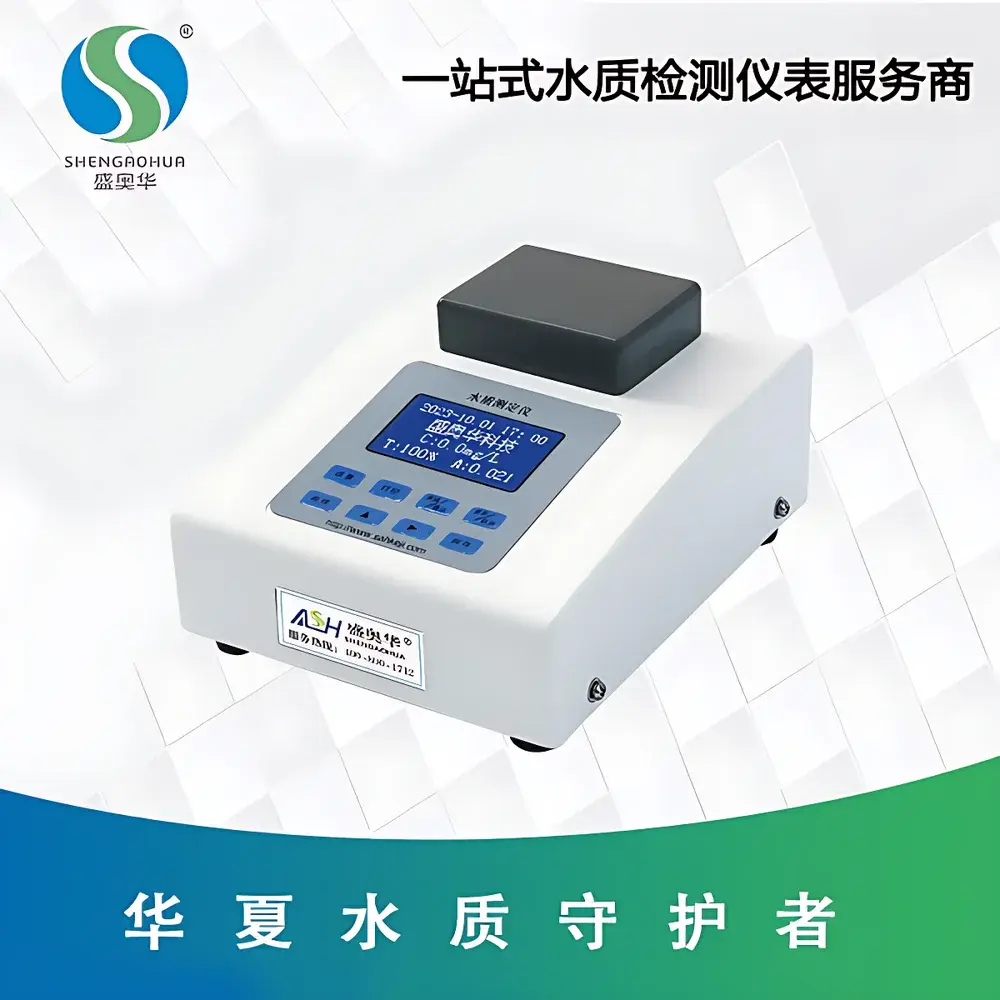
ShengAohua 6B-50LHW Sulfide Analyzer
| Brand | ShengAohua |
|---|---|
| Origin | Jiangsu, China |
| Manufacturer Type | Direct Manufacturer |
| Instrument Type | Laboratory Benchtop Analyzer |
| Model | 6B-50LHW |
| Measurement Range | 0–1 mg/L |
| Accuracy | ≤ ±5% |
| Repeatability | ≤ ±5% |
| Analysis Time | 1 minute per sample |
| Calibration Curves | 5 programmable and user-editable curves |
| Data Storage Capacity | 5,000,000 measurement records |
| Light Source | Cold LED with narrow-band interference filter (rated lifetime: 100,000 hours) |
| Display | Large-backlit LCD with Chinese graphical menu interface |
Overview
The ShengAohua 6B-50LHW Sulfide Analyzer is a dedicated benchtop photometric instrument engineered for the quantitative determination of total sulfide (as S²⁻) in aqueous environmental samples. It operates on the principle of methylene blue colorimetry—where sulfide ions react with N,N-dimethyl-p-phenylenediamine sulfate and ferric chloride under acidic conditions to form a stable, intensely colored methylene blue complex. Absorbance is measured at a fixed wavelength (typically 665 nm) using a cold LED light source coupled with a narrow-band interference optical filter, ensuring high spectral specificity and long-term photometric stability. Designed for routine compliance monitoring and research-grade water quality analysis, the 6B-50LHW delivers rapid, reliable results in one minute per sample—making it suitable for high-throughput laboratories operating under ISO/IEC 17025, EPA Method 376.1, and GB/T 16489–1996 (Chinese national standard for sulfide in water).
Key Features
- Integrated cold LED optical system with narrow-band interference filter (center wavelength ±1 nm tolerance), eliminating thermal drift and enabling >100,000 hours of stable illumination without recalibration.
- Large backlit monochrome LCD display with intuitive Chinese-language graphical menu navigation—designed for ease of use by technicians with varying levels of instrumentation experience.
- Onboard memory supporting up to five user-defined calibration curves; each curve may be named, edited, saved, or overwritten without external software dependency.
- Direct digital readout of sulfide concentration (mg/L as S²⁻); no manual calculation or lookup tables required.
- High-capacity internal storage (5 million data points) with timestamp, sample ID, curve ID, and operator tag—fully traceable per GLP data integrity requirements.
- Optional thermal printer interface (RS-232 or USB) for immediate hardcopy output of current measurement, including date/time stamp and calibration status flag.
Sample Compatibility & Compliance
The 6B-50LHW is validated for use with clarified, filtered, or acidified water samples—including surface water, groundwater, wastewater effluents, and industrial process streams. Sample pretreatment follows standardized procedures outlined in EPA 376.1 (distillation followed by colorimetric detection) or direct measurement for low-turbidity, non-interfering matrices. The analyzer complies with key regulatory frameworks governing environmental testing: it supports audit-ready data logging aligned with ISO/IEC 17025 Clause 7.7 (result reporting), enables full traceability for GLP/GMP environments, and meets minimum performance criteria specified in GB/T 16489–1996 for accuracy (≤±5%), repeatability (≤±5%), and detection range (0–1 mg/L). While not FDA 21 CFR Part 11–certified out-of-the-box, its secure local data storage architecture facilitates integration into validated laboratory information management systems (LIMS) requiring electronic record retention.
Software & Data Management
All data handling occurs onboard—no proprietary PC software is required for basic operation. Measurement records include automatic timestamping, user-assigned sample identifiers, active calibration curve reference, and pass/fail flags based on pre-set acceptance thresholds. Data export is supported via USB mass storage mode (FAT32 formatted drive), allowing CSV-formatted batch downloads for post-processing in Excel, R, or LIMS platforms. Firmware updates are delivered via USB stick and include version-controlled changelogs compliant with IEC 62304 Class B software safety requirements. Audit trail functionality logs all critical events—including curve edits, zero/calibration actions, and system resets—with immutable timestamps.
Applications
- Regulatory compliance monitoring at municipal wastewater treatment plants (WWTPs) for discharge permit reporting (e.g., NPDES).
- Process control in pulp & paper mills, tanneries, and textile dyeing facilities where sulfide accumulation poses odor and corrosion risks.
- Environmental impact assessments (EIAs) for upstream oil & gas operations, particularly in sour water handling systems.
- Academic and governmental research on sulfur biogeochemistry in freshwater and estuarine ecosystems.
- Quality assurance in pharmaceutical manufacturing where sulfide impurities must be controlled per ICH Q5D guidelines for cell culture media components.
FAQ
What sample preparation is required prior to analysis?
For wastewater or high-solids samples, acidification and distillation per EPA Method 376.1 is recommended to remove interferences (e.g., thiosulfate, sulfite). For clean surface water, direct analysis after filtration (0.45 µm) is acceptable.
Can the instrument store calibration curves from multiple users?
Yes—each of the five available curve slots can be labeled and secured with optional password protection (enabled via firmware update v2.3+).
Is method validation documentation provided with the instrument?
ShengAohua supplies a Factory Performance Verification Report (FPVR) including linearity, accuracy, and repeatability test data against NIST-traceable sulfide standards (SRM 2786). Full validation protocols are available upon request for IQ/OQ/PQ execution.
Does the device support remote diagnostics or network connectivity?
No Ethernet or Wi-Fi interface is built-in; however, the USB host port enables connection to network-attached storage or LIMS gateways via intermediate microcontroller-based bridges.
What maintenance intervals are recommended for long-term reliability?
Optical path cleaning every 6 months; LED intensity verification annually using supplied neutral density reference filters; full system verification recommended before each quarterly QA/QC audit cycle.
Related Products







