
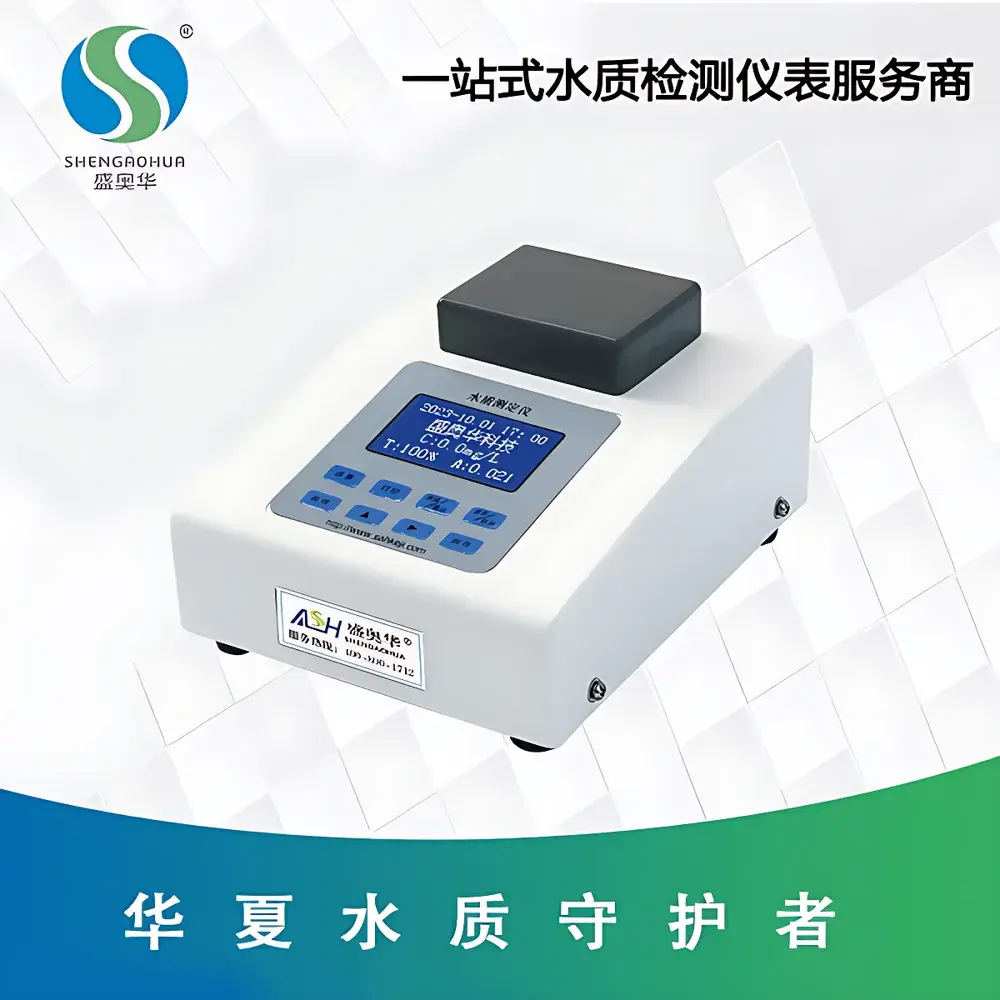
ShengAohua 6B-50SS (V9) Suspended Solids Analyzer
| Brand | ShengAohua |
|---|---|
| Origin | Jiangsu, China |
| Manufacturer Type | Direct Manufacturer |
| Instrument Type | Laboratory Benchtop Analyzer |
| Model | 6B-50SS (V9) |
| Measurement Range | 0–200 mg/L |
| Accuracy | ≤ ±10% |
| Repeatability | ≤ ±5% |
| Measurement Time | 1 minute per sample |
| Calibration Curves | 5 user-configurable curves |
| Data Storage Capacity | 5,000,000 measurement records |
| Light Source | Cold LED with Narrow-band Interference Filter (Lifetime ≥ 100,000 hours) |
| Display | Large-backlit LCD with Chinese GUI |
| Connectivity | Optional thermal printer interface (not standard) |
Overview
The ShengAohua 6B-50SS (V9) Suspended Solids Analyzer is a dedicated laboratory-grade photometric instrument engineered for rapid, reliable quantification of total suspended solids (TSS) in aqueous environmental and industrial samples. It operates on the principle of turbidimetric measurement—using narrow-band interference-filtered cold LED illumination to detect light attenuation caused by particulate scattering in filtered water samples. Unlike gravimetric TSS methods (e.g., EPA Method 160.2 or ISO 11923), which require filtration, drying, and weighing—a process prone to operator variability and time delays—the 6B-50SS delivers standardized optical readings in under 60 seconds per test. Its design targets laboratories requiring high-throughput screening without compromising method traceability, particularly where routine compliance monitoring against regulatory thresholds (e.g., discharge limits per EU Urban Wastewater Treatment Directive or China’s GB 3838–2002 Class V standards) is mandated.
Key Features
- Optimized optical architecture featuring a stable cold LED source with narrow-band interference filtering (center wavelength ±2 nm tolerance), minimizing spectral drift and ensuring long-term photometric consistency over >100,000 operating hours.
- Integrated microprocessor-controlled calibration system supporting up to five independently editable, user-defined calibration curves—enabling method adaptation for diverse matrix types (e.g., municipal wastewater, pulp mill effluents, or dairy processing rinse water).
- Large-character backlit LCD display with intuitive Chinese-language menu navigation—designed for operational clarity in shared lab environments where multilingual staff may interact with the device.
- Onboard data management engine capable of storing up to 5 million timestamped measurement records, each tagged with sample ID, curve ID, date/time, and operator code (if enabled via external login protocol).
- Rugged benchtop enclosure rated IP20, constructed from chemical-resistant ABS housing with reinforced sample chamber shielding to prevent ambient light leakage during measurement.
Sample Compatibility & Compliance
The 6B-50SS is validated for use with standard glass fiber filters (e.g., Whatman GF/C or equivalent) following pre-filtration protocols aligned with ISO 11923:1997 (Water quality — Determination of suspended solids — Gravimetric method) and ASTM D5907–22 (Standard Test Methods for Total Suspended Solids (TSS) in Water). While the instrument itself performs optical estimation—not gravimetric determination—it is routinely deployed as a screening tool preceding confirmatory gravimetric analysis in QA/QC workflows. Its accuracy specification (≤ ±10%) meets typical requirements for process control and trend monitoring in WWTPs, food & beverage facilities, and textile dyeing operations. The device supports GLP-aligned documentation when paired with optional thermal printing (via RS-232 or USB-to-serial adapter), generating audit-ready hard copies with embedded timestamps and curve identifiers.
Software & Data Management
No proprietary PC software is required for basic operation; all configuration, calibration, and data review occur directly on-device. However, stored datasets can be exported via USB flash drive (FAT32 formatted) in CSV format for downstream statistical analysis in Excel, R, or LIMS platforms. Each record includes: measurement value (mg/L), associated calibration curve index, date/time stamp (RTC-backed), and sequential test number. The system logs all critical events—including calibration updates, curve modifications, and power-cycle history—for internal traceability. Though not natively 21 CFR Part 11 compliant, its audit trail structure satisfies core ALCOA+ principles (Attributable, Legible, Contemporaneous, Original, Accurate) when operated within documented SOPs.
Applications
- Wastewater treatment plants: Real-time monitoring of influent/effluent TSS to optimize clarifier performance and verify regulatory compliance.
- Food & beverage production: Rapid assessment of suspended particulates in CIP rinse water, milk homogenate stability checks, and brewery wort clarity verification.
- Textile and dyeing facilities: Quantifying fiber shedding and pigment carryover in post-rinse effluents prior to pH adjustment or tertiary treatment.
- Environmental monitoring labs: Field-deployable screening at mobile labs or fixed stations for surface water quality surveys (rivers, lakes, reservoirs).
- Academic research: Teaching labs conducting comparative studies between optical and gravimetric TSS methods; method validation projects under ISO/IEC 17025 frameworks.
FAQ
Is the 6B-50SS suitable for drinking water analysis?
Yes—provided samples are pre-filtered through a 0.45 µm membrane and diluted appropriately to fall within the 0–200 mg/L linear range. Note that potable water typically exhibits TSS < 1 mg/L, so detection sensitivity may be limited relative to specialized low-range nephelometers.
Can calibration curves be imported from external sources?
No—curves must be generated in situ using certified reference suspensions (e.g., Formazin or AMCO AEPA standards) and manually entered or optimized via the built-in slope-intercept editor.
Does the instrument support automatic dilution?
No—sample dilution must be performed manually prior to analysis. Users are advised to validate linearity across the extended range using serial dilutions of representative matrices.
What maintenance is required beyond annual calibration verification?
Routine cleaning of the optical path (cuvette holder and LED window) with lint-free wipes and isopropyl alcohol every 200 measurements; periodic verification of filter integrity when used in high-turbidity applications.
Is firmware upgrade capability available?
Yes—firmware updates are distributed via ShengAohua’s authorized service network and applied using a USB drive; version history and release notes are provided in English upon request.
Related Products







