
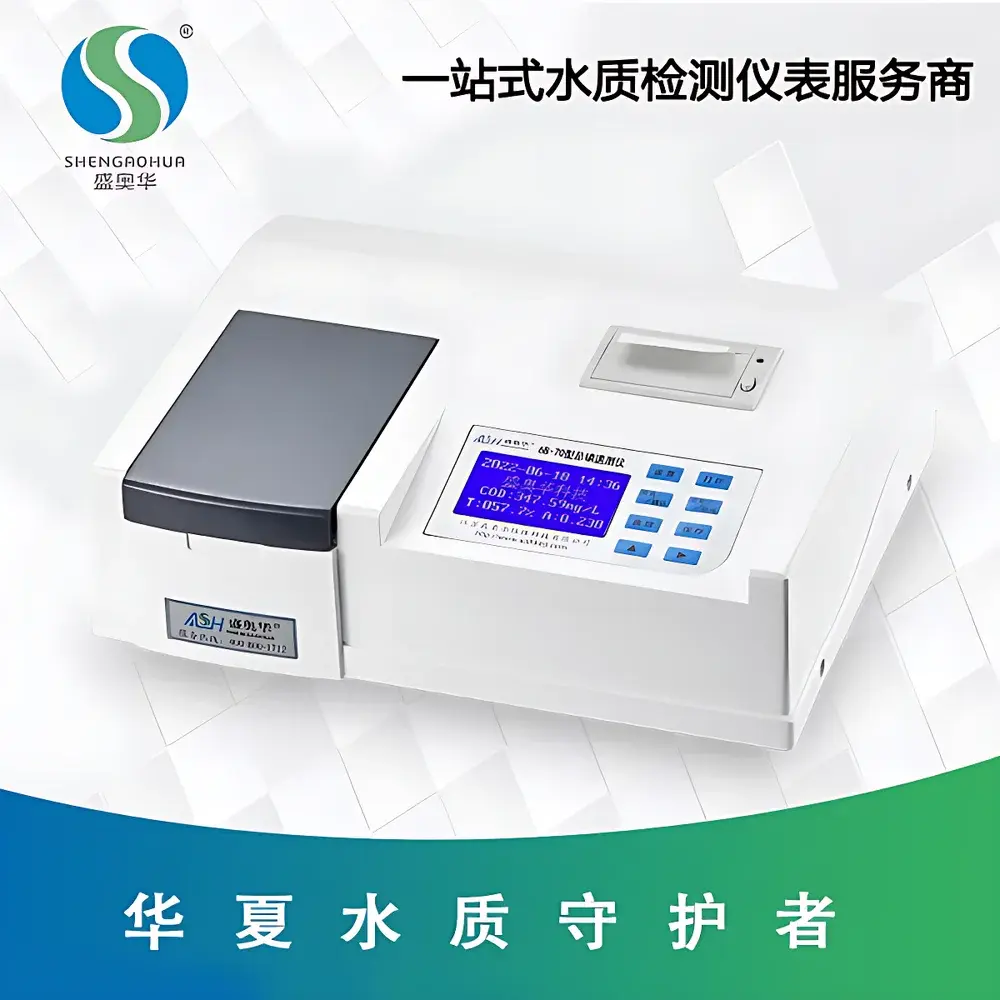
Shengaohua 6B-50(V9) Ammonia Nitrogen Analyzer
| Brand | Shengaohua |
|---|---|
| Origin | Jiangsu, China |
| Manufacturer Type | Direct Manufacturer |
| Product Category | Domestic |
| Model | 6B-50(V9) |
| Instrument Type | Benchtop Laboratory Analyzer |
| Measurement Principle | Colorimetric Method (Nesslerization or Salicylate-based, per standard water quality protocols) |
| Measurement Range | 0.01–100 mg/L (multi-range auto-segmentation) |
| Accuracy | ≤ ±5% of reading |
| Detection Limit | 0.01 mg/L |
| Measurement Time | 15–20 minutes per batch |
| Batch Capacity | 12 samples |
| Repeatability | ±5% |
| Photometric Stability | ≤ ±0.001 A/10 min |
| Operating Temperature | 5–40 °C |
| Relative Humidity | <85% RH (non-condensing) |
| Preloaded Calibration Curves | 100 (5 factory-calibrated, 95 user-editable) |
| Data Storage Capacity | 5,000,000 records |
| Display | Backlit LCD with Chinese interface |
| Connectivity | USB port for PC-based data export and firmware update |
| Power Supply | AC 220 V ±10%, 50 Hz |
| Dimensions | 360 × 280 × 100 mm |
| Net Weight | 3 kg |
Overview
The Shengaohua 6B-50(V9) Ammonia Nitrogen Analyzer is a benchtop laboratory instrument engineered for reliable, standardized quantification of ammonia nitrogen (NH₃-N) in aqueous environmental and industrial samples. It operates on the colorimetric principle—specifically optimized for either Nesslerization (for low-to-mid range) or salicylate-hypochlorite reaction (for enhanced selectivity and reduced interference), in accordance with ISO 7150-1, HJ 535–2009 (Chinese EPA standard), and APHA Standard Methods 4500-NH₃ F/G. The analyzer employs a cold LED light source with narrow-band optical interference filtering (center wavelength ±1 nm tolerance), ensuring long-term photometric integrity (>100,000 hours MTBF) and minimal spectral drift across repeated measurements. Its fixed optical path design eliminates manual cuvette alignment errors, contributing to high inter-run reproducibility under routine QC conditions.
Key Features
- Cold LED optical source with narrow-band interference filter—eliminates warm-up time, reduces thermal noise, and ensures stable absorbance baseline over extended operation.
- Integrated backlit LCD display with native Chinese menu navigation—enables intuitive method selection, real-time concentration readout, and on-device calibration verification without external software.
- Built-in thermal printer supporting immediate hardcopy output of current measurement results, calibration logs, and historical query reports (date/time stamped, sample ID indexed).
- Preloaded library of 100 calibration curves—including five traceable reference curves validated against CRM-certified NH₄⁺ standards (e.g., NIST SRM 2020a)—with full user authority to modify, validate, and save custom curves using standard solution series.
- Automated multi-range segmentation logic: automatically selects optimal optical gain and dilution factor based on preliminary absorbance scan, enabling seamless coverage from 0.01 mg/L (sub-ppb sensitivity) to 100 mg/L without manual range switching.
- Robust mechanical architecture: aluminum alloy chassis, sealed optical compartment, and ESD-protected circuitry—designed for continuous use in shared lab environments with variable ambient humidity (<85% RH) and temperature (5–40 °C).
Sample Compatibility & Compliance
The 6B-50(V9) is validated for direct analysis of raw and pretreated water matrices including surface water, groundwater, wastewater effluent, activated sludge supernatant, and industrial process streams (e.g., from pulp/paper, pharmaceutical, food & beverage, and municipal treatment facilities). Sample turbidity up to 50 NTU is accommodated via integrated digital compensation algorithms; suspended solids >100 mg/L require centrifugation or membrane filtration (0.45 µm) prior to analysis. The system supports compliance with GLP documentation requirements through timestamped audit trails embedded in stored records, and meets electrical safety Class I requirements per IEC 61010-1. While not FDA 21 CFR Part 11–certified out-of-the-box, its USB data export protocol (CSV/Excel-compatible) enables integration into validated LIMS environments where electronic record controls are externally governed.
Software & Data Management
Data handling is managed entirely onboard via non-volatile flash memory supporting up to 5,000,000 discrete measurement records—each tagged with sample ID, operator code, date/time stamp, curve ID used, raw absorbance value, calculated concentration, and pass/fail QC flag (based on blank deviation thresholds). USB connectivity enables bidirectional communication: users may export datasets for statistical review (e.g., control charting per ISO 8466-1), re-import updated calibration curves, or perform remote firmware updates. No proprietary runtime or driver installation is required on host PCs—standard CDC ACM-class USB serial emulation ensures compatibility with Windows, macOS, and Linux platforms.
Applications
This analyzer serves as a primary tool in environmental monitoring laboratories conducting routine compliance testing under national discharge permits (e.g., China’s GB 8978–1996, EU Urban Wastewater Treatment Directive Annex I), as well as in R&D settings evaluating nitrification/denitrification kinetics, bioreactor performance, or inhibitor screening. It is routinely deployed in QA/QC workflows for drinking water treatment plants verifying chloramination residuals, in dairy processing facilities monitoring anaerobic digester influent, and in academic teaching labs demonstrating fundamental principles of spectrophotometric quantitation and calibration function derivation.
FAQ
What digestion or pretreatment steps are required before analysis?
No digestion is needed for free and total ammonia nitrogen determination. However, samples containing significant organic nitrogen (e.g., amino acids, urea) require separate Kjeldahl or persulfate oxidation pretreatment—this instrument measures only NH₃-N, not organic-N or nitrate.
Can the instrument be used for field deployment?
It is designed exclusively for controlled laboratory environments. Battery operation, shock resistance, and IP-rated enclosure are not provided; portable alternatives (e.g., 6B-50P series) are available separately.
How are calibration curves verified for regulatory reporting?
Users must perform daily bracketing with at least two certified reference materials (CRMs) spanning the working range; instrument-generated calibration reports include slope, intercept, correlation coefficient (r² ≥ 0.999), and residual error—sufficient for internal QA and third-party audit documentation.
Is method validation support available?
Shengaohua provides application notes aligned with HJ 535–2009 and ISO 7150-1, including LOD/LOQ determination protocols, spike recovery templates (n = 7 per matrix), and inter-laboratory comparison guidelines—available upon request with proof of instrument registration.
Related Products







