
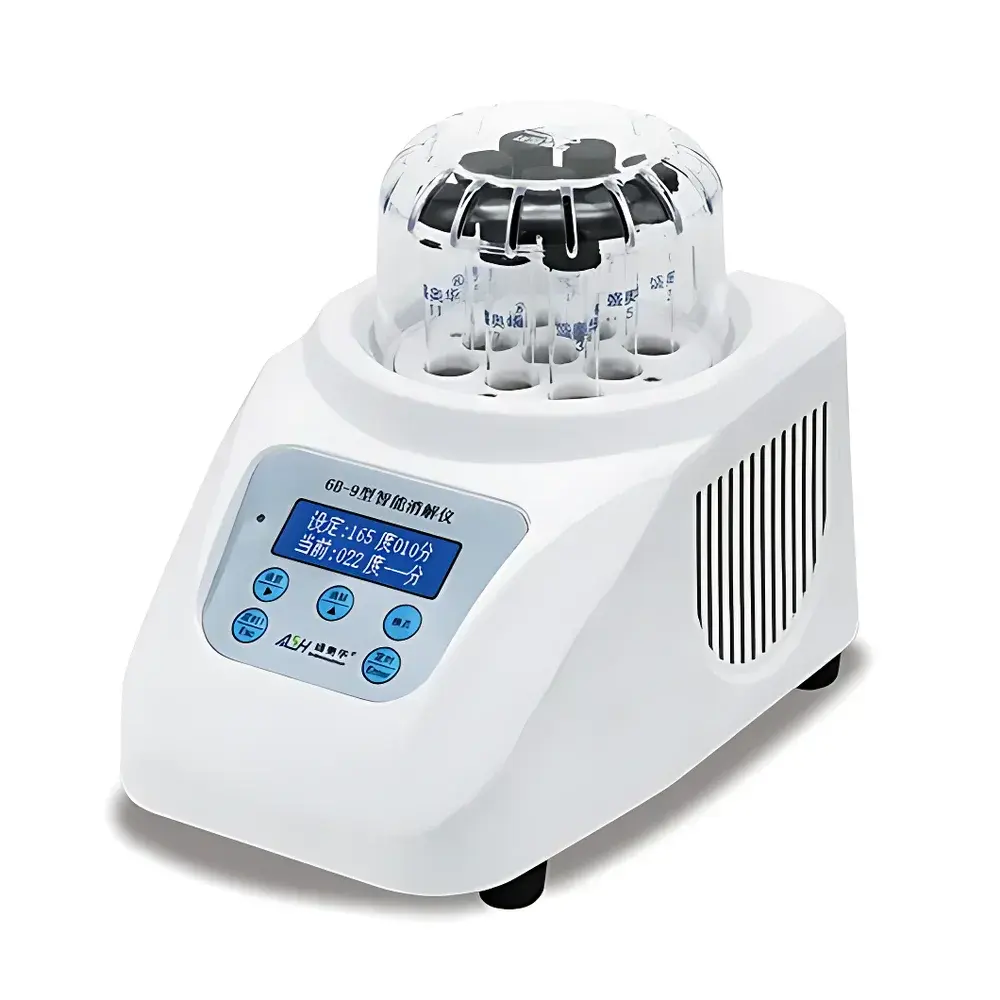
Shengaohua 6B-9 Intelligent COD Digestion Analyzer (9-Position)
| Brand | Shengaohua |
|---|---|
| Origin | Jiangsu, China |
| Manufacturer Type | Direct Manufacturer |
| Product Origin | Domestic (China) |
| Model | 6B-9 |
| Digestion Method | Rapid Digestion |
| Heating Module | Single Aluminum Block Heater |
| Batch Capacity | 9 samples |
| Temperature Range | Ambient to 200 °C |
| Temperature Accuracy | ±0.5 °C |
| Digestion Vessel Volume | 17 mL |
| Timer Accuracy | ±0.1 s at 10 min |
| Temperature Control Precision | ±1 °C at 165 °C |
| Timer Range | 1–199 min |
| Power Supply | AC 220 V ±10%, 50 Hz, 460 W |
| Dimensions (L×W×H) | 300 × 240 × 220 mm |
| Net Weight | 5.8 kg |
| Housing Material | Molded High-Temperature Corrosion-Resistant Polymer |
| Display | Full-Text Chinese Blue LCD Screen |
| Predefined Digestion Programs | 6 standard curves (COD, Total Phosphorus, Total Nitrogen, Total Copper, Hexavalent Chromium, etc.) |
| Safety Protection | Automatic thermal cutoff upon overtemperature |
Overview
The Shengaohua 6B-9 Intelligent COD Digestion Analyzer is a compact, single-block, 9-position benchtop digestion system engineered for precision and reproducibility in regulated water quality laboratories. It operates on the principle of closed-vessel rapid thermal digestion—applying controlled conductive heating to sealed digestion tubes containing acidified water samples and oxidizing reagents (e.g., potassium dichromate in sulfuric acid under reflux conditions). This method accelerates oxidation of organic matter, enabling accurate chemical oxygen demand (COD) quantification per ISO 6060, ASTM D1252 (Method B), and EPA 410.4. The instrument supports parallel processing of up to nine 17 mL samples per batch, with programmable temperature ramping and precise dwell-time control essential for method compliance across multiple analytes—including total phosphorus (TP), total nitrogen (TN), total copper, and hexavalent chromium (Cr(VI)). Its aluminum heating block delivers uniform thermal distribution, minimizing inter-sample variability and supporting GLP-aligned workflows.
Key Features
- Single high-density aluminum heating block with optimized thermal mass for stable, repeatable temperature profiles across all 9 positions
- Full-text Chinese blue LCD interface with intuitive menu navigation and real-time display of setpoint, actual temperature, remaining time, and program status
- Dedicated 4-key timer panel for independent start/stop control of individual or grouped digestion cycles
- Six preloaded digestion protocols stored in non-volatile memory—including default settings for COD (165 °C, 10–120 min), TP (120 °C, 30 min), TN (100 °C, 60 min), and Cr(VI) (105 °C, 30 min)—all compliant with national standard methods (HJ 828–2017, HJ 670–2013, HJ 636–2012)
- User-modifiable temperature/time parameters with 1 °C and 1 min resolution; modified curves can be saved to dedicated memory slots
- Overtemperature safety cutoff: automatic power disengagement when sensor detects deviation >±3 °C from setpoint, preventing tube rupture and reagent degradation
- Corrosion-resistant polymer housing rated for continuous operation in humid, acidic lab environments (IP20 rating)
- Rapid thermal response: reaches 165 °C from ambient in ≤10 minutes, reducing turnaround time without compromising reaction completeness
Sample Compatibility & Compliance
The 6B-9 accommodates standard 16 mm × 150 mm borosilicate glass digestion tubes (17 mL capacity), compatible with common COD reagent kits (e.g., Hach LCK series, Merck Spectroquant®). Its closed-tube design minimizes fume release and ensures consistent pressure-assisted oxidation kinetics. The system meets core requirements for routine environmental testing under China’s Environmental Monitoring Technical Specifications (HJ/T 91–2002), as well as international reference frameworks including ISO/IEC 17025:2017 (Clause 6.4.2 on equipment suitability) and EU Water Framework Directive (WFD) Annex V analytical validity criteria. While not FDA 21 CFR Part 11–certified out-of-the-box, its deterministic timer logic and non-volatile program storage support audit-ready documentation when integrated into validated laboratory information management systems (LIMS).
Software & Data Management
The 6B-9 operates as a standalone hardware controller with no embedded PC or network interface. All operational parameters—including temperature setpoints, dwell times, active program IDs, and real-time thermal logs—are retained in EEPROM and displayed locally. For traceability, users are advised to manually record batch IDs, calibration dates, and digestion outcomes in paper-based or electronic lab notebooks aligned with GLP principles. The device supports periodic verification via NIST-traceable RTD probe calibration (recommended every 6 months), and its ±0.5 °C temperature accuracy satisfies ISO 17025 metrological requirements for Class II digestion equipment. No proprietary software drivers or cloud connectivity are required or provided.
Applications
Designed for routine use in municipal wastewater treatment plants, environmental monitoring stations, and industrial effluent QC labs, the 6B-9 serves critical roles in regulatory reporting and process optimization. Typical applications include: COD determination in influent/effluent streams per HJ 828–2017; total phosphorus quantification in surface water and agricultural runoff; total nitrogen analysis in nutrient-sensitive watersheds; speciation of hexavalent chromium in electroplating discharge; and copper recovery monitoring in mining leachates. Its robust architecture and modular design make it suitable for field-deployable mobile labs and teaching laboratories where reliability, ease of maintenance, and method transparency are prioritized over automation.
FAQ
Does the 6B-9 support external data logging or USB export?
No. It is a stand-alone digestion controller with no digital output ports, RS-232, or USB interfaces. Data must be recorded manually or via external thermal printer (not included).
Can I use digestion tubes from other manufacturers?
Yes—provided they conform to outer diameter (16 mm), length (≤150 mm), and thermal stability specifications (≥200 °C short-term exposure). Borosilicate glass is strongly recommended; quartz or PTFE-lined tubes are not supported due to dimensional mismatch.
What is the recommended calibration frequency?
Temperature verification using a calibrated RTD or thermistor probe is advised before each daily use or after any physical impact; full calibration against a reference standard is recommended every six months.
Is the unit suitable for hazardous waste digestion per EPA SW-846 Method 3015A?
It meets the thermal profile requirements (150 °C ±2 °C for 2 hours) but lacks pressure-rated vessel certification. Use only with open-top or vented digestion tubes approved for that method.
How is overtemperature protection implemented?
A redundant bimetallic thermal cutoff switch disconnects power if the block exceeds 170 °C, independent of the primary PID controller—ensuring fail-safe operation even during sensor failure.







