
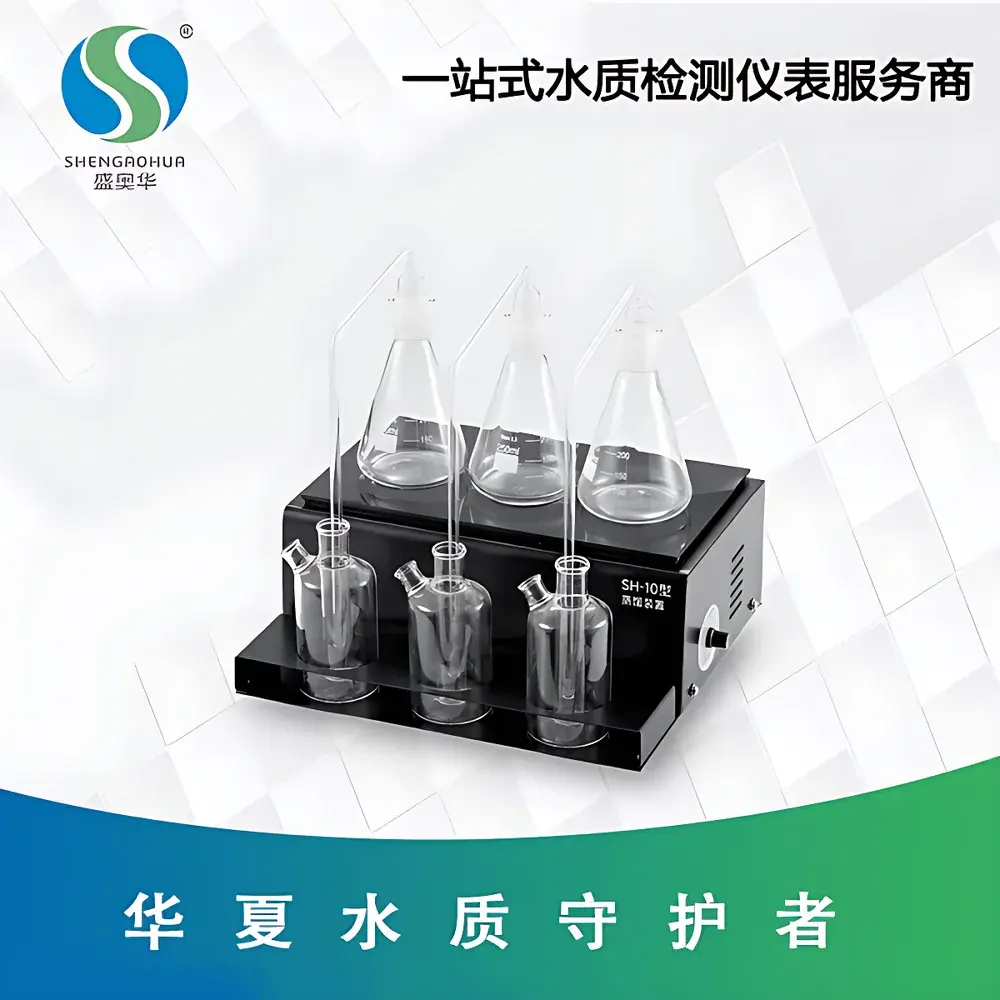
Shengaohua SH-10 Ammonia Nitrogen Pre-Distillation Unit
| Brand | Shengaohua |
|---|---|
| Origin | Jiangsu, China |
| Manufacturer Type | Direct Manufacturer |
| Product Origin | Domestic (China) |
| Model | SH-10 |
| Instrument Category | Laboratory Benchtop Unit |
| Measurement Range | 0.01–100 mg/L |
| Accuracy | ≤ ±5% |
| Detection Limit | 0.01 mg/L |
| Distillation Time | User-Programmable |
| Batch Capacity | 3 Samples per Run |
| Temperature Control Range | Ambient to 400 °C |
| Power Rating | 0–1500 W |
| Dimensions | 320 × 285 × 110 mm |
| Interference Removal | Effective against color, turbidity, suspended solids, heavy metals, and organic matrix interference |
Overview
The Shengaohua SH-10 Ammonia Nitrogen Pre-Distillation Unit is a purpose-engineered benchtop system designed to perform controlled, reproducible steam distillation of aqueous samples prior to ammonia nitrogen quantification—typically by spectrophotometric (e.g., Nessler or salicylate), ion-selective electrode (ISE), or automated colorimetric methods. Unlike open-flame or conventional water-bath distillation setups, the SH-10 employs precise resistive heating via a high-stability silicon crystal heating panel, enabling rapid thermal response and uniform temperature distribution across three independent digestion zones. Its core function is to isolate volatile NH₃ from complex matrices—including wastewater, industrial effluents, surface water, and digested sludge—by converting ammonium ions (NH₄⁺) to gaseous ammonia under alkaline conditions (pH > 12), followed by selective condensation and collection in an acid-trapping receiver. This pre-analytical step is critical for eliminating interferences that compromise downstream analysis accuracy, especially in samples with high turbidity, color, suspended solids, heavy metal content, or dissolved organic carbon.
Key Features
- Triple-channel parallel distillation architecture supports simultaneous processing of up to three samples per batch, improving laboratory throughput without cross-contamination risk.
- Wide programmable temperature range (ambient to 400 °C) with ±1 °C thermal stability ensures consistent distillation kinetics across diverse sample types—from low-conductivity drinking water to high-salinity brines or viscous digestates.
- Silicon crystal heating surface provides rapid heat-up and cool-down cycles, reducing total distillation time by up to 90% compared to conventional hotplate-based systems—typical run times range from 8 to 15 minutes per sample depending on matrix and target recovery.
- Compact footprint (320 × 285 × 110 mm) optimizes space utilization in ISO/IEC 17025-accredited laboratories, QC/QA facilities, and mobile environmental testing units.
- Energy-efficient design operates at variable power output (0–1500 W), minimizing electricity consumption during standby and low-load operation—average power draw during active distillation is ~850 W per channel.
- Integrated safety controls include overtemperature cutoff, dry-run protection, and automatic power modulation to prevent bumping or foaming-induced carryover.
Sample Compatibility & Compliance
The SH-10 is validated for use with standard EPA Method 350.1, ISO 5667-16:2009, and HJ 537–2009 (Chinese Environmental Protection Standard for Ammonia Nitrogen Determination). It accommodates sample volumes from 50 mL to 250 mL and is compatible with common distillation reagents including sodium hydroxide (NaOH) pellets, boric acid (H₃BO₃) receiving solution, and anti-foaming agents. The unit effectively removes spectral and chemical interferences associated with colored humic substances, colloidal suspensions, transition metals (e.g., Fe²⁺, Cu²⁺), and volatile organic compounds (VOCs) that otherwise distort absorbance readings or poison ISE membranes. All wetted components are chemically resistant borosilicate glass (supplied separately), compliant with ASTM E438 Type I, Class A specifications.
Software & Data Management
The SH-10 operates as a standalone hardware platform with manual parameter setting via front-panel digital interface; no embedded software or computer connectivity is required. However, its operational parameters—including setpoint temperature, ramp rate, hold time, and batch ID—are fully documentable within laboratory notebooks or LIMS-integrated workflows. For GLP/GMP environments, users may log instrument usage, calibration checks, and maintenance events in accordance with 21 CFR Part 11-compliant electronic records when paired with validated data capture protocols. Routine verification includes temperature probe calibration traceable to NIST standards and distillate recovery testing using certified reference materials (CRMs) such as NIST SRM 2783 (Wastewater Sludge).
Applications
- Environmental monitoring labs conducting routine compliance testing for discharge permits (e.g., NPDES, EU WFD).
- Wastewater treatment plants performing process control and nitrification/denitrification optimization.
- Pharmaceutical and biotechnology manufacturers validating cleaning-in-place (CIP) rinse water quality.
- Food & beverage facilities assessing nitrogen load in dairy processing effluents or brewery spent wash.
- Academic and research institutions studying nitrogen cycling in aquatic ecosystems or soil leachates.
- Third-party testing laboratories accredited to ISO/IEC 17025:2017 requiring auditable, interference-free sample preparation for ammonia nitrogen reporting.
FAQ
What sample matrices are compatible with the SH-10?
The unit is validated for municipal wastewater, industrial effluents, surface water, groundwater, seawater (with salinity adjustment), digested biosolids extracts, and high-COD process streams.
Does the SH-10 include distillation glassware and reagents?
No—borosilicate distillation flasks, condensers, receivers, and standardized reagent kits (NaOH, boric acid, antifoam) are supplied separately to meet lab-specific SOP requirements.
How is temperature accuracy verified?
Users perform periodic calibration using a traceable NIST-certified thermometer inserted into a calibrated reference well adjacent to the heating zone; deviation must remain within ±1 °C at 200 °C and ±2 °C at 400 °C.
Can the SH-10 be integrated into automated analytical workflows?
Yes—its discrete batch output enables seamless coupling with autosamplers feeding UV-Vis spectrophotometers, flow injection analyzers (FIA), or discrete analyzers equipped with ammonia detection modules.
What maintenance is required for long-term reliability?
Monthly inspection of heating panel integrity, quarterly cleaning of vapor pathways with dilute nitric acid, and annual verification of thermal sensor linearity using dual-point calibration.
Related Products







