
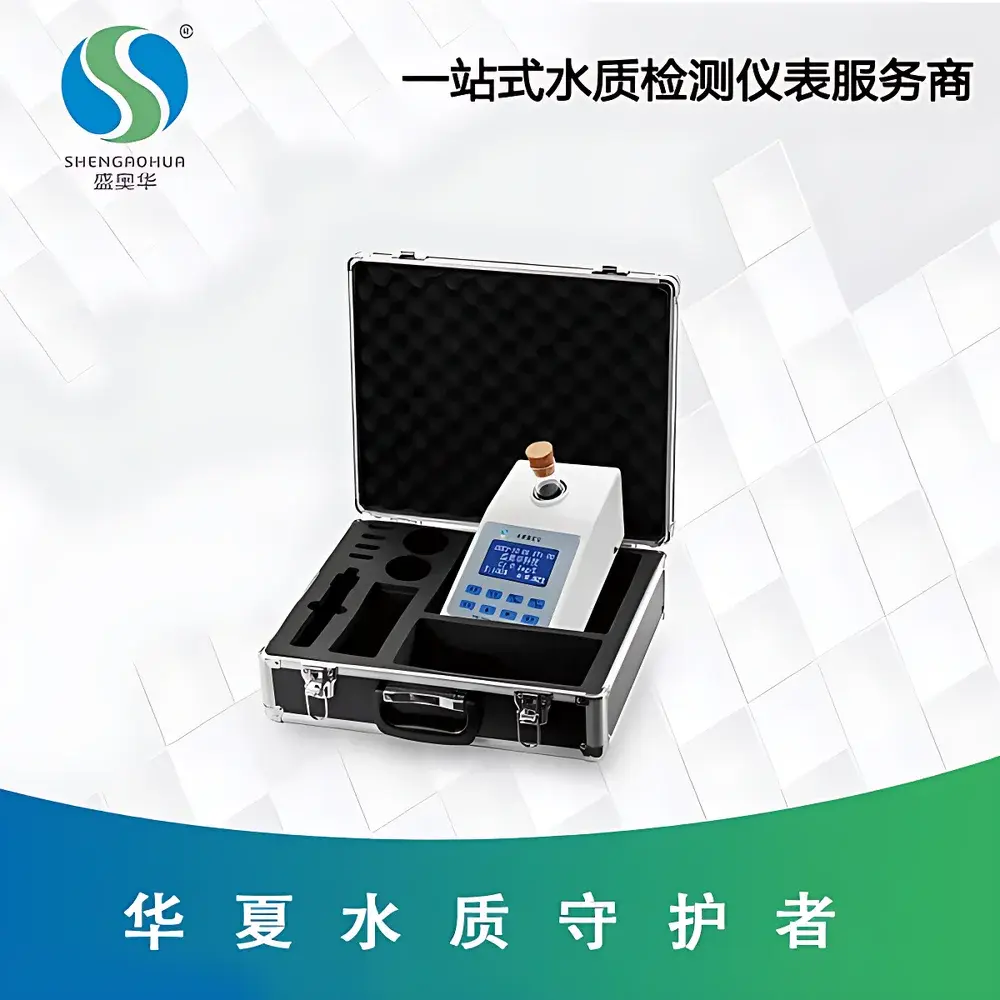
Shengaohua SH-50Z Portable Turbidimeter
| Brand | Shengaohua |
|---|---|
| Origin | Jiangsu, China |
| Manufacturer Type | Direct Manufacturer |
| Product Origin | Domestic (China) |
| Model | SH-50Z |
| Price Range | USD 0.15–750 (FOB) |
| Type | Portable |
| Measurement Range | 5–200 NTU |
| Resolution | 0.001 NTU |
| Operating Ambient Temperature | 10–30 °C |
| Accuracy | ±5% |
| Repeatability | ±3% |
| Zero Drift | <0.001 NTU |
| Data Storage | 8 GB internal microSD card (capacity for ≥5 million records) |
| Light Source | Long-life LED (cold white, 850 nm nominal wavelength) |
| Display | Backlit LCD with Chinese/English bilingual interface |
| Power Supply | Integrated rechargeable Li-ion battery (≥12 h continuous operation) |
| Connectivity | USB 2.0 host/device port for data export and firmware update |
| Calibration | Factory-calibrated |
Overview
The Shengaohua SH-50Z Portable Turbidimeter is a field-deployable optical instrument engineered for rapid, on-site quantification of turbidity in aqueous samples based on the principle of nephelometric measurement—specifically, the detection of 90° scattered light intensity from suspended particulate matter under controlled illumination at 850 nm. Designed in accordance with ISO 7027-1:2016 (optical properties of turbidimeters) and aligned with ASTM D6508-21 (standard practice for measuring turbidity of water using portable instruments), the SH-50Z delivers traceable, repeatable results across its validated range of 5–200 NTU. Its compact, IP65-rated housing ensures operational integrity in humid, dusty, or intermittently wet environments typical of wastewater outfalls, distribution system sampling points, pharmaceutical clean utility monitoring, and raw water intake stations. The device employs a stable, thermally compensated LED light source eliminating warm-up delay and minimizing spectral drift over time—critical for field consistency where ambient temperature fluctuation exceeds ±5 °C.
Key Features
- True nephelometric detection geometry compliant with ISO 7027-1:2016, using a fixed-angle (90° ±2.5°) photodiode detector
- High-resolution 0.001 NTU display resolution with auto-ranging and real-time stability indicator
- Integrated rechargeable lithium-ion battery supporting ≥12 hours of continuous measurement cycles (typical usage: 500 readings per charge)
- Bilingual (Chinese/English) menu-driven interface with tactile membrane keypad optimized for gloved operation
- No pre-warmup required: LED light source achieves photometric stability within 2 seconds of power-on
- On-device two-point calibration capability using supplied formazin or StablCal® standards (NIST-traceable reference materials recommended)
- USB 2.0 interface enabling direct connection to Windows/Linux PCs for bulk data export, firmware updates, and remote configuration via Shengaohua T-Link™ desktop utility
Sample Compatibility & Compliance
The SH-50Z is validated for use with clear to moderately turbid aqueous matrices including potable water, process water, filtered effluent, pharmaceutical purified water (PW), and clean steam condensate. It is not intended for highly colored, viscous, or emulsified samples without prior filtration (e.g., 0.45 µm membrane). Instrument design conforms to IEC 61000-4 electromagnetic compatibility requirements and meets RoHS Directive 2011/65/EU material restrictions. All factory calibration records are archived with NIST-traceable reference standard documentation. The device supports GLP-compliant workflows through timestamped data logging, operator ID entry (optional), and audit-ready file export (CSV/Excel-compatible format).
Software & Data Management
Data acquisition and reporting are managed via embedded firmware v3.2+ and the optional Shengaohua T-Link™ desktop application (Windows 10/11, macOS 12+). Each stored record includes sample ID, date/time stamp, NTU value, instrument serial number, calibration status flag, and environmental temperature (measured via onboard thermistor). The 8 GB internal microSD card retains ≥5 million entries with automatic rollover and folder-based organization by month. Exported datasets include MD5 checksums for data integrity verification. Firmware supports configurable data validation rules (e.g., rejection of readings outside ±10% of previous median in sequential mode) and optional 21 CFR Part 11–compliant electronic signature modules (available under separate validation package).
Applications
- Drinking water quality verification at treatment plant outlets and distribution network sampling points
- In-process monitoring of clarification efficiency in municipal and industrial wastewater facilities
- Pharmaceutical water system surveillance per USP and EU GMP Annex 1 requirements
- Raw material water assessment in beverage, dairy, and brewing production lines
- Field validation of membrane filter integrity during clean-in-place (CIP) verification
- Educational laboratory instruction in environmental chemistry and analytical instrumentation courses
FAQ
What turbidity standards are compatible with the SH-50Z for calibration?
Formazin suspension (ISO 7027 reference), StablCal® polymer standards, or AMCO AEPA-1 equivalents are supported. Calibration must be performed using at least two points spanning the intended measurement range.
Does the SH-50Z meet regulatory requirements for drinking water testing?
Yes—it satisfies EPA Method 180.1 and ISO 7027-1:2016 specifications for portable turbidimeters used in compliance monitoring when operated within its stated accuracy and maintained per the manufacturer’s scheduled verification protocol.
Can measurement data be exported to LIMS systems?
Yes—CSV-formatted files generated via USB export contain all required metadata (timestamps, units, instrument ID) and are directly ingestible by most modern LIMS platforms without transformation.
Is battery replacement user-serviceable?
No—the integrated Li-ion battery is sealed and replaceable only by authorized Shengaohua service centers to maintain IP65 certification and calibration traceability.
What is the recommended recalibration interval under routine field use?
Shengaohua recommends functional verification with zero and span standards before each daily use cycle, and full two-point calibration every 30 days or after 200 measurements—whichever occurs first.




