
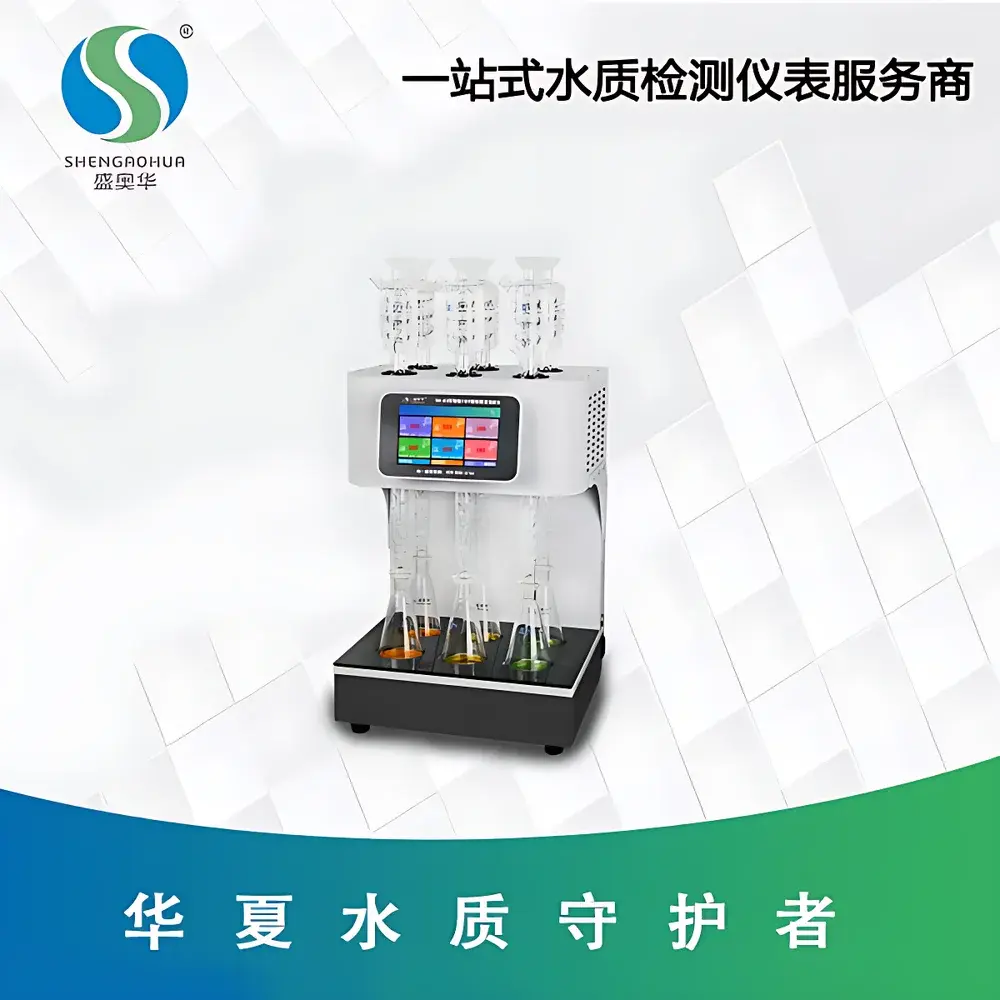
Shengaohua SH-6S Intelligent Reflux COD Digestion System
| Brand | Shengaohua |
|---|---|
| Origin | Jiangsu, China |
| Manufacturer Type | Direct Manufacturer |
| Country of Origin | China |
| Model | SH-6S |
| Digestion Method | Reflux Digestion |
| Heating Module | Integrated Aluminum Block with Forced Air & Optional Water Cooling |
| Batch Capacity | 6 samples |
| Temperature Range | Ambient to 200 °C |
| Temperature Accuracy | ±1 °C |
| Digestion Vessel Volume | 250 mL |
| Timer Resolution | 0.1 s |
| Power Rating | 3000 W (AC 220 V ±10%, 50 Hz) |
| Net Weight | 32 kg |
| Display | 7-inch TFT Touchscreen (Chinese UI) |
| Sample Independence | Per-channel individual temperature & timer control |
| Cooling Mode | Dual-mode (fan-cooled standard |
| Alarm | Audible end-of-digestion alert with automatic heating cutoff |
| Measuring Range | 4–700 mg/L COD (direct) |
| Digestion Time Setting | 1–999 min (user-programmable) |
| Precision | ≤5.0% RSD for 500 mg/L potassium hydrogen phthalate standard |
| Operating Ambient | −5 °C to 45 °C |
| Fan Control | Auto/Manual mode selection |
Overview
The Shengaohua SH-6S Intelligent Reflux COD Digestion System is an engineered solution for standardized chemical oxygen demand (COD) determination in aqueous matrices, fully compliant with HJ 828–2017 — the People’s Republic of China’s national standard for the dichromate method. It implements a controlled reflux digestion process based on open-system thermal oxidation under acidic, high-temperature conditions (up to 200 °C), where organic matter is oxidized by potassium dichromate in concentrated sulfuric acid medium. The system utilizes a modular aluminum heating block with per-channel thermal regulation and dual-mode cooling (forced-air standard, water-cooling optional) to ensure uniform thermal distribution across all six digestion positions. Its design prioritizes analytical reproducibility, operator safety, and laboratory throughput — particularly in routine environmental monitoring labs processing municipal wastewater, industrial effluents, and surface water samples.
Key Features
- Independent channel control: Each of the six digestion positions features dedicated temperature setpoint, timer, and power modulation — eliminating cross-channel thermal interference and enabling mixed-sample batches with varying digestion requirements.
- Dual cooling architecture: A high-volume, sealed forced-air system maintains consistent inter-channel temperature uniformity (<±1 °C deviation at 150 °C), while optional water-cooling integration supports extended operation under high ambient loads or stringent thermal stability demands.
- Intuitive human-machine interface: A 7-inch capacitive touchscreen delivers localized Chinese-language navigation, real-time parameter visualization, and one-touch program initiation — reducing operator training time and procedural errors.
- Precision thermal management: Calibrated Pt100 sensors coupled with PID feedback loops achieve ±1 °C temperature accuracy across the full 0–200 °C range; timer resolution is 0.1 s, supporting strict adherence to HJ 828–2017’s 120-minute reflux requirement.
- Automated workflow safeguards: End-of-digestion acoustic alarm triggers automatic heating termination and fan cooldown sequence; programmable delay start and auto-shutdown enhance energy efficiency and unattended operation capability.
- Compact, low-radiation chassis: Engineered aluminum housing minimizes thermal leakage and footprint (≤0.45 m²), suitable for benchtop deployment in GLP-compliant QC laboratories with space constraints.
Sample Compatibility & Compliance
The SH-6S accommodates standard 250 mL digestion vessels (e.g., borosilicate glass reflux flasks) and supports both undiluted and pre-diluted samples per HJ 828–2017 protocols. It is validated for use with domestic and industrial wastewater, leachates, pretreated influent, and surface water containing suspended solids up to 100 mg/L. While not certified to ISO/IEC 17025 or ASTM D1252 by default, its operational parameters align with the metrological requirements of ISO 6060 (water quality — determination of COD) and support traceable calibration using certified potassium hydrogen phthalate reference standards. For regulated environments (e.g., municipal compliance reporting), users are advised to perform in-house verification against NIST-traceable CRM batches and document thermal uniformity profiles per internal SOPs.
Software & Data Management
The SH-6S operates via embedded firmware with no external PC dependency. All method parameters — including temperature ramp profiles, hold times, cooling modes, and alarm thresholds — are stored locally in non-volatile memory with timestamped execution logs (retained for ≥1,000 cycles). Though it does not feature USB export, Ethernet connectivity, or FDA 21 CFR Part 11-compliant audit trails out-of-the-box, the system supports manual log transcription into LIMS or ELN platforms via screen capture or handwritten record. Future firmware updates may introduce RS-232 serial output for basic data streaming to external controllers — consult Shengaohua’s technical documentation for revision history and compatibility notes.
Applications
- Routine COD analysis in municipal wastewater treatment plants (WWTPs) for process control and discharge compliance reporting.
- Industrial effluent monitoring across metallurgy, petrochemical, pharmaceutical, textile dyeing, food & beverage, pulp & paper, electroplating, and semiconductor manufacturing sectors.
- Environmental research laboratories conducting comparative biodegradability studies or evaluating oxidation kinetics of novel organic contaminants.
- Third-party testing organizations performing accredited water quality assessments under CNAS accreditation scopes referencing HJ 828–2017.
- Educational institutions teaching standard methods for water pollution analysis and analytical chemistry laboratory workflows.
FAQ
Does the SH-6S meet international standards such as ISO 6060 or ASTM D1252?
It is designed to execute the core reflux digestion step in accordance with HJ 828–2017, which is technically harmonized with ISO 6060. However, formal certification to ISO/IEC 17025 or ASTM standards requires independent laboratory validation and scope-specific accreditation — not provided by the instrument alone.
Can the system be integrated into a LIMS or automated lab network?
No native digital interface is included; integration requires external hardware (e.g., relay-controlled I/O modules) or manual data entry. RS-232 support is planned in future firmware revisions but currently unavailable.
What maintenance is required to sustain temperature accuracy over time?
Annual verification of Pt100 sensor calibration using a traceable dry-block calibrator is recommended. Cleaning of air intake filters every 3 months prevents thermal drift due to dust accumulation in the forced-air system.
Is water-cooling mandatory for compliance with HJ 828–2017?
No — the standard specifies reflux duration and temperature, not cooling methodology. The standard fan-cooling configuration meets all thermal stability requirements specified in Clause 7.2 of HJ 828–2017.







