
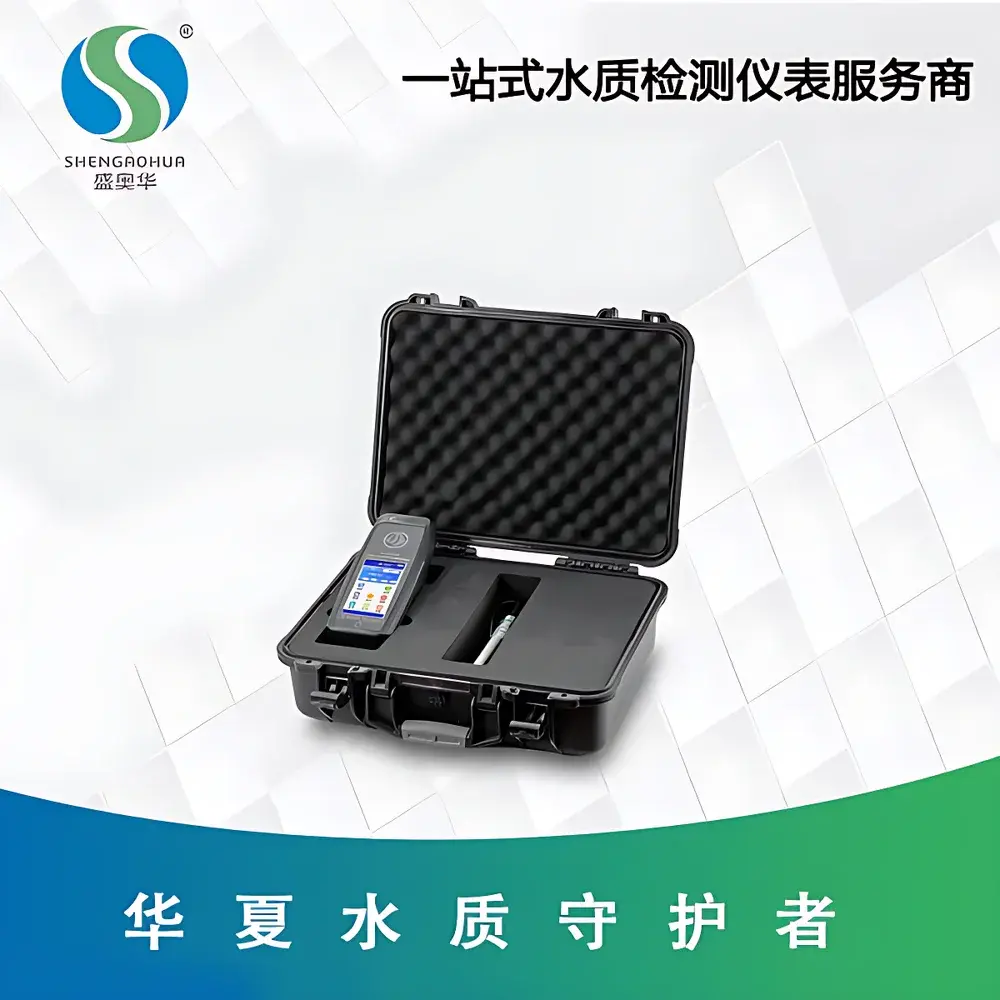
Shengaohua SH-6V10 Portable Fluorescence-Based Dissolved Oxygen Meter
| Brand | Shengaohua |
|---|---|
| Origin | Jiangsu, China |
| Manufacturer Type | Direct Manufacturer |
| Country of Origin | China |
| Model | SH-6V10 |
| Instrument Type | Portable |
| Measurement Principle | Fluorescence Quenching |
| Range | 0–20 mg/L |
| Accuracy | ±3% FS |
| Repeatability | ±5% FS |
| Detection Limit | 0.01 mg/L |
| Temperature Range | 0–60 °C |
| Temperature Compensation Accuracy | ±0.5 °C |
| Resolution | 0.1 °C |
| Dimensions (H×W×D) | 200 × 100 × 35 mm |
| Power Supply | Rechargeable Lithium-ion Battery |
| Electrode Type | Digital Fluorescent Sensor (No Membrane, No Electrolyte, Zero Polarization Time) |
Overview
The Shengaohua SH-6V10 Portable Fluorescence-Based Dissolved Oxygen Meter is an engineered solution for field-deployable, high-reliability dissolved oxygen (DO) measurement in aqueous environments. It operates on the principle of fluorescence quenching—where molecular oxygen modulates the lifetime and intensity of a ruthenium-based luminophore immobilized on an optically transparent sensor spot. Unlike traditional electrochemical Clark-type sensors, this method eliminates membrane diffusion limitations, electrolyte depletion, and polarization delays. The absence of consumable membranes or fill solutions ensures long-term stability, minimal maintenance, and consistent calibration integrity across repeated field deployments. Designed for ambient temperature operation (0–60 °C), the instrument integrates real-time temperature compensation with ±0.5 °C accuracy to correct for thermal effects on oxygen solubility—critical for compliance with ISO 5814:2012 and ASTM D888-22 standards governing DO measurement in natural waters and wastewater.
Key Features
- Digital fluorescent sensor with zero polarization time—immediate stabilization upon immersion, enabling rapid sequential sampling across multiple locations.
- Integrated rechargeable lithium-ion battery supporting >12 hours of continuous operation under typical field conditions, eliminating dependency on external power sources during extended monitoring campaigns.
- Ergonomic handheld form factor (200 × 100 × 35 mm) optimized for single-hand operation, glove-compatible interface, and IP67-rated enclosure for dust and temporary water immersion resistance.
- On-device data storage via embedded microSD card slot—capable of logging timestamped DO concentration (mg/L and % saturation), temperature, and measurement duration without external software.
- Self-diagnostic LED indicators and intuitive menu navigation with dual-language display support (English default) reduce operator training burden and minimize misinterpretation risk in multi-user environments.
Sample Compatibility & Compliance
The SH-6V10 is validated for use in freshwater, seawater, wastewater effluents, aquaculture ponds, and process streams with turbidity ≤400 NTU and salinity up to 35 ppt. Its optical sensing architecture is inherently insensitive to hydrogen sulfide, chlorine, and other redox-active interferents that compromise amperometric DO sensors. The device conforms to the functional requirements of ISO/IEC 17025:2017 for field instruments used in accredited environmental testing laboratories. While not certified for GLP or FDA 21 CFR Part 11 compliance out-of-the-box, its audit-ready data export (CSV via USB) and immutable timestamping support traceability frameworks required under EPA Method 360.1 and EU Water Framework Directive (2000/60/EC) reporting protocols.
Software & Data Management
Data retrieval is accomplished via standard USB 2.0 interface; no proprietary drivers required. Exported CSV files contain columns for UTC timestamp, DO (mg/L), DO (% sat), temperature (°C), and sensor status flags (e.g., “stable”, “calibrating”, “low signal”). Firmware updates are delivered as signed binary packages through Shengaohua’s secure technical portal—ensuring version control and integrity verification. For enterprise integration, the instrument supports Modbus RTU over USB-serial emulation, enabling direct ingestion into SCADA or LIMS platforms compliant with ASTM E1469-20 data exchange specifications.
Applications
- Field validation of wastewater treatment plant aeration basins per ISO 15839:2012 performance criteria.
- Real-time DO profiling in aquaculture operations to prevent hypoxia-induced mortality (FAO Technical Paper No. 572).
- Regulatory compliance monitoring for municipal drinking water distribution systems (US EPA 40 CFR Part 141).
- Process control in bioreactors and fermentation tanks where rapid DO transients require sub-second response fidelity.
- Academic and research applications including limnological surveys, benthic flux studies, and climate-driven deoxygenation trend analysis.
FAQ
Does the SH-6V10 require periodic recalibration in the field?
Yes—calibration is recommended before each daily deployment using air-saturated water (100% saturation at local barometric pressure and temperature) or a certified zero-oxygen standard (e.g., sodium sulfite solution). The instrument stores up to three user-defined calibration points.
Can the fluorescent sensor be cleaned in situ without replacement?
Yes—the optical sensing surface is chemically resistant to mild detergent washes and ultrasonic cleaning (≤40 kHz, 5 min); abrasive scrubbing or organic solvent immersion is prohibited to preserve luminophore integrity.
Is temperature compensation automatically applied during measurement?
Yes—integrated NTC thermistor continuously monitors sample temperature and applies algorithmic correction based on the Benson–Krause solubility model, referenced to ISO 5814 Annex A.
What is the expected operational lifetime of the digital fluorescent electrode?
Under normal field use (≤8 h/day, pH 4–10, no exposure to strong UV or hydrofluoric acid), the sensor maintains ±3% accuracy for ≥24 months or 5,000 immersion cycles—whichever occurs first.
Does the device support Bluetooth or wireless data transmission?
No—wireless modules are omitted to ensure electromagnetic compatibility in industrial zones and extend battery life. All data transfer is conducted via physical USB connection to maintain data chain-of-custody integrity.







